Blog

Best Automotive Spray Gun: Best HVLP Spray Guns for Automotive Paint

Version 1.0.0

If you are searching for the best automotive spray gun, you are probably not looking for a toy-grade paint sprayer that works fine on patio furniture but falls apart when it is time to lay down basecoat, clear coat, or primer on an actual vehicle. Automotive paint work is unforgiving. The wrong gun can leave you fighting orange peel, poor atomization, uneven metallic laydown, dry spray, wasted paint, and frustrating rework.

That is why choosing the best automotive paint spray gun matters so much. Whether you are a professional collision painter, a restoration enthusiast, a body shop owner, or a serious DIY garage user, the right spray gun can completely change the quality of your finish and the efficiency of your workflow.

The challenge is that the market is crowded. Some guns are built for premium refinish work. Some are better for primer. Others are designed around production speed, lightweight ergonomics, or pressure-pot setups. Then there are portable options that offer convenience but may not be ideal for a true show-quality finish. If you search for the best automotive HVLP spray gun or the best spray gun for automotive finishes, you will find endless generic roundups that do not actually explain what matters.

This guide is different. It is written from scratch to help you understand what separates a good automotive spray gun from a bad one, what features matter most, and what type of gun best fits your painting needs. It is also built around the products you referenced, with the focus kept on serious options available through Amazon.com.

Why the Right Automotive Spray Gun Matters

A spray gun is not just another tool. In automotive paint work, it is one of the biggest variables between an average finish and a finish that looks professional. Even high-quality paint materials can perform poorly if the gun does not atomize correctly or does not suit the job.

A top-tier automotive spray paint gun affects:

  • Atomization quality
  • Paint transfer efficiency
  • Overspray control
  • Finish smoothness
  • Metallic orientation
  • Clear coat flow
  • Painter fatigue
  • Material waste
  • Cleanup time
  • Overall consistency across panels

That is why people ask questions like what is the best automotive spray gun, what is the best automotive spray paint gun, and what is the best spray gun for automotive finishes. They are not really asking for one magic product. They are asking how to avoid expensive mistakes.

What Makes the Best Automotive Spray Gun?

Not every painter wants the same thing from a spray gun. Some want absolute finish quality. Some want lighter weight and easier cleanup. Some want a gun that works better with a smaller compressor. Others need a setup that can handle longer, more continuous spraying sessions.

Here is what actually matters when shopping for the best HVLP spray gun automotive buyers should consider.

1. Atomization Quality

Atomization is the way the gun breaks paint into fine droplets. Better atomization generally means a more even finish, smoother clear coat, and less texture. This is one of the reasons premium guns from brands like SATA, Iwata, 3M, Binks, DeVilbiss, and Graco draw so much attention.

2. Spray Pattern Consistency

A good automotive gun should deliver a predictable fan pattern. Uneven patterns create inconsistent coverage and can make blending or panel matching much harder.

3. Transfer Efficiency

One major reason so many painters search for the best automotive HVLP spray gun is because HVLP systems are usually better at reducing overspray and improving paint transfer efficiency compared with older conventional designs.

4. Nozzle Size

Nozzle size changes the way materials flow. In general:

  • 1.2 to 1.3 mm works well for many basecoats and clear coats
  • 1.4 mm is a flexible all-around size
  • 1.7 mm and above is often better for primer or thicker materials

If you are focused on refinishing rather than heavy primer work, a 1.3 or 1.4 setup is often the sweet spot.

5. Ergonomics

Weight matters more than many buyers think. A gun that feels balanced and light during a ten-minute test can feel dramatically different during a long painting session. This is especially important if you paint often.

6. Cleanup and Workflow

Some spray gun systems are much easier to clean than others. In a busy shop, time lost to cleanup adds up fast. Systems that simplify cup changes and reduce maintenance can save real money.

7. Air Requirements

The best automotive paint spray gun on paper may still be the wrong choice if your compressor cannot support it. Many serious HVLP guns need a stable air supply to perform correctly.

HVLP vs Pressure Pot vs Airless for Automotive Painting

When buyers look for the best automotive spray gun, they often assume all paint guns work the same way. They do not.

HVLP Spray Guns

HVLP stands for High Volume Low Pressure. This is the category most people mean when they search for the best automotive HVLP spray gun. HVLP guns are popular because they typically offer strong control, lower overspray, and solid efficiency for basecoat and clear coat work.

Pressure Pot Spray Guns

Pressure pot systems feed paint from a pressurized external container rather than a small gravity cup. These setups are useful when you need longer spray time without refilling or when working on larger jobs.

Airless Sprayers

Airless systems are fast and convenient for certain coatings and applications, but they are not always the first choice for high-end automotive refinishing. They can still be useful for specific users and certain workflows.

Who Needs the Best Automotive Paint Spray Gun?

You do not have to be a full-time body shop technician to justify a high-quality spray gun. The right tool makes sense for:

  • Collision repair shops
  • Vehicle restoration projects
  • Custom paint work
  • Panel repainting
  • Touch-up and blend work
  • Serious garage painters
  • Fleet or shop maintenance work

The difference is that each type of user may want a different type of gun. That is why there is no single universal answer to what is the best automotive spray gun. There is only the best choice for your specific use case.

Best Automotive Spray Gun Brands to Watch

If you are narrowing down the best spray gun for automotive finishes, brand reputation still matters. In the list you shared, several names stand out immediately.

SATA

SATA is one of the most respected names in premium automotive refinishing. The brand is closely associated with professional-level finish quality, precise atomization, and high-end shop use.

3M

3M brings a modern systems-based approach to paint application, especially with cup systems and lightweight spray guns designed to improve workflow efficiency.

ANEST IWATA

Iwata has a loyal following in the automotive refinish world, especially for guns that excel at clear coat and fine finish work.

Binks

Binks remains a trusted name for traditional professional spray equipment and pressure pot systems.

DeVilbiss

DeVilbiss is a major name in automotive refinish, particularly for basecoat and professional shop work.

Graco

Graco is best known for sprayers that emphasize durability, speed, and convenience, especially in handheld and airless applications.

Best Automotive Spray Gun Options from the Product Set

Now let’s break down the type of buyers each major option suits best.

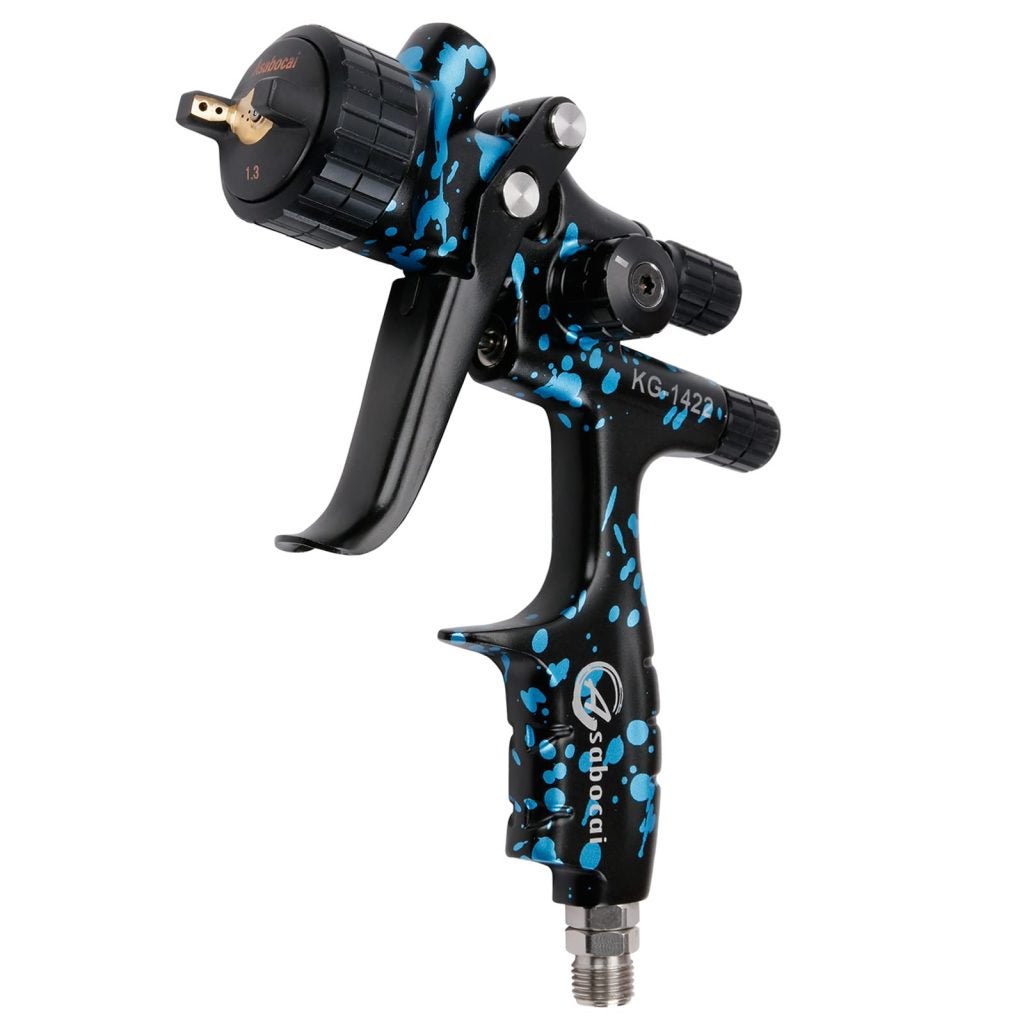
SATA X5500 HVLP 1.3

For many professionals, this is the benchmark answer to the best automotive HVLP spray gun question. It is aimed at painters who care about atomization, finish control, and overall refinement. A gun like this makes the most sense for users who already know what they are doing and want a premium result.

This is the kind of gun that belongs in conversations about the best automotive paint spray gun for serious basecoat-clearcoat work. It is not cheap, and it is not built for casual hobby use. It is built for people who expect top-level performance.

3M Performance Industrial Spray Gun Starter Kit

The 3M system is one of the smartest choices for painters who value lightweight handling, quick cleanup, and a more modern spray workflow. Instead of feeling like a traditional heavy metal spray gun, it is designed around efficiency and reduced fatigue.

For many users, especially those who want something practical and versatile, this is one of the most compelling answers to what is the best spray gun for automotive finishes. It may not carry the same prestige as some old-school names, but in day-to-day use it can be an excellent choice.

Iwata WS400 Series S2 Clear 1.3

If your priority is clear coat performance, the Iwata deserves serious attention. Clear coat is where a paint job either looks refined or exposes every weakness in the process. A strong clear gun can improve atomization, reduce texture, and help produce a finish that needs less correction afterward.

For painters specifically chasing the best automotive spray paint gun for clear work, this is one of the most attractive options in the premium category.

Binks Paint Pressure Pot Spray Gun Outfit Kit

This type of setup is ideal for painters who need longer uninterrupted spray sessions and a more production-oriented workflow. Pressure pot systems are not as convenient for small spot repairs, but they can be very effective for medium- to high-volume work.

If your priority is less refilling and a more shop-style workflow, this kind of setup has real advantages over a simple gravity gun.

TCP Global 2 Quart Pressure Pot Spray Paint Tank

TCP Global offers a more accessible route into pressure-pot spraying. If you want to explore continuous-feed style automotive painting without spending at the highest level, this can be a practical option.

It is not necessarily the elite answer to best automotive spray gun for high-end clear and base work, but it can fit certain autobody workflows well.

Graco Ultra Cordless Airless Handheld Paint Sprayer

This is the outlier in the group. It is portable, convenient, and useful in situations where hoses and compressor limitations are a headache. That said, it is not the first thing most painters would choose for traditional show-quality automotive finishing.

Still, for certain specialty jobs, quick applications, and mobile work, it offers real value. If convenience matters more than classic HVLP refinement, it can absolutely make sense.

DeVilbiss DV1-B

DeVilbiss has strong credibility in professional paint environments, especially for basecoat applications. If you care about metallic control, blend quality, and color consistency, a basecoat-focused gun from DeVilbiss can be a serious asset.

For users who care more about color application than all-around generality, this type of gun belongs high on the shortlist.

Best Automotive Spray Gun for Beginners

A lot of first-time buyers think the solution is to buy the most expensive gun they can afford. That is not always smart. The best beginner gun is not necessarily the one with the highest prestige. It is the one that gives you a manageable learning curve, good control, and easier maintenance.

For many beginners, a lighter, more user-friendly system can make far more sense than a high-end gun that demands perfect setup and technique. That is one reason the 3M system stands out. It offers serious capability while also making daily use less punishing.

So if you are asking what is the best automotive spray gun for a newer user, the answer may be a practical workflow-driven option rather than the most elite professional gun.

Best HVLP Spray Gun Automotive Buyers Should Choose

If you specifically want an HVLP gun for automotive refinishing, your shortlist usually comes down to three types of buyers:

For premium finish quality

Choose a SATA or Iwata-level gun.

For modern convenience and efficiency

Choose a 3M Performance system.

For specialized basecoat work

Look closely at DeVilbiss.

That is the real answer behind searches like best hvlp spray gun automotive and best automotive hvlp spray gun. It depends on whether you prioritize finish, speed, comfort, or material-specific performance.

Common Buying Mistakes

Buying the wrong gun for your compressor

A premium gun will not perform like a premium gun if your air system cannot support it.

Using one nozzle for everything

Basecoat, clear, and primer do not always belong on the same setup.

Prioritizing hype over workflow

A famous gun is not automatically the smartest buy for your shop.

Ignoring cleanup time

A gun that saves time after every use can be a much better investment than one that only feels impressive at purchase.

Assuming all automotive spray guns are equal

They are not. Material delivery, ergonomics, pattern control, and finish behavior vary significantly.

How to Choose the Best Automotive Spray Paint Gun for Your Needs

Here is a simple way to think about it.

If you are a professional shop painter who wants elite finish quality, start with premium HVLP options and work from there.

If you want easier cleanup, lighter weight, and better daily efficiency, consider a modern system-focused design.

If your jobs are larger or more production-oriented, pressure pot setups deserve attention.

If mobility matters more than conventional refinishing, portable options may be worth considering.

That is why the phrase best automotive paint spray gun means different things to different buyers. It is not only about quality. It is about fit.

Final Verdict

The search for the best automotive spray gun only becomes easy once you stop asking for one universal winner and start asking the right question: what type of painting do you actually do?

If your priority is premium professional refinish quality, top-tier HVLP guns like SATA and Iwata are where the serious conversation begins.

If you want a highly practical, modern option that improves comfort and cleanup, 3M is one of the smartest choices on the board.

If you need a production-style setup for longer spray sessions, Binks and TCP Global pressure systems make much more sense.

If portability matters, Graco offers a different type of value.

The best purchase is the one that matches your paint materials, compressor, workflow, skill level, and finish expectations. That is the real key to choosing the best spray gun for automotive finishes instead of wasting money on the wrong tool.

FAQ

What is the best automotive spray gun?

The best option depends on your use case, but for premium automotive refinishing, high-end HVLP guns from brands like SATA, Iwata, 3M, and DeVilbiss are usually the strongest contenders.

What is the best automotive paint spray gun?

The best automotive paint spray gun is the one that matches your material type, desired finish quality, compressor setup, and skill level. Premium HVLP guns are usually the top choice for basecoat and clear coat work.

What is the best automotive HVLP spray gun?

If you want premium finish quality, a professional-grade HVLP gun from the high-end category is usually the best route. Many painters prioritize SATA, Iwata, 3M, or DeVilbiss depending on their workflow.

What is the best spray gun for automotive finishes?

For automotive finishes, especially basecoat and clear, a high-quality HVLP gun with good atomization and a stable fan pattern is usually the best choice.

Is a pressure pot better than a gravity-feed spray gun?

Not always. Pressure pot systems are better for longer spray sessions and higher-volume work, while gravity-feed guns are often more convenient for general refinishing and smaller jobs.

Is airless good for automotive painting?

Airless systems can be useful for certain specialty situations, but most traditional automotive refinishing work still relies on HVLP or comparable spray-gun systems for maximum finish control.
Recommended Posts

Is Mazda a Luxury Brand?

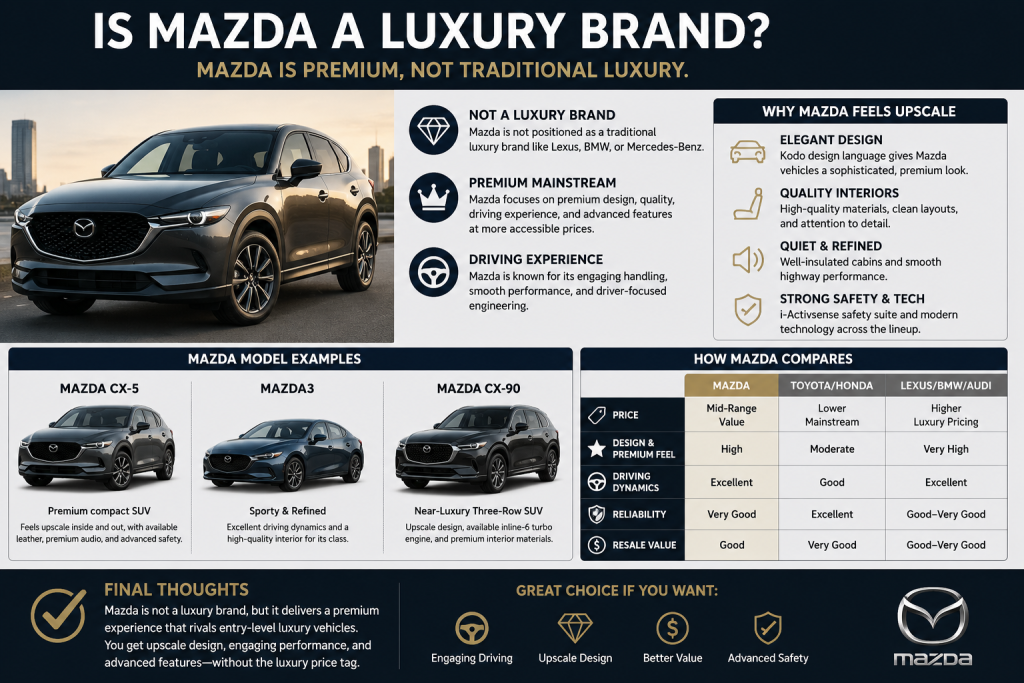
Is Mazda a Luxury Brand? Mazda is not officially a luxury brand, but it is one of the clearest examples of a premium mainstream brand. That means Mazda sits between regular brands like Toyota, Honda, Hyundai, Nissan, and Subaru, and traditional luxury brands like Lexus, Acura, BMW, Audi, Mercedes-Benz, and Volvo. Mazda does not sell itself as a full luxury automaker, but many of its newer vehicles feel more upscale than their price suggests. The simple answer is this: Mazda is not a luxury brand, but it is a premium-feeling brand with luxury-like design, interiors, and driving dynamics. Why People Think Mazda Is a Luxury Brand People ask whether Mazda is a luxury brand because newer Mazda models look and feel more expensive than many mainstream competitors. Mazda has focused heavily on interior quality, clean design, quiet cabins, better materials, strong paint colors, refined driving feel, and upscale trims. Models like the Mazda CX-5, CX-50, CX-70, CX-90, Mazda3, and MX-5 Miata all show that Mazda is trying to be more than just another economy car brand. Mazda itself has leaned into the idea of “premium” more than “luxury.” In a 2026 Mazda survey, the company described modern premium value as being about design, comfort, technology, and daily experience rather than just the badge on the grille. Mazda said its focus remains on vehicles that elevate everyday driving through thoughtful design, intuitive technology, and safety. Mazda USA That is exactly where Mazda fits today. It is not trying to copy Lexus directly. It is trying to make mainstream vehicles feel more special. Mazda Is Premium, Not Traditional Luxury A traditional luxury brand usually offers things like exclusive dealer experiences, higher-end powertrains, wider customization, premium materials across the lineup, prestige branding, luxury service programs, and higher base pricing. Mazda does not fully operate in that space. Instead, Mazda gives buyers a more premium experience without jumping fully into luxury-brand pricing. This is why shoppers often compare a loaded Mazda CX-5 or Mazda CX-90 against entry-level Lexus, Acura, Volvo, Audi, or BMW models. Motor1 reported that Mazda’s internal idea of “premium” does not necessarily mean “luxury.” The brand has been aiming for a more boutique, higher-end customer, but not in the same exact way as traditional luxury automakers. Motor1 That distinction matters. Mazda is premium by design and feel. It is not luxury by official market category. What Makes Mazda Feel Upscale? Mazda vehicles often feel upscale because of the way they are designed. The cabins usually avoid the cheap, cluttered look found in some mainstream vehicles. Controls are simple. Materials feel better than expected. Steering and handling are more engaging. Exterior styling is mature and elegant instead of loud or overly busy. Mazda’s Kodo design philosophy is a big part of this. The brand focuses on shape, proportion, motion, and restraint. That gives many Mazda vehicles a more expensive look than their window sticker suggests. The result is a brand that feels grown-up. A Mazda may not have the badge prestige of a Lexus or BMW, but the vehicle itself often feels more refined than many shoppers expect. Is the Mazda CX-5 a Luxury SUV? The Mazda CX-5 is not a luxury SUV, but upper trims can feel close to entry-level luxury. A well-equipped CX-5 can include leather seating, available Nappa leather on certain trims in some markets, a premium audio system, heated and ventilated front seats, a quiet cabin, elegant interior design, and strong handling. That is why the CX-5 is often cross-shopped against premium compact SUVs. But it is still priced and positioned as a mainstream compact SUV. The CX-5 is best described as a premium compact SUV, not a true luxury SUV. Is the Mazda CX-90 a Luxury SUV? The Mazda CX-90 is probably the closest Mazda gets to luxury right now. It uses a rear-biased platform, available inline-six turbo engine, upscale cabin design, premium materials, and a more refined three-row SUV layout. Car and Driver describes the CX-90 as part of Mazda’s continuing effort to position itself as a premium brand, with elegant styling and a luxurious interior. Car and Driver That does not make the CX-90 a Mercedes-Benz GLS or BMW X7 competitor. But it does make it one of the most premium-feeling mainstream three-row SUVs. For buyers who want near-luxury feel without full luxury pricing, the CX-90 is one of Mazda’s strongest arguments. Is Mazda More Premium Than Toyota or Honda? Yes, Mazda often feels more premium than Toyota or Honda at similar price points. Toyota and Honda usually focus more on practicality, resale value, fuel economy, reliability, and broad appeal. Mazda focuses more on design, interior feel, and driving enjoyment. That does not mean Mazda is better for every buyer. Toyota and Honda may still be stronger choices for maximum resale value, hybrid selection, or long-term low-cost ownership. But if the question is which mainstream brand feels more upscale, Mazda is usually one of the top answers. Mazda’s advantage is emotional. The cars feel more carefully styled and more enjoyable to drive. Mazda vs Lexus, Acura, BMW, and Audi Mazda is not in the same official category as Lexus, Acura, BMW, or Audi. Luxury brands usually offer stronger badge prestige, more powerful engines, higher-end dealer experiences, deeper luxury options, and more expensive flagship models. They also usually come with higher ownership costs. Mazda’s advantage is value. A loaded Mazda can give shoppers a premium cabin, handsome design, and strong driving dynamics for less money than many luxury SUVs. But there are still differences. A Lexus RX, BMW X3, Audi Q5, or Mercedes-Benz GLC may offer more luxury-brand prestige, more advanced powertrain options, more refinement, or a more traditional luxury ownership experience. Mazda gives you a premium feel. Luxury brands give you the luxury badge and ecosystem. Is Mazda Trying to Become a Luxury Brand? Mazda has been moving more upscale, but it has not fully become a luxury brand. The brand has invested in more premium products, cleaner retail spaces, better interiors, higher-end SUVs, and more refined vehicle platforms. But Mazda still sells mainstream vehicles and competes heavily with Toyota, Honda, Subaru, Hyundai, Kia, and Nissan. The best way to describe Mazda’s strategy is near-luxury or premium mainstream. That is a smart position because many buyers want a vehicle that feels expensive without paying full luxury-brand pricing. Is Mazda Worth It Over a Luxury Brand? Mazda can be worth it if you care more about the vehicle experience than the badge. A Mazda makes sense if you want upscale styling, a nice interior, good handling, strong safety features, and lower pricing than many luxury vehicles. It may also cost less to insure, maintain, and repair than some German luxury brands. A luxury brand makes more sense if badge prestige, maximum refinement, advanced powertrain choices, concierge-level dealer experience, or higher-end materials are the priority. For many buyers, Mazda is the smarter middle ground. FAQs About Mazda as a Luxury Brand Is Mazda considered a luxury brand? No. Mazda is not officially considered a luxury brand. It is better described as a premium mainstream brand. Is Mazda a premium brand? Yes. Mazda has moved strongly into premium territory with upscale design, refined interiors, better driving dynamics, and higher-end models like the CX-70 and CX-90. Is Mazda as good as Lexus? Mazda can feel premium, but Lexus is a true luxury brand with stronger reliability reputation, dealer experience, and luxury-market positioning. Mazda is usually more affordable. Is Mazda better than Toyota? Mazda often feels more stylish and premium than Toyota, while Toyota usually has stronger hybrid options, resale value, and long-term reliability reputation. Is the Mazda CX-5 luxury? The Mazda CX-5 is not a true luxury SUV, but higher trims can feel near-luxury compared with many mainstream compact SUVs. Is the Mazda CX-90 a luxury SUV? The Mazda CX-90 is not officially a luxury SUV, but it is one of Mazda’s most premium vehicles and can feel close to entry-level luxury SUVs. Final Thoughts: Mazda Is Not Luxury, But It Feels Premium Mazda is not a luxury brand in the traditional sense. It does not sit directly beside Lexus, BMW, Audi, Mercedes-Benz, or Volvo. But it has become one of the most premium-feeling mainstream automakers. That is Mazda’s sweet spot. You get upscale design, strong driving feel, refined interiors, and a more emotional ownership experience without paying full luxury-brand prices. For shoppers who want something nicer than a basic mainstream SUV but do not care about a luxury badge, Mazda makes a very strong case.

Are Mazdas Expensive to Maintain?

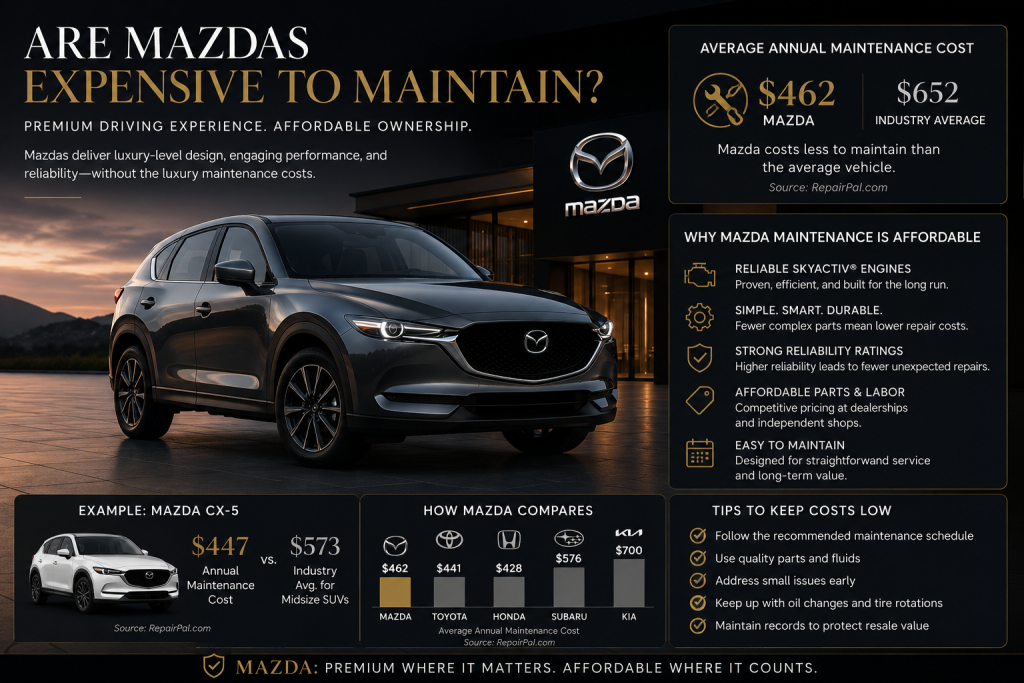
Are Mazdas Expensive to Maintain? No, Mazdas are not expensive to maintain compared with many other brands. The simple answer is this: Mazda maintenance costs are usually lower than the industry average and close to Toyota and Honda in real-world ownership cost. Mazda is not always the absolute cheapest brand to maintain, but it is generally affordable, especially compared with European luxury brands, larger trucks, and some turbocharged or hybrid vehicles. RepairPal lists the average annual repair and maintenance cost for Mazda at $462, which is below the overall average of $652 for all vehicle models. RepairPal also gives Mazda a strong overall reliability profile, which helps explain why Mazda is often considered one of the better mainstream brands for long-term ownership. Why Mazda Maintenance Is Usually Affordable Mazda maintenance is usually affordable because most Mazda vehicles use fairly conventional gas engines, widely available parts, and relatively simple drivetrains compared with luxury brands. Mazda also does not rely as heavily on complicated hybrid systems across its whole lineup as some competitors. Many popular models, like the Mazda3, Mazda6, CX-30, CX-5, and CX-9, use proven gasoline engines and automatic transmissions that many independent shops can service. That matters because maintenance cost is not just about parts. It is also about labor time, diagnostic complexity, and how easy the vehicle is to work on. Mazda gives you a more premium-feeling interior and driving experience without the full luxury-brand service bill. Mazda Maintenance Cost Per Year The average Mazda costs about $462 per year for maintenance and repairs, according to RepairPal. RepairPal That is lower than the overall vehicle average and competitive with other reliable mainstream brands. For comparison, Toyota and Honda are often slightly cheaper, but Mazda is usually in the same general ownership-cost range. The gap is not huge for most common repairs and regular maintenance. Where costs can increase is with older high-mileage models, turbocharged engines, AWD systems, poor service history, or vehicles that were neglected by previous owners. Are Mazda CX-5 Maintenance Costs High? No, the Mazda CX-5 is not expensive to maintain for a compact SUV. RepairPal lists the annual repair and maintenance cost for the Mazda CX-5 at $447, compared with $573 for midsize SUVs and $652 for all vehicle models. RepairPal That makes the CX-5 one of Mazda’s stronger ownership-cost examples. It gives shoppers a premium-feeling cabin, sharp handling, and available AWD without the maintenance cost of a luxury SUV. A CX-5 can cost more to maintain if it has turbo power, AWD, higher mileage, or poor service records, but a well-maintained gas CX-5 is usually affordable to own. Are Mazda Parts Expensive? Mazda parts are usually not expensive compared with luxury brands. Common maintenance items like oil filters, air filters, brake pads, spark plugs, belts, tires, and fluids are generally reasonable. Mazda parts may sometimes cost a little more than the cheapest Toyota or Honda parts, but they are not usually in BMW, Mercedes-Benz, Audi, or Volvo territory. The biggest factor is where you service the vehicle. A Mazda dealership may cost more than a trusted independent shop, especially for basic maintenance. But dealership service can be useful for recalls, warranty repairs, software updates, and model-specific inspections. For routine maintenance, many Mazda owners can keep costs controlled by following the maintenance schedule and avoiding deferred repairs. What Mazda Maintenance Costs the Most? Most Mazda maintenance is normal: oil changes, tires, brakes, filters, spark plugs, fluids, batteries, and inspections. The more expensive items usually come later in ownership. These can include suspension parts, control arms, wheel bearings, engine mounts, transmission service, AWD system service, air-conditioning repairs, infotainment repairs, and turbo-related repairs on turbo models. Older Mazda vehicles can also need rust-related repairs depending on climate, road salt, and storage conditions. If you are buying used, check the service history carefully. A cheap used Mazda with skipped maintenance can become more expensive than a slightly pricier one with clean records. Is Mazda Cheaper to Maintain Than Toyota? Mazda is usually close to Toyota, but Toyota is often slightly cheaper long-term. Toyota’s biggest advantage is its extremely broad parts availability, huge service network, and long-standing reputation for simple, durable vehicles. Mazda is still affordable, but Toyota often wins if the only question is lowest possible maintenance cost. That said, Mazda often feels more upscale and more engaging to drive. For many shoppers, the small difference in maintenance cost is worth it for the better interior feel and sharper driving experience. Is Mazda Cheaper to Maintain Than Honda? Mazda and Honda are usually close in maintenance costs. Honda is known for efficient engines, strong resale value, and low ownership costs. Mazda is also affordable, especially on naturally aspirated models like many Mazda3 and CX-5 trims. The better choice depends on the specific model and condition. A well-maintained Mazda CX-5 can be cheaper to own than a neglected Honda CR-V. A clean Honda Civic can be cheaper than an older Mazda with poor service records. Condition matters more than the badge. Is Mazda Cheaper to Maintain Than Subaru? Mazda is often cheaper to maintain than Subaru. Subaru’s standard AWD systems are a major selling point, but they can add maintenance complexity and cost. Subaru models may also have specific repair patterns that can raise ownership costs depending on the year and model. Mazda offers available AWD on many models, but not every Mazda has it. A front-wheel-drive Mazda3 or CX-5 may be cheaper to maintain than an AWD Subaru with similar mileage. Is Mazda Cheaper to Maintain Than Luxury Brands? Yes, Mazda is much cheaper to maintain than most luxury brands. This is one of Mazda’s biggest strengths. Mazda vehicles often feel more premium than other mainstream brands, but they do not usually carry the repair costs of BMW, Audi, Mercedes-Benz, Lexus, Acura, or Volvo. Lexus and Acura may still have strong reliability and reasonable costs for luxury brands, but Mazda usually stays cheaper because it is still a mainstream brand. If you want a near-luxury feel without luxury maintenance bills, Mazda is one of the best brands to consider. Do Turbo Mazdas Cost More to Maintain? Yes, turbocharged Mazdas can cost more to maintain than non-turbo models. A turbo engine has more heat, more pressure, and more components than a naturally aspirated engine. It also needs consistent oil changes and proper maintenance to stay healthy. Mazda’s turbo engines can be strong, but buyers should not treat them like low-maintenance base engines. If you are buying a used turbo Mazda, look for regular oil changes, no boost-related issues, clean startup, no smoke, no oil leaks, and no signs of abuse. For the lowest maintenance costs, a non-turbo Mazda is usually the safer choice. Is Mazda AWD Expensive to Maintain? Mazda AWD is not usually expensive, but it can add cost compared with front-wheel drive. AWD systems have extra components, including a rear differential and driveline parts. These parts may need fluid service and inspection over time. Tires also matter more on AWD vehicles because mismatched tire wear can create drivetrain stress. If you want the lowest possible ownership cost, front-wheel drive is usually cheaper. If you need better traction in rain, snow, or mountain driving, Mazda AWD can be worth the added cost. Used Mazda Maintenance: What to Check Used Mazdas can be affordable, but maintenance history is critical. Before buying a used Mazda, check for oil-change records, tire condition, brake wear, suspension noise, transmission behavior, coolant condition, battery age, rust, infotainment issues, and open recalls. For Mazda CX-5, Mazda3, Mazda6, CX-30, and CX-9 models, also check that the infotainment screen works properly and that the backup camera, Bluetooth, navigation, and control knob function as expected. A class action settlement reported in 2025 involved Mazda Connect infotainment issues on several 2014 to 2023 Mazda models, including Mazda3, Mazda6, CX-3, CX-5, CX-9, and MX-5. Mazda denied wrongdoing but agreed to settlement terms involving reimbursements and warranty extension coverage for eligible owners. The Sun That does not make Mazdas expensive overall, but it is a reminder to check electronics before buying used. How to Keep Mazda Maintenance Costs Low The best way to keep Mazda maintenance costs low is simple: follow the maintenance schedule and fix small issues early. Do regular oil changes. Replace air and cabin filters on time. Rotate tires. Keep the correct tire pressure. Change spark plugs when due. Service fluids as recommended. Do not ignore warning lights. Use quality parts. Keep records. For AWD models, keep tires matched and rotate them regularly. For turbo models, use the correct oil and do not stretch oil-change intervals too far. A Mazda that gets basic maintenance on time can be one of the more affordable vehicles to own. Are Mazdas Good Long-Term Cars? Yes, Mazdas are good long-term cars when maintained properly. Mazda has built a strong reputation for combining reliability, driving enjoyment, and upscale design without extreme ownership costs. Many Mazda3, Mazda6, CX-5, and CX-9 models can last well beyond 150,000 miles with regular service. The key is not neglecting maintenance. Like any vehicle, a Mazda will become expensive if oil changes are skipped, tires are ignored, brakes are delayed, or small leaks are allowed to become major repairs. Should You Buy a Mazda If You Want Low Maintenance Costs? Yes, Mazda is a strong choice if you want a vehicle that feels more premium than many mainstream brands but does not cost like a luxury car to maintain. Toyota and Honda may still be the safest choices for the absolute lowest long-term costs, but Mazda is very competitive. It is especially attractive if you want a better driving feel and nicer interior without jumping into luxury-brand repairs. For shoppers comparing Mazda models, look at the latest new Mazda inventory or compare pre-owned options in the used inventory. If you are budgeting around payments, trade value, and service costs, you can also review current Mazda specials. FAQs About Mazda Maintenance Costs Are Mazdas expensive to maintain? No. Mazdas are generally affordable to maintain. RepairPal lists the average annual Mazda repair and maintenance cost at $462, which is below the industry average. Is the Mazda CX-5 expensive to maintain? No. The Mazda CX-5 is one of the more affordable SUVs to maintain. RepairPal lists its average annual repair and maintenance cost at $447. Are Mazda parts expensive? Mazda parts are usually not expensive compared with luxury brands. Common maintenance parts are generally reasonable and widely available. Is Mazda cheaper to maintain than Toyota? Mazda is usually close to Toyota, but Toyota is often slightly cheaper long-term. Mazda may feel more premium and more enjoyable to drive. Is Mazda cheaper to maintain than Honda? Mazda and Honda are usually close. The better buy depends on the specific model, mileage, service history, and condition. Do Mazda turbo engines cost more to maintain? Yes, Mazda turbo engines can cost more than non-turbo engines because they add heat, pressure, and more components. They require consistent oil changes and proper maintenance. Are used Mazdas expensive to fix? Used Mazdas are usually not expensive to fix if they have been maintained well. Neglected used Mazdas can become costly, especially if they have turbo, AWD, infotainment, or suspension issues. Final Thoughts: Mazdas Are Affordable to Maintain Mazdas are not expensive to maintain for most drivers. They cost less than the industry average, are usually close to Toyota and Honda in ownership costs, and are much cheaper to maintain than most luxury brands. The Mazda CX-5 is a strong example, with average annual repair and maintenance costs below the broader vehicle average. The best Mazda to own is the one with clean service records, regular oil changes, no major accident history, and the right drivetrain for your needs. Choose carefully, maintain it properly, and a Mazda can deliver premium feel without premium repair bills.

What Engine Does the 2015 Mazda CX-5 Have?

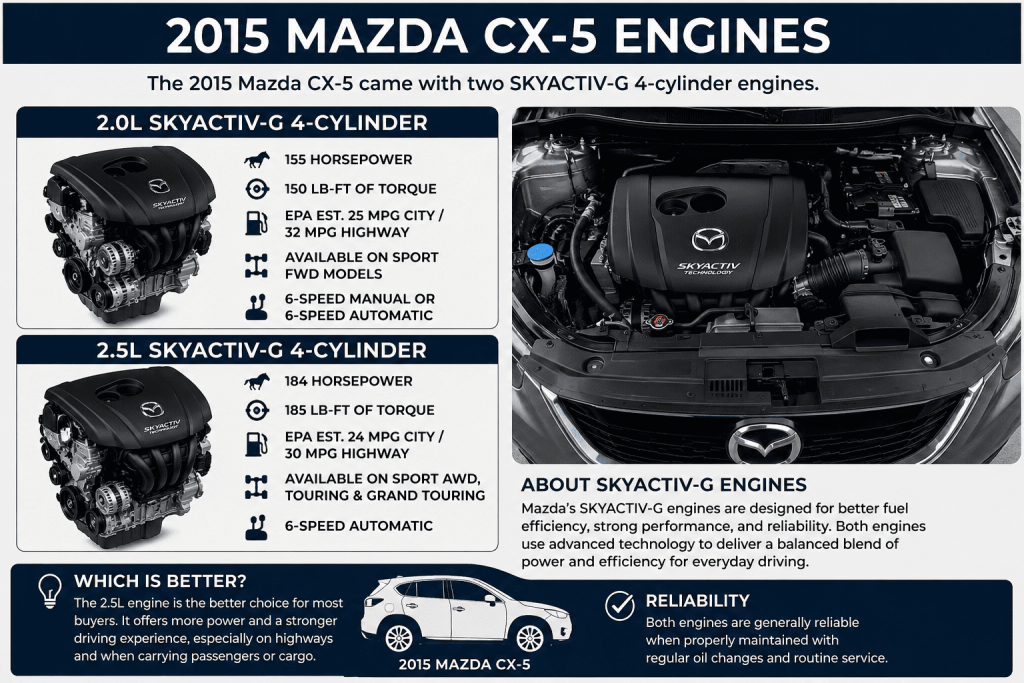
What Engine Does the 2015 Mazda CX-5 Have? The 2015 Mazda CX-5 came with two engine options in North America: a 2.0L SKYACTIV-G 4-cylinder engine and a 2.5L SKYACTIV-G 4-cylinder engine. The simple answer is this: most 2015 Mazda CX-5 models have the 2.5L SKYACTIV-G 4-cylinder engine, while the base Sport front-wheel-drive model could come with the smaller 2.0L SKYACTIV-G engine. Mazda’s official 2015 CX-5 specifications list the 2.0L engine at 155 horsepower and the 2.5L engine at 184 horsepower. Mazda 2015 CX-5 specs 2015 Mazda CX-5 Engine Options The 2015 Mazda CX-5 was offered with Mazda’s SKYACTIV-G gasoline engines. The smaller engine was a 2.0L SKYACTIV-G 4-cylinder. It produced 155 horsepower and was available on Sport front-wheel-drive models. Mazda offered it with either a 6-speed manual transmission or a 6-speed automatic transmission, depending on configuration. Mazda 2015 CX-5 specs The larger engine was a 2.5L SKYACTIV-G 4-cylinder. It produced 184 horsepower and was used on Sport AWD, Touring, and Grand Touring models. This engine came with a 6-speed automatic transmission. Mazda 2015 CX-5 specs Which 2015 CX-5 Engine Is More Common? The 2.5L engine is the more common and more desirable choice for most used buyers. It gives the CX-5 better acceleration, stronger highway passing power, and a more relaxed driving feel than the 2.0L engine. The 2.0L is fuel-efficient and simple, but it can feel underpowered, especially with passengers, cargo, hills, or highway merging. Edmunds notes that the 2015 Mazda CX-5 Sport front-wheel-drive model came with the 2.0L 4-cylinder engine making 155 horsepower and 150 lb-ft of torque, while other models used the stronger 2.5L 4-cylinder with 184 horsepower and 185 lb-ft of torque. Edmunds 2015 Mazda CX-5 2.0L Engine The 2.0L SKYACTIV-G engine was the entry-level engine. It made 155 horsepower and 150 lb-ft of torque. This engine was mainly found in the base Sport front-wheel-drive model. It could be paired with a 6-speed manual transmission or a 6-speed automatic transmission. This engine is fine if you want a basic, efficient used SUV and do not care much about quick acceleration. But for most buyers, the 2.5L engine is the better fit. 2015 Mazda CX-5 2.5L Engine The 2.5L SKYACTIV-G engine was the stronger option. It made 184 horsepower and 185 lb-ft of torque. It was standard on Touring and Grand Touring models and was also used on Sport AWD models. Edmunds lists the 2015 CX-5 Touring with a 2.5L inline-4 gas engine, 184 hp, 185 lb-ft of torque, and a 6-speed automatic transmission. Edmunds For most shoppers, this is the engine to look for. It gives the CX-5 a better balance of fuel economy and usable power. Is the 2015 Mazda CX-5 Engine Reliable? Yes, the 2015 Mazda CX-5 engines are generally considered reliable, especially when maintained properly. Mazda’s SKYACTIV-G engines are known for being efficient, relatively simple compared with turbocharged engines, and strong for daily driving. The 2015 CX-5 did not use a turbo engine in the North American market, which helps reduce complexity. As with any used vehicle, maintenance matters. Before buying a 2015 CX-5, check for regular oil changes, coolant condition, transmission service history, clean startup, no warning lights, no oil leaks, and no signs of overheating. Which 2015 Mazda CX-5 Engine Should You Buy? For most buyers, the 2.5L SKYACTIV-G engine is the better choice. It has more power, better real-world drivability, and is easier to recommend for highway driving, family use, and daily commuting. The 2.0L engine can still be a good option if the price is right and you want the simplest base model, but it is not as strong when the vehicle is loaded. If you are shopping used, focus more on condition than engine alone. A clean 2.0L CX-5 with full service records can be better than a neglected 2.5L model. FAQs About the 2015 Mazda CX-5 Engine What engine does the 2015 Mazda CX-5 have? The 2015 Mazda CX-5 has either a 2.0L SKYACTIV-G 4-cylinder engine or a 2.5L SKYACTIV-G 4-cylinder engine, depending on trim and drivetrain. Does the 2015 Mazda CX-5 have a V6? No, the 2015 Mazda CX-5 does not have a V6 engine. It only came with 4-cylinder gasoline engines in North America. How much horsepower does the 2015 Mazda CX-5 have? The 2.0L engine makes 155 horsepower, while the 2.5L engine makes 184 horsepower. Which 2015 Mazda CX-5 engine is better? The 2.5L SKYACTIV-G 4-cylinder is better for most buyers because it has more power and feels stronger in everyday driving. Is the 2015 Mazda CX-5 turbocharged? No, the 2015 Mazda CX-5 was not turbocharged in the North American market. Turbocharged CX-5 models came later. Final Thoughts: The 2.5L Is the One Most Buyers Want The 2015 Mazda CX-5 came with two engines: a 2.0L SKYACTIV-G 4-cylinder and a 2.5L SKYACTIV-G 4-cylinder. The 2.0L engine was mainly for base Sport front-wheel-drive models. The 2.5L engine was used in more trims and is the better choice for most shoppers because it offers stronger acceleration and better everyday drivability. If you are buying a used 2015 CX-5, look for the 2.5L engine, clean maintenance records, no warning lights, and a solid inspection. That combination gives you the best chance of getting a dependable compact SUV with Mazda’s sharp driving feel.