Blog

Is Mazda Japanese? A Deep Dive into Heritage, Innovation & Modern Identity

When you search “Is Mazda Japanese?” you’re really asking about more than geography — you’re exploring how a carmaker’s culture, craft, and philosophy shape every vehicle it builds
Mazda’s story is unmistakably Japanese, from its origins in Hiroshima nearly a century ago to the Jinba Ittai driving spirit that lives in every modern CX-5, CX-50, or MX-5 Miata.

And if you’re curious how that legacy translates into the SUVs and crossovers available today, you can explore current models and specials right now at Marin Mazda — a dealership that brings this proud heritage to local drivers every day.

Mazda may build some cars abroad, but its soul has never left Japan. From meticulous design studios in Hiroshima to cutting-edge research labs in Yokohama, the brand blends craft, technology, and emotion in a uniquely Japanese way. Whether you’re drawn to the sculpted curves of a CX-90 or the effortless efficiency of the CX-30, you can see how this Japanese DNA comes alive in every offer listed on Marin Mazda’s specials page.


A Brief History of Mazda’s Japanese Roots

Mazda began in 1920 as the Toyo Cork Kogyo Company in Hiroshima, producing industrial goods before turning to vehicles in 1931 with the tiny three-wheeled “Mazda-Go.” The brand’s very name came from Ahura Mazda — a symbol of wisdom and harmony — and its founders’ desire to unite practical engineering with spiritual balance.

Over the decades, Mazda endured wartime destruction, rebuilt alongside Hiroshima’s renaissance, and rose to international prominence through innovation. By 1967 it became one of the few automakers in the world to master the rotary engine, an icon of Japanese engineering daring.


The Japanese Philosophy Behind Every Mazda

Mazda’s designers often speak of “KODO — Soul of Motion.” This design philosophy captures the grace of living movement, inspired by calligraphy, martial arts, and the quiet discipline found throughout Japanese culture. Look at a Mazda’s body line: it’s meant to feel alive, not just aerodynamic.

Equally integral is Jinba Ittai, the horse-and-rider unity that guides Mazda’s chassis tuning and steering response. Engineers spend years perfecting how a driver’s smallest input translates into motion — an ethos rooted in centuries of Japanese craftsmanship, where harmony matters more than brute force.

Inside, Mazda cabins embody “Takumi” artisan quality — minimalist, tactile, and centered around balance. Every stitch and switch placement reflects the Japanese concept of omotenashi: hospitality that anticipates your needs.


Japanese Engineering Meets Global Production

Though unmistakably Japanese in spirit, Mazda now operates worldwide. Manufacturing plants exist in Japan, Mexico, China, Thailand, and the United States. Yet all major engineering development, powertrain design, and final quality benchmarks still originate in Japan.

  • Headquarters: Hiroshima, Japan
  • Primary R&D centers: Hiroshima and Yokohama
  • Design centers: Hiroshima and Irvine, California (for regional input)
  • Production plants: Japan (Hiroshima & Yamaguchi) plus global partners

Every new model — from the latest CX-70 Hybrid to the upcoming electric line — passes through Hiroshima’s proving grounds before release. That means whether your Mazda is assembled in Alabama or Hofu, it’s built to Japanese specifications, reflecting Mazda’s uncompromising standards.


Cultural DNA in Modern Mazdas

Mazda’s attention to detail mirrors Japanese arts like pottery and woodworking: mastery through repetition and humility before the craft. Designers use clay modeling by hand, even in the age of digital simulation, believing touch reveals subtleties machines can’t replicate.

Lighting design follows ma — the Japanese sense of space and timing — ensuring every headlamp and cabin reflection feels calm rather than flashy. Paintwork employs proprietary Takuminuri layering, hand-polished to mirror-grade smoothness. It’s not marketing — it’s modern Japanese artistry on four wheels.


The Hiroshima Influence

Mazda’s headquarters remain in Hiroshima — a city that symbolizes resilience and reinvention. After 1945, Mazda helped revive the region’s industry, exporting vehicles that would later introduce Japan’s craftsmanship to the world. That spirit of endurance still defines Mazda’s culture: thoughtful progress, human empathy, and quiet pride.

Every engineer who trains at Hiroshima’s proving grounds absorbs this mindset. Many executives describe it as “a responsibility to represent Japanese precision with warmth.” It’s a national identity translated into motion.


Global Recognition of Japanese Quality

Reviewers consistently note that Mazda cars feel more premium than their price suggests. That refinement comes from Japanese manufacturing discipline — obsessive attention to tolerances and the Kaizen approach of constant improvement.

Even small details, like the click of a climate-control dial or the soft detent of a gear selector, are tuned by sound engineers to convey confidence and serenity — qualities deeply rooted in Japanese aesthetics.

When you step into a Mazda showroom or visit your local dealer, that quiet excellence is evident. To experience it firsthand, browse the current Japanese-crafted SUVs and crossovers featured on Marin Mazda’s specials page.


Japanese Innovation: Rotary Engines to Skyactiv Technology

Mazda’s reputation for bold engineering choices began with the rotary engine — lightweight, compact, and remarkably smooth. Though rotary production paused in 2012, the spirit of experimentation lived on in Skyactiv Technology, a suite of powertrain and chassis innovations focused on real-world efficiency.

Skyactiv engines achieve higher compression ratios without sacrificing drivability — a nod to Japan’s obsession with harmony between mechanical systems and nature’s laws. Pair that with Mazda’s responsive steering and the result is efficiency without numbness.

Newer systems like Skyactiv-X and Mazda’s hybrid collaborations continue this Japanese-led pursuit of balance — power meeting responsibility, emotion meeting intellect.


Design Language as Cultural Expression

Where other brands use sharp creases and loud surfaces, Mazda prefers restraint. Its designers often describe each model as a living creature poised in motion. The subtle curvature of a CX-5’s fender or MX-5’s hood is intentional — capturing fleeting beauty, much like brushstrokes in Japanese ink painting.

Inside, horizontal layouts and natural textures evoke shibui: understated elegance. Every Mazda aims to calm rather than overwhelm — a design language born of Japanese serenity, not Western excess.


Mazda in North America: A Bridge Between Cultures

While Mazda remains proudly Japanese, its American operations in Irvine, California and its new joint factory in Huntsville, Alabama demonstrate how a Japanese ethos can thrive globally. North American engineers adapt suspension tuning and climate performance for local roads, but the emotional core still traces back to Hiroshima.

That’s why enthusiasts describe Mazdas as “driver’s cars” — they blend Japanese precision with Western practicality. The result: vehicles that feel universal yet unmistakably Japanese at their core.

If you’re in California and curious to see this philosophy in metal, you can schedule a test drive or review current offers directly through Marin Mazda’s specials section.


The Future of a Japanese Icon

Mazda’s next chapter remains rooted in Japan even as it goes electric. The upcoming generations of Skyactiv-EV and Skyactiv-Hybrid powertrains are being developed in Hiroshima with help from Japanese suppliers and universities. These will gradually appear across models like the CX-70 PHEV and the CX-90 Plug-in Hybrid, marrying traditional driving feel with sustainable performance.

Mazda’s leaders describe this shift as “engineering with a Japanese conscience” — progress that respects nature while honoring craftsmanship. The company’s new sustainability goals aim for full carbon neutrality by 2050, guided by the same cultural integrity that’s shaped it since 1920.


Why Mazda Still Feels Uniquely Japanese

Even as globalization blurs borders, Mazda stands out for how deeply Japanese its mindset remains:

  1. Harmony over haste — Every decision balances efficiency, beauty, and emotion.
  2. Craftsmanship as identity — Real humans refine what machines build.
  3. Respect for environment and people — Design follows empathy.
  4. Perfection through imperfection — The Japanese idea of wabi-sabi informs Mazda’s minimalist interiors and natural materials.
  5. Continuous self-improvement — The Kaizen philosophy ensures no detail is ever final.

This isn’t corporate branding — it’s cultural continuity.


The Answer: Yes, Mazda Is Japanese — and Proudly So

Mazda is as Japanese as the artistry that inspired it. Its cars are global, its assembly may span continents, but its spirit, discipline, and emotional depth are born of Japan. Every curve, engine note, and ergonomic detail reflects the country that built it — precise yet poetic, efficient yet soulful.

And if you’d like to feel that spirit for yourself, explore the latest lineup inspired by Japanese engineering at Marin Mazda. Whether you’re considering a CX-30, CX-50 Hybrid, or the flagship CX-90, each one carries Hiroshima’s heart in its chassis and craftsmanship in its stitching.


Conclusion: Japan’s Gift to the Road

So, is Mazda Japanese? Absolutely — not just by birth, but by belief. It’s a company that proves technology can coexist with humanity, and precision can express emotion. Mazda’s story is the story of Japan itself: disciplined, inventive, quietly confident.

From the hand-formed fenders to the carefully tuned steering, every Mazda reminds us that driving can still be an art form. The answer to “Is Mazda Japanese?” is written not in a passport, but in the way a Mazda moves.

To experience that heritage firsthand and see today’s offers, visit Marin Mazda’s specials page — where Japanese craftsmanship meets California roads.


FAQ: Is Mazda Japanese? | Marin Mazda

1) Is Mazda a Japanese company?
Yes. Mazda Motor Corporation is a Japanese automaker headquartered in Hiroshima, Japan. Founded in 1920 as Toyo Cork Kogyo Co., Mazda’s heart, design, and engineering philosophy remain deeply rooted in Japanese culture.


2) Where are Mazda cars made?
While Mazda builds vehicles in multiple countries — including Japan, the U.S., Mexico, China, and Thailand — its primary engineering, design, and R&D centers are still located in Hiroshima and Yokohama, Japan. Every global plant follows Japanese standards and quality benchmarks.


3) What does the name “Mazda” mean?
The name derives from Ahura Mazda, the ancient Persian god of wisdom and harmony. It also echoes the surname of the company’s founder, Jujiro Matsuda. This blend of symbolism reflects Mazda’s mission to unite technology with balance and humanity — a core Japanese value.


4) How does Japanese culture influence Mazda’s design?
Mazda design embodies several Japanese philosophies:

  • KODO – Soul of Motion: Vehicles are sculpted to look alive, capturing movement even at rest.
  • Jinba Ittai: “Horse and rider as one” — the seamless connection between car and driver.
  • Omotenashi: Anticipating the driver’s needs through intuitive, human-centered design.
  • Takumi Craftsmanship: Hand-finished details that celebrate precision and care.

5) Are all Mazdas still engineered in Japan?
Yes. Even though assembly may occur globally, every Mazda’s platform, engine, and software are engineered in Japan. Every model — from the CX-5 to the CX-90 — undergoes final validation at Mazda’s Hiroshima proving grounds.


6) What is Mazda’s headquarters address?
Mazda Motor Corporation’s global headquarters are located in Aki-gun, Hiroshima Prefecture, Japan, the city that has shaped Mazda’s spirit of resilience and craftsmanship.


7) Why is Hiroshima significant to Mazda’s identity?
Mazda helped rebuild Hiroshima after World War II, becoming a symbol of perseverance and innovation. That heritage still defines Mazda’s culture today — emphasizing humility, precision, and respect for progress.


8) What is KODO design language?
“KODO” translates to “Soul of Motion.” Inspired by Japanese calligraphy and traditional martial arts, it expresses vitality and grace in every line and surface — a living, breathing aesthetic seen across all Mazda models.


9) What does “Jinba Ittai” mean in Mazda’s context?
It’s the Japanese principle of harmony between horse and rider. Mazda engineers design every car to respond intuitively to the driver’s inputs — resulting in balance, control, and connection that feels natural, not mechanical.


10) What makes Mazda interiors feel Japanese?
Mazda cabins embrace minimalism and balance, guided by Japanese ideas like shibui (understated beauty) and ma (the space between elements). Every control, surface, and stitch is placed with intention to create calm and focus.


11) Does Mazda still use Japanese artisans in its design process?
Yes. Mazda continues to employ Takumi modelers — master Japanese craftspeople who sculpt every design in clay by hand before it’s digitized. This ensures warmth and emotion in every curve.


12) Are Mazdas as reliable as other Japanese brands?
Absolutely. Mazda consistently ranks among the top three most reliable automakers, often surpassing Toyota and Honda in independent studies. Japanese engineering discipline ensures long-term durability and performance.


13) Does Mazda build cars in America?
Yes. Mazda operates a joint plant with Toyota in Huntsville, Alabama, producing models like the CX-50 for North American drivers. However, all quality and design processes remain under Japanese supervision.


14) How does Japanese engineering influence Mazda performance?
Mazda’s Skyactiv Technology embodies Japanese harmony — optimizing engine, transmission, and chassis as one system. The result: better fuel efficiency, sharper handling, and a natural driving feel.


15) What is “Takuminuri” paint technology?
“Takuminuri” means “artisan painting” in Japanese. Mazda’s painters and robots apply multiple ultra-thin layers and hand-polish them to create deep, mirror-like finishes — such as Soul Red Crystal and Machine Gray Metallic.


16) What are some key Mazda values rooted in Japanese culture?

  • Kaizen: Continuous self-improvement in every process.
  • Wabi-sabi: Finding beauty in simplicity and imperfection.
  • Harmony (Wa): Balance between performance, comfort, and sustainability.
    These principles shape every Mazda vehicle, from design to driving dynamics.

17) Is Mazda still independent as a Japanese brand?
Yes. Mazda remains an independent Japanese automaker, though it collaborates with Toyota and other partners for electrification and hybrid systems. Independence lets Mazda preserve its unique driving character.


18) How does Mazda’s Japanese heritage affect its customer experience?
Mazda dealerships — including Marin Mazda — reflect omotenashi, or Japanese hospitality. From intuitive design to personalized service, every step aims to anticipate rather than react to customer needs.


19) What are examples of Japanese innovation in Mazda vehicles?

  • Rotary Engine (1967–2012): Lightweight, high-revving engineering marvel.
  • Skyactiv-X Engine: Combines spark and compression ignition for peak efficiency.
  • G-Vectoring Control: Subtle torque adjustments that improve handling harmony.

20) So, is Mazda Japanese?
Yes — in heritage, philosophy, and spirit.
Even as production spans the globe, Mazda remains a distinctly Japanese automaker, defined by craftsmanship, emotional design, and the pursuit of driving joy.

To experience this legacy firsthand, explore the latest Mazda SUVs and sedans at Marin Mazda — where Japanese engineering meets California roads.

Recommended Posts

Is Mazda a Luxury Brand?

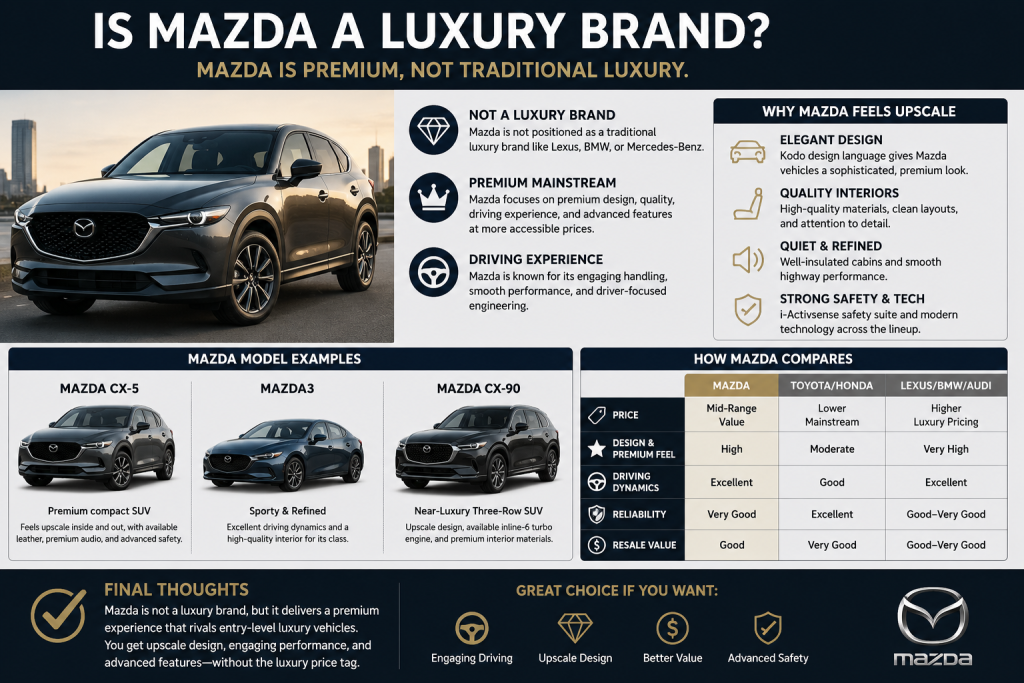
Is Mazda a Luxury Brand? Mazda is not officially a luxury brand, but it is one of the clearest examples of a premium mainstream brand. That means Mazda sits between regular brands like Toyota, Honda, Hyundai, Nissan, and Subaru, and traditional luxury brands like Lexus, Acura, BMW, Audi, Mercedes-Benz, and Volvo. Mazda does not sell itself as a full luxury automaker, but many of its newer vehicles feel more upscale than their price suggests. The simple answer is this: Mazda is not a luxury brand, but it is a premium-feeling brand with luxury-like design, interiors, and driving dynamics. Why People Think Mazda Is a Luxury Brand People ask whether Mazda is a luxury brand because newer Mazda models look and feel more expensive than many mainstream competitors. Mazda has focused heavily on interior quality, clean design, quiet cabins, better materials, strong paint colors, refined driving feel, and upscale trims. Models like the Mazda CX-5, CX-50, CX-70, CX-90, Mazda3, and MX-5 Miata all show that Mazda is trying to be more than just another economy car brand. Mazda itself has leaned into the idea of “premium” more than “luxury.” In a 2026 Mazda survey, the company described modern premium value as being about design, comfort, technology, and daily experience rather than just the badge on the grille. Mazda said its focus remains on vehicles that elevate everyday driving through thoughtful design, intuitive technology, and safety. Mazda USA That is exactly where Mazda fits today. It is not trying to copy Lexus directly. It is trying to make mainstream vehicles feel more special. Mazda Is Premium, Not Traditional Luxury A traditional luxury brand usually offers things like exclusive dealer experiences, higher-end powertrains, wider customization, premium materials across the lineup, prestige branding, luxury service programs, and higher base pricing. Mazda does not fully operate in that space. Instead, Mazda gives buyers a more premium experience without jumping fully into luxury-brand pricing. This is why shoppers often compare a loaded Mazda CX-5 or Mazda CX-90 against entry-level Lexus, Acura, Volvo, Audi, or BMW models. Motor1 reported that Mazda’s internal idea of “premium” does not necessarily mean “luxury.” The brand has been aiming for a more boutique, higher-end customer, but not in the same exact way as traditional luxury automakers. Motor1 That distinction matters. Mazda is premium by design and feel. It is not luxury by official market category. What Makes Mazda Feel Upscale? Mazda vehicles often feel upscale because of the way they are designed. The cabins usually avoid the cheap, cluttered look found in some mainstream vehicles. Controls are simple. Materials feel better than expected. Steering and handling are more engaging. Exterior styling is mature and elegant instead of loud or overly busy. Mazda’s Kodo design philosophy is a big part of this. The brand focuses on shape, proportion, motion, and restraint. That gives many Mazda vehicles a more expensive look than their window sticker suggests. The result is a brand that feels grown-up. A Mazda may not have the badge prestige of a Lexus or BMW, but the vehicle itself often feels more refined than many shoppers expect. Is the Mazda CX-5 a Luxury SUV? The Mazda CX-5 is not a luxury SUV, but upper trims can feel close to entry-level luxury. A well-equipped CX-5 can include leather seating, available Nappa leather on certain trims in some markets, a premium audio system, heated and ventilated front seats, a quiet cabin, elegant interior design, and strong handling. That is why the CX-5 is often cross-shopped against premium compact SUVs. But it is still priced and positioned as a mainstream compact SUV. The CX-5 is best described as a premium compact SUV, not a true luxury SUV. Is the Mazda CX-90 a Luxury SUV? The Mazda CX-90 is probably the closest Mazda gets to luxury right now. It uses a rear-biased platform, available inline-six turbo engine, upscale cabin design, premium materials, and a more refined three-row SUV layout. Car and Driver describes the CX-90 as part of Mazda’s continuing effort to position itself as a premium brand, with elegant styling and a luxurious interior. Car and Driver That does not make the CX-90 a Mercedes-Benz GLS or BMW X7 competitor. But it does make it one of the most premium-feeling mainstream three-row SUVs. For buyers who want near-luxury feel without full luxury pricing, the CX-90 is one of Mazda’s strongest arguments. Is Mazda More Premium Than Toyota or Honda? Yes, Mazda often feels more premium than Toyota or Honda at similar price points. Toyota and Honda usually focus more on practicality, resale value, fuel economy, reliability, and broad appeal. Mazda focuses more on design, interior feel, and driving enjoyment. That does not mean Mazda is better for every buyer. Toyota and Honda may still be stronger choices for maximum resale value, hybrid selection, or long-term low-cost ownership. But if the question is which mainstream brand feels more upscale, Mazda is usually one of the top answers. Mazda’s advantage is emotional. The cars feel more carefully styled and more enjoyable to drive. Mazda vs Lexus, Acura, BMW, and Audi Mazda is not in the same official category as Lexus, Acura, BMW, or Audi. Luxury brands usually offer stronger badge prestige, more powerful engines, higher-end dealer experiences, deeper luxury options, and more expensive flagship models. They also usually come with higher ownership costs. Mazda’s advantage is value. A loaded Mazda can give shoppers a premium cabin, handsome design, and strong driving dynamics for less money than many luxury SUVs. But there are still differences. A Lexus RX, BMW X3, Audi Q5, or Mercedes-Benz GLC may offer more luxury-brand prestige, more advanced powertrain options, more refinement, or a more traditional luxury ownership experience. Mazda gives you a premium feel. Luxury brands give you the luxury badge and ecosystem. Is Mazda Trying to Become a Luxury Brand? Mazda has been moving more upscale, but it has not fully become a luxury brand. The brand has invested in more premium products, cleaner retail spaces, better interiors, higher-end SUVs, and more refined vehicle platforms. But Mazda still sells mainstream vehicles and competes heavily with Toyota, Honda, Subaru, Hyundai, Kia, and Nissan. The best way to describe Mazda’s strategy is near-luxury or premium mainstream. That is a smart position because many buyers want a vehicle that feels expensive without paying full luxury-brand pricing. Is Mazda Worth It Over a Luxury Brand? Mazda can be worth it if you care more about the vehicle experience than the badge. A Mazda makes sense if you want upscale styling, a nice interior, good handling, strong safety features, and lower pricing than many luxury vehicles. It may also cost less to insure, maintain, and repair than some German luxury brands. A luxury brand makes more sense if badge prestige, maximum refinement, advanced powertrain choices, concierge-level dealer experience, or higher-end materials are the priority. For many buyers, Mazda is the smarter middle ground. FAQs About Mazda as a Luxury Brand Is Mazda considered a luxury brand? No. Mazda is not officially considered a luxury brand. It is better described as a premium mainstream brand. Is Mazda a premium brand? Yes. Mazda has moved strongly into premium territory with upscale design, refined interiors, better driving dynamics, and higher-end models like the CX-70 and CX-90. Is Mazda as good as Lexus? Mazda can feel premium, but Lexus is a true luxury brand with stronger reliability reputation, dealer experience, and luxury-market positioning. Mazda is usually more affordable. Is Mazda better than Toyota? Mazda often feels more stylish and premium than Toyota, while Toyota usually has stronger hybrid options, resale value, and long-term reliability reputation. Is the Mazda CX-5 luxury? The Mazda CX-5 is not a true luxury SUV, but higher trims can feel near-luxury compared with many mainstream compact SUVs. Is the Mazda CX-90 a luxury SUV? The Mazda CX-90 is not officially a luxury SUV, but it is one of Mazda’s most premium vehicles and can feel close to entry-level luxury SUVs. Final Thoughts: Mazda Is Not Luxury, But It Feels Premium Mazda is not a luxury brand in the traditional sense. It does not sit directly beside Lexus, BMW, Audi, Mercedes-Benz, or Volvo. But it has become one of the most premium-feeling mainstream automakers. That is Mazda’s sweet spot. You get upscale design, strong driving feel, refined interiors, and a more emotional ownership experience without paying full luxury-brand prices. For shoppers who want something nicer than a basic mainstream SUV but do not care about a luxury badge, Mazda makes a very strong case.

Are Mazdas Expensive to Maintain?

Are Mazdas Expensive to Maintain? No, Mazdas are not expensive to maintain compared with many other brands. The simple answer is this: Mazda maintenance costs are usually lower than the industry average and close to Toyota and Honda in real-world ownership cost. Mazda is not always the absolute cheapest brand to maintain, but it is generally affordable, especially compared with European luxury brands, larger trucks, and some turbocharged or hybrid vehicles. RepairPal lists the average annual repair and maintenance cost for Mazda at $462, which is below the overall average of $652 for all vehicle models. RepairPal also gives Mazda a strong overall reliability profile, which helps explain why Mazda is often considered one of the better mainstream brands for long-term ownership. Why Mazda Maintenance Is Usually Affordable Mazda maintenance is usually affordable because most Mazda vehicles use fairly conventional gas engines, widely available parts, and relatively simple drivetrains compared with luxury brands. Mazda also does not rely as heavily on complicated hybrid systems across its whole lineup as some competitors. Many popular models, like the Mazda3, Mazda6, CX-30, CX-5, and CX-9, use proven gasoline engines and automatic transmissions that many independent shops can service. That matters because maintenance cost is not just about parts. It is also about labor time, diagnostic complexity, and how easy the vehicle is to work on. Mazda gives you a more premium-feeling interior and driving experience without the full luxury-brand service bill. Mazda Maintenance Cost Per Year The average Mazda costs about $462 per year for maintenance and repairs, according to RepairPal. RepairPal That is lower than the overall vehicle average and competitive with other reliable mainstream brands. For comparison, Toyota and Honda are often slightly cheaper, but Mazda is usually in the same general ownership-cost range. The gap is not huge for most common repairs and regular maintenance. Where costs can increase is with older high-mileage models, turbocharged engines, AWD systems, poor service history, or vehicles that were neglected by previous owners. Are Mazda CX-5 Maintenance Costs High? No, the Mazda CX-5 is not expensive to maintain for a compact SUV. RepairPal lists the annual repair and maintenance cost for the Mazda CX-5 at $447, compared with $573 for midsize SUVs and $652 for all vehicle models. RepairPal That makes the CX-5 one of Mazda’s stronger ownership-cost examples. It gives shoppers a premium-feeling cabin, sharp handling, and available AWD without the maintenance cost of a luxury SUV. A CX-5 can cost more to maintain if it has turbo power, AWD, higher mileage, or poor service records, but a well-maintained gas CX-5 is usually affordable to own. Are Mazda Parts Expensive? Mazda parts are usually not expensive compared with luxury brands. Common maintenance items like oil filters, air filters, brake pads, spark plugs, belts, tires, and fluids are generally reasonable. Mazda parts may sometimes cost a little more than the cheapest Toyota or Honda parts, but they are not usually in BMW, Mercedes-Benz, Audi, or Volvo territory. The biggest factor is where you service the vehicle. A Mazda dealership may cost more than a trusted independent shop, especially for basic maintenance. But dealership service can be useful for recalls, warranty repairs, software updates, and model-specific inspections. For routine maintenance, many Mazda owners can keep costs controlled by following the maintenance schedule and avoiding deferred repairs. What Mazda Maintenance Costs the Most? Most Mazda maintenance is normal: oil changes, tires, brakes, filters, spark plugs, fluids, batteries, and inspections. The more expensive items usually come later in ownership. These can include suspension parts, control arms, wheel bearings, engine mounts, transmission service, AWD system service, air-conditioning repairs, infotainment repairs, and turbo-related repairs on turbo models. Older Mazda vehicles can also need rust-related repairs depending on climate, road salt, and storage conditions. If you are buying used, check the service history carefully. A cheap used Mazda with skipped maintenance can become more expensive than a slightly pricier one with clean records. Is Mazda Cheaper to Maintain Than Toyota? Mazda is usually close to Toyota, but Toyota is often slightly cheaper long-term. Toyota’s biggest advantage is its extremely broad parts availability, huge service network, and long-standing reputation for simple, durable vehicles. Mazda is still affordable, but Toyota often wins if the only question is lowest possible maintenance cost. That said, Mazda often feels more upscale and more engaging to drive. For many shoppers, the small difference in maintenance cost is worth it for the better interior feel and sharper driving experience. Is Mazda Cheaper to Maintain Than Honda? Mazda and Honda are usually close in maintenance costs. Honda is known for efficient engines, strong resale value, and low ownership costs. Mazda is also affordable, especially on naturally aspirated models like many Mazda3 and CX-5 trims. The better choice depends on the specific model and condition. A well-maintained Mazda CX-5 can be cheaper to own than a neglected Honda CR-V. A clean Honda Civic can be cheaper than an older Mazda with poor service records. Condition matters more than the badge. Is Mazda Cheaper to Maintain Than Subaru? Mazda is often cheaper to maintain than Subaru. Subaru’s standard AWD systems are a major selling point, but they can add maintenance complexity and cost. Subaru models may also have specific repair patterns that can raise ownership costs depending on the year and model. Mazda offers available AWD on many models, but not every Mazda has it. A front-wheel-drive Mazda3 or CX-5 may be cheaper to maintain than an AWD Subaru with similar mileage. Is Mazda Cheaper to Maintain Than Luxury Brands? Yes, Mazda is much cheaper to maintain than most luxury brands. This is one of Mazda’s biggest strengths. Mazda vehicles often feel more premium than other mainstream brands, but they do not usually carry the repair costs of BMW, Audi, Mercedes-Benz, Lexus, Acura, or Volvo. Lexus and Acura may still have strong reliability and reasonable costs for luxury brands, but Mazda usually stays cheaper because it is still a mainstream brand. If you want a near-luxury feel without luxury maintenance bills, Mazda is one of the best brands to consider. Do Turbo Mazdas Cost More to Maintain? Yes, turbocharged Mazdas can cost more to maintain than non-turbo models. A turbo engine has more heat, more pressure, and more components than a naturally aspirated engine. It also needs consistent oil changes and proper maintenance to stay healthy. Mazda’s turbo engines can be strong, but buyers should not treat them like low-maintenance base engines. If you are buying a used turbo Mazda, look for regular oil changes, no boost-related issues, clean startup, no smoke, no oil leaks, and no signs of abuse. For the lowest maintenance costs, a non-turbo Mazda is usually the safer choice. Is Mazda AWD Expensive to Maintain? Mazda AWD is not usually expensive, but it can add cost compared with front-wheel drive. AWD systems have extra components, including a rear differential and driveline parts. These parts may need fluid service and inspection over time. Tires also matter more on AWD vehicles because mismatched tire wear can create drivetrain stress. If you want the lowest possible ownership cost, front-wheel drive is usually cheaper. If you need better traction in rain, snow, or mountain driving, Mazda AWD can be worth the added cost. Used Mazda Maintenance: What to Check Used Mazdas can be affordable, but maintenance history is critical. Before buying a used Mazda, check for oil-change records, tire condition, brake wear, suspension noise, transmission behavior, coolant condition, battery age, rust, infotainment issues, and open recalls. For Mazda CX-5, Mazda3, Mazda6, CX-30, and CX-9 models, also check that the infotainment screen works properly and that the backup camera, Bluetooth, navigation, and control knob function as expected. A class action settlement reported in 2025 involved Mazda Connect infotainment issues on several 2014 to 2023 Mazda models, including Mazda3, Mazda6, CX-3, CX-5, CX-9, and MX-5. Mazda denied wrongdoing but agreed to settlement terms involving reimbursements and warranty extension coverage for eligible owners. The Sun That does not make Mazdas expensive overall, but it is a reminder to check electronics before buying used. How to Keep Mazda Maintenance Costs Low The best way to keep Mazda maintenance costs low is simple: follow the maintenance schedule and fix small issues early. Do regular oil changes. Replace air and cabin filters on time. Rotate tires. Keep the correct tire pressure. Change spark plugs when due. Service fluids as recommended. Do not ignore warning lights. Use quality parts. Keep records. For AWD models, keep tires matched and rotate them regularly. For turbo models, use the correct oil and do not stretch oil-change intervals too far. A Mazda that gets basic maintenance on time can be one of the more affordable vehicles to own. Are Mazdas Good Long-Term Cars? Yes, Mazdas are good long-term cars when maintained properly. Mazda has built a strong reputation for combining reliability, driving enjoyment, and upscale design without extreme ownership costs. Many Mazda3, Mazda6, CX-5, and CX-9 models can last well beyond 150,000 miles with regular service. The key is not neglecting maintenance. Like any vehicle, a Mazda will become expensive if oil changes are skipped, tires are ignored, brakes are delayed, or small leaks are allowed to become major repairs. Should You Buy a Mazda If You Want Low Maintenance Costs? Yes, Mazda is a strong choice if you want a vehicle that feels more premium than many mainstream brands but does not cost like a luxury car to maintain. Toyota and Honda may still be the safest choices for the absolute lowest long-term costs, but Mazda is very competitive. It is especially attractive if you want a better driving feel and nicer interior without jumping into luxury-brand repairs. For shoppers comparing Mazda models, look at the latest new Mazda inventory or compare pre-owned options in the used inventory. If you are budgeting around payments, trade value, and service costs, you can also review current Mazda specials. FAQs About Mazda Maintenance Costs Are Mazdas expensive to maintain? No. Mazdas are generally affordable to maintain. RepairPal lists the average annual Mazda repair and maintenance cost at $462, which is below the industry average. Is the Mazda CX-5 expensive to maintain? No. The Mazda CX-5 is one of the more affordable SUVs to maintain. RepairPal lists its average annual repair and maintenance cost at $447. Are Mazda parts expensive? Mazda parts are usually not expensive compared with luxury brands. Common maintenance parts are generally reasonable and widely available. Is Mazda cheaper to maintain than Toyota? Mazda is usually close to Toyota, but Toyota is often slightly cheaper long-term. Mazda may feel more premium and more enjoyable to drive. Is Mazda cheaper to maintain than Honda? Mazda and Honda are usually close. The better buy depends on the specific model, mileage, service history, and condition. Do Mazda turbo engines cost more to maintain? Yes, Mazda turbo engines can cost more than non-turbo engines because they add heat, pressure, and more components. They require consistent oil changes and proper maintenance. Are used Mazdas expensive to fix? Used Mazdas are usually not expensive to fix if they have been maintained well. Neglected used Mazdas can become costly, especially if they have turbo, AWD, infotainment, or suspension issues. Final Thoughts: Mazdas Are Affordable to Maintain Mazdas are not expensive to maintain for most drivers. They cost less than the industry average, are usually close to Toyota and Honda in ownership costs, and are much cheaper to maintain than most luxury brands. The Mazda CX-5 is a strong example, with average annual repair and maintenance costs below the broader vehicle average. The best Mazda to own is the one with clean service records, regular oil changes, no major accident history, and the right drivetrain for your needs. Choose carefully, maintain it properly, and a Mazda can deliver premium feel without premium repair bills.

What Engine Does the 2015 Mazda CX-5 Have?

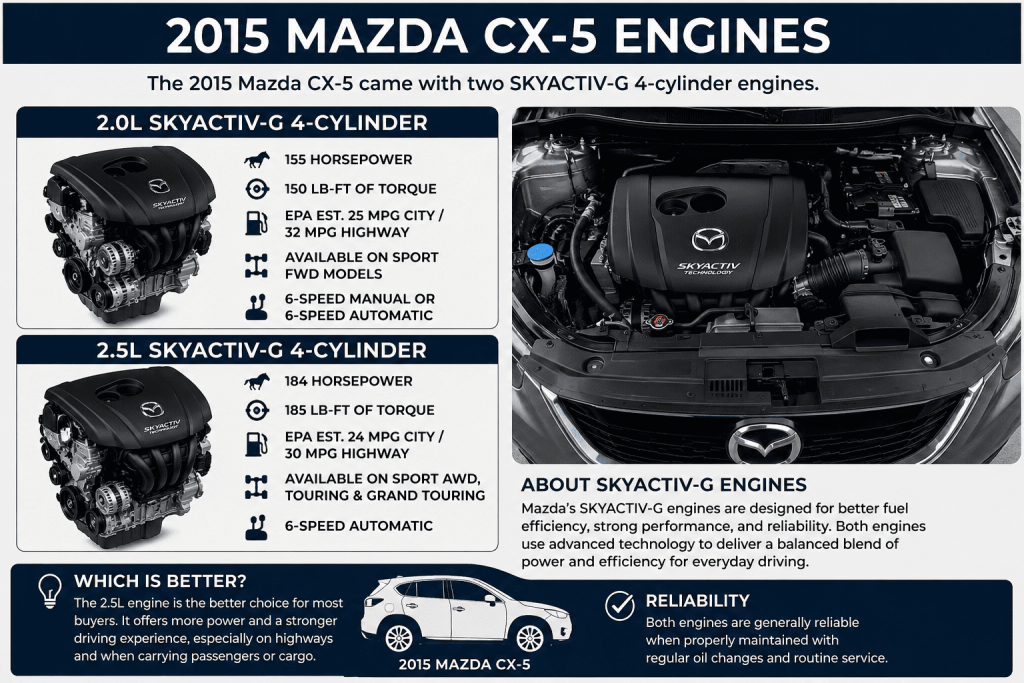
What Engine Does the 2015 Mazda CX-5 Have? The 2015 Mazda CX-5 came with two engine options in North America: a 2.0L SKYACTIV-G 4-cylinder engine and a 2.5L SKYACTIV-G 4-cylinder engine. The simple answer is this: most 2015 Mazda CX-5 models have the 2.5L SKYACTIV-G 4-cylinder engine, while the base Sport front-wheel-drive model could come with the smaller 2.0L SKYACTIV-G engine. Mazda’s official 2015 CX-5 specifications list the 2.0L engine at 155 horsepower and the 2.5L engine at 184 horsepower. Mazda 2015 CX-5 specs 2015 Mazda CX-5 Engine Options The 2015 Mazda CX-5 was offered with Mazda’s SKYACTIV-G gasoline engines. The smaller engine was a 2.0L SKYACTIV-G 4-cylinder. It produced 155 horsepower and was available on Sport front-wheel-drive models. Mazda offered it with either a 6-speed manual transmission or a 6-speed automatic transmission, depending on configuration. Mazda 2015 CX-5 specs The larger engine was a 2.5L SKYACTIV-G 4-cylinder. It produced 184 horsepower and was used on Sport AWD, Touring, and Grand Touring models. This engine came with a 6-speed automatic transmission. Mazda 2015 CX-5 specs Which 2015 CX-5 Engine Is More Common? The 2.5L engine is the more common and more desirable choice for most used buyers. It gives the CX-5 better acceleration, stronger highway passing power, and a more relaxed driving feel than the 2.0L engine. The 2.0L is fuel-efficient and simple, but it can feel underpowered, especially with passengers, cargo, hills, or highway merging. Edmunds notes that the 2015 Mazda CX-5 Sport front-wheel-drive model came with the 2.0L 4-cylinder engine making 155 horsepower and 150 lb-ft of torque, while other models used the stronger 2.5L 4-cylinder with 184 horsepower and 185 lb-ft of torque. Edmunds 2015 Mazda CX-5 2.0L Engine The 2.0L SKYACTIV-G engine was the entry-level engine. It made 155 horsepower and 150 lb-ft of torque. This engine was mainly found in the base Sport front-wheel-drive model. It could be paired with a 6-speed manual transmission or a 6-speed automatic transmission. This engine is fine if you want a basic, efficient used SUV and do not care much about quick acceleration. But for most buyers, the 2.5L engine is the better fit. 2015 Mazda CX-5 2.5L Engine The 2.5L SKYACTIV-G engine was the stronger option. It made 184 horsepower and 185 lb-ft of torque. It was standard on Touring and Grand Touring models and was also used on Sport AWD models. Edmunds lists the 2015 CX-5 Touring with a 2.5L inline-4 gas engine, 184 hp, 185 lb-ft of torque, and a 6-speed automatic transmission. Edmunds For most shoppers, this is the engine to look for. It gives the CX-5 a better balance of fuel economy and usable power. Is the 2015 Mazda CX-5 Engine Reliable? Yes, the 2015 Mazda CX-5 engines are generally considered reliable, especially when maintained properly. Mazda’s SKYACTIV-G engines are known for being efficient, relatively simple compared with turbocharged engines, and strong for daily driving. The 2015 CX-5 did not use a turbo engine in the North American market, which helps reduce complexity. As with any used vehicle, maintenance matters. Before buying a 2015 CX-5, check for regular oil changes, coolant condition, transmission service history, clean startup, no warning lights, no oil leaks, and no signs of overheating. Which 2015 Mazda CX-5 Engine Should You Buy? For most buyers, the 2.5L SKYACTIV-G engine is the better choice. It has more power, better real-world drivability, and is easier to recommend for highway driving, family use, and daily commuting. The 2.0L engine can still be a good option if the price is right and you want the simplest base model, but it is not as strong when the vehicle is loaded. If you are shopping used, focus more on condition than engine alone. A clean 2.0L CX-5 with full service records can be better than a neglected 2.5L model. FAQs About the 2015 Mazda CX-5 Engine What engine does the 2015 Mazda CX-5 have? The 2015 Mazda CX-5 has either a 2.0L SKYACTIV-G 4-cylinder engine or a 2.5L SKYACTIV-G 4-cylinder engine, depending on trim and drivetrain. Does the 2015 Mazda CX-5 have a V6? No, the 2015 Mazda CX-5 does not have a V6 engine. It only came with 4-cylinder gasoline engines in North America. How much horsepower does the 2015 Mazda CX-5 have? The 2.0L engine makes 155 horsepower, while the 2.5L engine makes 184 horsepower. Which 2015 Mazda CX-5 engine is better? The 2.5L SKYACTIV-G 4-cylinder is better for most buyers because it has more power and feels stronger in everyday driving. Is the 2015 Mazda CX-5 turbocharged? No, the 2015 Mazda CX-5 was not turbocharged in the North American market. Turbocharged CX-5 models came later. Final Thoughts: The 2.5L Is the One Most Buyers Want The 2015 Mazda CX-5 came with two engines: a 2.0L SKYACTIV-G 4-cylinder and a 2.5L SKYACTIV-G 4-cylinder. The 2.0L engine was mainly for base Sport front-wheel-drive models. The 2.5L engine was used in more trims and is the better choice for most shoppers because it offers stronger acceleration and better everyday drivability. If you are buying a used 2015 CX-5, look for the 2.5L engine, clean maintenance records, no warning lights, and a solid inspection. That combination gives you the best chance of getting a dependable compact SUV with Mazda’s sharp driving feel.