Blog

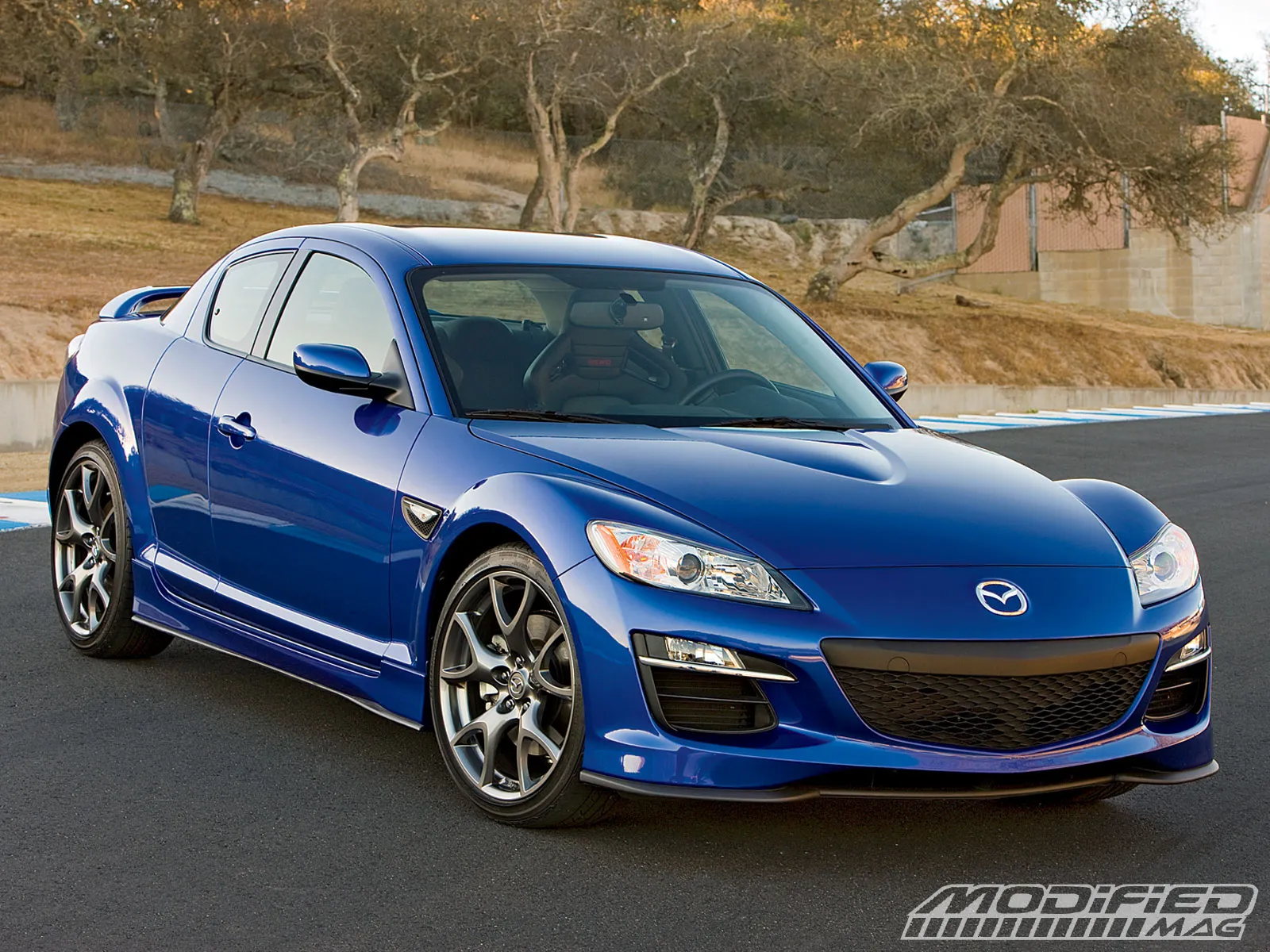
Mazda RX-8: Is It Really That Bad, or Just Misunderstood?

Image

A deep, human, no-nonsense look at one of the most controversial sports cars ever built

Few cars trigger as much debate as the Mazda RX-8. Mention it in a car forum or at a meet, and you’ll hear two completely different stories. One side calls it unreliable, fragile, and expensive to own. The other side calls it one of the best-handling driver’s cars ever made, unfairly blamed for problems most owners caused themselves.

So what’s the truth?

Is the Mazda RX-8 really that bad?
Is it a good car to buy today?
And why does it still attract so much attention nearly two decades later?

This in-depth article cuts through the myths, the horror stories, and the nostalgia to explain what the RX-8 actually is, why it failed commercially, and whether it makes sense for a real buyer in today’s market.


What the Mazda RX-8 Was Meant to Be

To understand the RX-8, you have to understand Mazda’s mindset in the early 2000s.

At the time, most sports coupes were doing one of two things:

  • Chasing straight-line speed
  • Chasing luxury

Mazda went in a completely different direction.

The RX-8 was designed to be:

  • Naturally balanced
  • Lightweight for its size
  • Perfectly distributed front-to-rear
  • Engineered around feel rather than numbers

It wasn’t built to dominate drag races or dyno charts. It was built to reward the driver, especially on twisty roads and track days.

And in that one area, it succeeded brilliantly.


The Rotary Engine: Genius and the Source of All Trouble

The RX-8’s reputation lives and dies by one thing: the rotary engine.

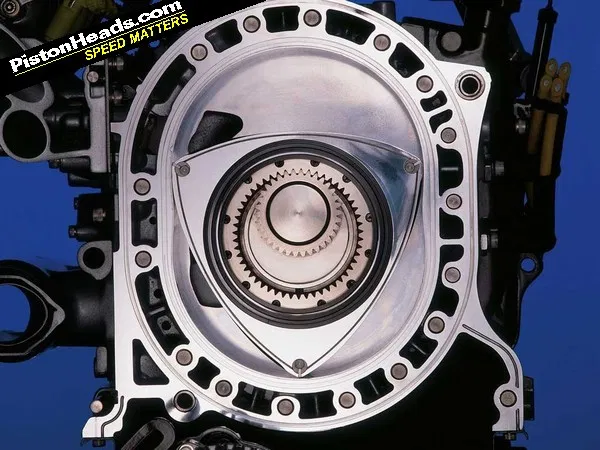
Mazda used the RENESIS rotary, a compact, high-revving engine unlike anything else sold in a mass-production car at the time. No pistons. No valves. Just smooth rotation and sky-high revs.

Why Mazda Loved the Rotary

From an engineering perspective, the rotary had huge advantages:

  • Extremely compact size
  • Very low center of gravity
  • Smooth power delivery
  • Ability to rev safely past 9,000 RPM

This allowed Mazda to mount the engine far back in the chassis, giving the RX-8 near-perfect weight distribution.

The result?
Handling that embarrassed cars with far more power.

Why Owners Hated It

The rotary also came with serious downsides:

  • High oil consumption (by design, not a defect)
  • Poor fuel economy
  • Sensitivity to maintenance
  • Cold-start and flooding issues if abused

Here’s the critical point many people miss:

The RX-8 didn’t fail because the rotary was bad.
It failed because most owners didn’t understand it.


Is the Mazda RX-8 a Good Car?

This is the most searched question, and the answer depends entirely on who you are.

The Honest Short Answer

For the average car buyer looking for cheap, reliable transportation: no.
For an enthusiast who understands what they’re buying: yes, absolutely.

The RX-8 is not a forgiving car. It does not tolerate neglect, ignorance, or cheap ownership habits. But when cared for properly, it delivers something few cars ever have: pure, mechanical connection.


Why the RX-8 Got Such a Bad Reputation

The RX-8 entered the market at exactly the wrong time.

Problem #1: Sold to the Wrong Buyers

Mazda marketed the RX-8 like a normal sporty coupe. That attracted buyers who:

  • Never checked oil levels
  • Did short, cold trips only
  • Ignored warm-up procedures
  • Treated it like a Corolla with a spoiler

Rotary engines don’t work that way.

Problem #2: Oil Consumption Shock

RX-8s intentionally burn oil as part of normal operation. Owners unfamiliar with this panicked, ignored it, or blamed Mazda.

Running low on oil in a rotary engine is catastrophic.

Problem #3: Emissions Regulations

The RENESIS engine was clean enough to launch, but tightening emissions rules killed its long-term viability. Mazda had to make compromises that affected durability.

The RX-8 became a victim of regulations as much as engineering.
Image

What the RX-8 Gets Right (Even Today)

Despite the reputation, the RX-8 excels in areas that still matter.

Handling and Balance

This is where the RX-8 shines brightest.

  • Near 50:50 weight distribution
  • Hydraulic steering with real feedback
  • Neutral cornering behavior
  • Predictable chassis at the limit

Even modern sports cars struggle to match the RX-8’s chassis feel without electronic trickery.

Steering Feel

The RX-8’s steering is often described as “telepathic.” It communicates road texture, grip limits, and chassis balance in a way modern EPS systems rarely do.

This alone keeps the RX-8 relevant among enthusiasts.

Practicality (Surprisingly)

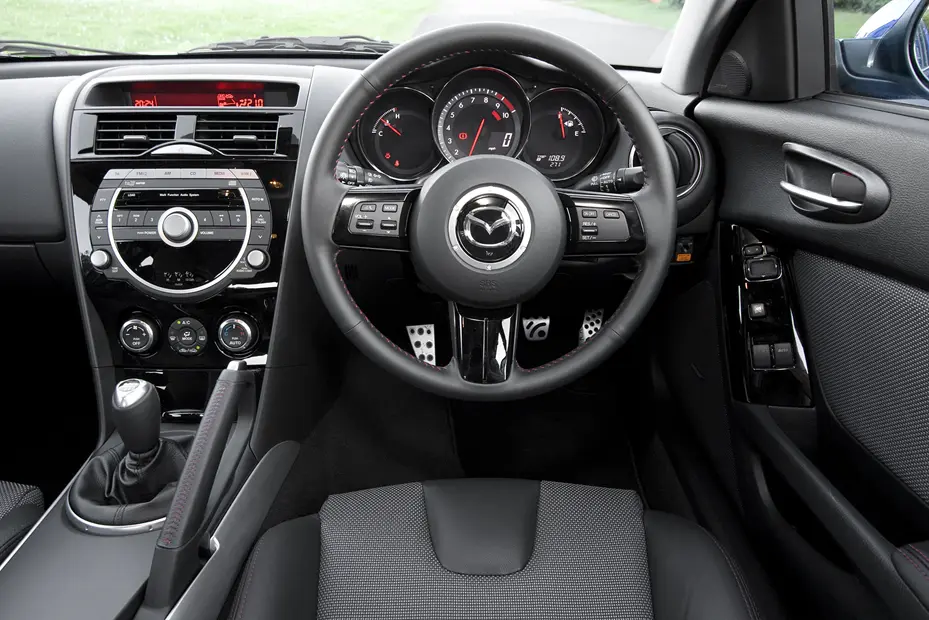
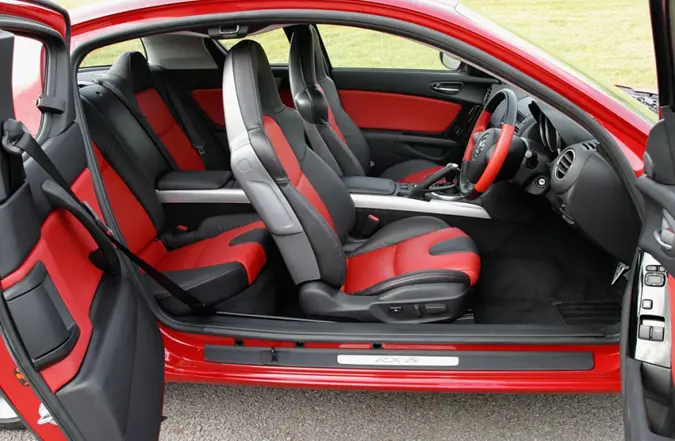
Thanks to its rear-hinged doors, the RX-8 offers:

  • Usable rear seats
  • Easier access than most coupes
  • Decent trunk space for a sports car

It’s one of the few true sports coupes that can function as a daily driver if you accept its quirks.


Reliability: The Real Story

The RX-8 is not unreliable in the traditional sense. It doesn’t randomly break electrical systems or eat transmissions. Its reputation comes almost entirely from engine failures, and those failures follow patterns.

Common RX-8 Problems

  • Loss of compression over time
  • Apex seal wear
  • Flooded engines from improper shutdown
  • Weak ignition coils in early models

Here’s the important distinction:

Most RX-8 engine failures are preventable.

Owners who:

  • Check oil regularly
  • Warm the engine properly
  • Use quality ignition components
  • Avoid short cold starts

often see far better longevity than the horror stories suggest.
Image

Buying a Used Mazda RX-8 Today

Searches for “Mazda RX-8 for sale” and “RX-8 coupe for sale” are rising, largely because prices are still relatively low.

Why Prices Are Tempting

  • Depreciation hit the RX-8 hard
  • Fear keeps demand low
  • Many clean examples still exist

This creates an unusual situation: exceptional chassis for very little money.

What to Check Before Buying

If you’re considering an RX-8, these checks are non-negotiable:

  • Compression test (rotary-specific)
  • Cold start behavior
  • Hot restart behavior
  • Oil consumption history
  • Ignition system condition

Skipping these steps is how people end up hating the RX-8.


Ownership Costs: What No One Tells You

The RX-8 is not cheap to own, but it’s not outrageous either if expectations are realistic.

Fuel

Fuel economy is poor by modern standards. This is the price of high-revving rotary performance.

Oil

You will add oil between changes. This is normal.

Maintenance

Preventive maintenance is essential. Reactive maintenance is expensive.

The RX-8 punishes laziness more than incompetence.


Is the Mazda RX-8 Really That Bad?

No.
But it is honest.

It doesn’t hide its demands. It doesn’t forgive neglect. It doesn’t pretend to be something it’s not.

The RX-8 is a car that asks something of its owner in return for what it gives. In an era of increasingly isolated, automated driving, that relationship is rare.


Who Should Buy an RX-8?

The RX-8 makes sense if:

  • You enjoy learning your car
  • You value handling over horsepower
  • You understand rotary ownership
  • You want something genuinely different

It does not make sense if:

  • You want cheap transportation
  • You hate maintenance
  • You expect Toyota-level indifference
  • You never check fluids

The RX-8’s Legacy

The Mazda RX-8 represents the end of an era. It was the last mass-produced rotary sports car, and likely the last of its kind.

It failed commercially, not because it was bad, but because it demanded more from buyers than the market was willing to give.

Ironically, that’s exactly why it’s so interesting today.


Final Verdict

So, is the Mazda RX-8 a good car?

Yes for the right person.
No for the wrong expectations.

It is one of the most misunderstood cars ever built. Treat it like an appliance, and it will punish you. Treat it like a machine with character, and it will reward you in ways few cars can.

The RX-8 isn’t bad.
It’s just honest.

And honesty, in cars and in life, often gets blamed for things it didn’t do.

Image

Recommended Posts

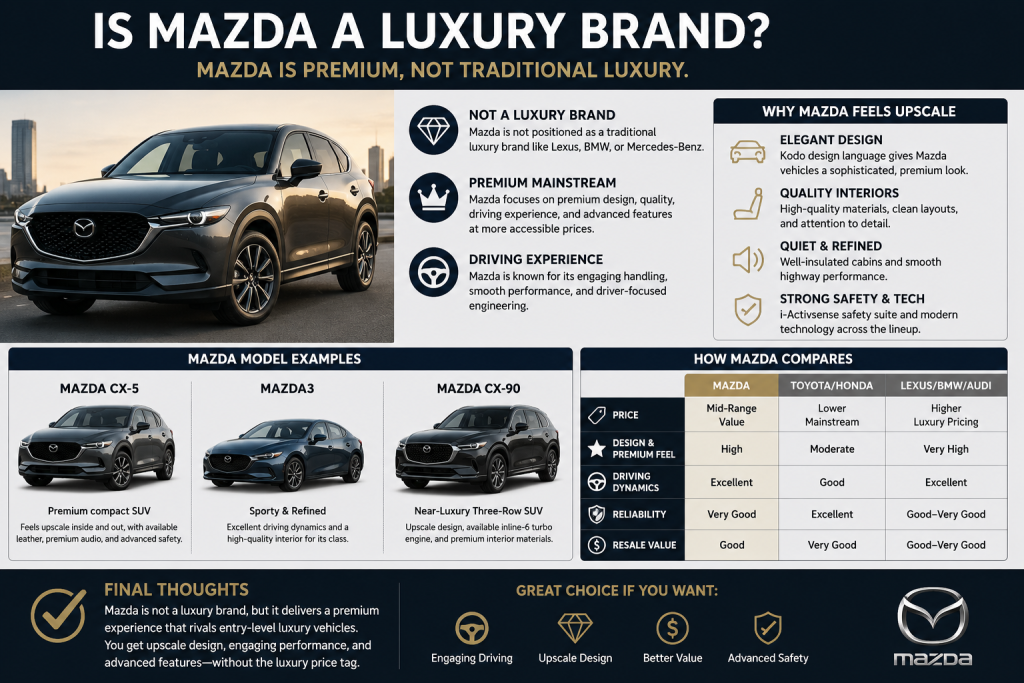
Is Mazda a Luxury Brand?

Is Mazda a Luxury Brand? Mazda is not officially a luxury brand, but it is one of the clearest examples of a premium mainstream brand. That means Mazda sits between regular brands like Toyota, Honda, Hyundai, Nissan, and Subaru, and traditional luxury brands like Lexus, Acura, BMW, Audi, Mercedes-Benz, and Volvo. Mazda does not sell itself as a full luxury automaker, but many of its newer vehicles feel more upscale than their price suggests. The simple answer is this: Mazda is not a luxury brand, but it is a premium-feeling brand with luxury-like design, interiors, and driving dynamics. Why People Think Mazda Is a Luxury Brand People ask whether Mazda is a luxury brand because newer Mazda models look and feel more expensive than many mainstream competitors. Mazda has focused heavily on interior quality, clean design, quiet cabins, better materials, strong paint colors, refined driving feel, and upscale trims. Models like the Mazda CX-5, CX-50, CX-70, CX-90, Mazda3, and MX-5 Miata all show that Mazda is trying to be more than just another economy car brand. Mazda itself has leaned into the idea of “premium” more than “luxury.” In a 2026 Mazda survey, the company described modern premium value as being about design, comfort, technology, and daily experience rather than just the badge on the grille. Mazda said its focus remains on vehicles that elevate everyday driving through thoughtful design, intuitive technology, and safety. Mazda USA That is exactly where Mazda fits today. It is not trying to copy Lexus directly. It is trying to make mainstream vehicles feel more special. Mazda Is Premium, Not Traditional Luxury A traditional luxury brand usually offers things like exclusive dealer experiences, higher-end powertrains, wider customization, premium materials across the lineup, prestige branding, luxury service programs, and higher base pricing. Mazda does not fully operate in that space. Instead, Mazda gives buyers a more premium experience without jumping fully into luxury-brand pricing. This is why shoppers often compare a loaded Mazda CX-5 or Mazda CX-90 against entry-level Lexus, Acura, Volvo, Audi, or BMW models. Motor1 reported that Mazda’s internal idea of “premium” does not necessarily mean “luxury.” The brand has been aiming for a more boutique, higher-end customer, but not in the same exact way as traditional luxury automakers. Motor1 That distinction matters. Mazda is premium by design and feel. It is not luxury by official market category. What Makes Mazda Feel Upscale? Mazda vehicles often feel upscale because of the way they are designed. The cabins usually avoid the cheap, cluttered look found in some mainstream vehicles. Controls are simple. Materials feel better than expected. Steering and handling are more engaging. Exterior styling is mature and elegant instead of loud or overly busy. Mazda’s Kodo design philosophy is a big part of this. The brand focuses on shape, proportion, motion, and restraint. That gives many Mazda vehicles a more expensive look than their window sticker suggests. The result is a brand that feels grown-up. A Mazda may not have the badge prestige of a Lexus or BMW, but the vehicle itself often feels more refined than many shoppers expect. Is the Mazda CX-5 a Luxury SUV? The Mazda CX-5 is not a luxury SUV, but upper trims can feel close to entry-level luxury. A well-equipped CX-5 can include leather seating, available Nappa leather on certain trims in some markets, a premium audio system, heated and ventilated front seats, a quiet cabin, elegant interior design, and strong handling. That is why the CX-5 is often cross-shopped against premium compact SUVs. But it is still priced and positioned as a mainstream compact SUV. The CX-5 is best described as a premium compact SUV, not a true luxury SUV. Is the Mazda CX-90 a Luxury SUV? The Mazda CX-90 is probably the closest Mazda gets to luxury right now. It uses a rear-biased platform, available inline-six turbo engine, upscale cabin design, premium materials, and a more refined three-row SUV layout. Car and Driver describes the CX-90 as part of Mazda’s continuing effort to position itself as a premium brand, with elegant styling and a luxurious interior. Car and Driver That does not make the CX-90 a Mercedes-Benz GLS or BMW X7 competitor. But it does make it one of the most premium-feeling mainstream three-row SUVs. For buyers who want near-luxury feel without full luxury pricing, the CX-90 is one of Mazda’s strongest arguments. Is Mazda More Premium Than Toyota or Honda? Yes, Mazda often feels more premium than Toyota or Honda at similar price points. Toyota and Honda usually focus more on practicality, resale value, fuel economy, reliability, and broad appeal. Mazda focuses more on design, interior feel, and driving enjoyment. That does not mean Mazda is better for every buyer. Toyota and Honda may still be stronger choices for maximum resale value, hybrid selection, or long-term low-cost ownership. But if the question is which mainstream brand feels more upscale, Mazda is usually one of the top answers. Mazda’s advantage is emotional. The cars feel more carefully styled and more enjoyable to drive. Mazda vs Lexus, Acura, BMW, and Audi Mazda is not in the same official category as Lexus, Acura, BMW, or Audi. Luxury brands usually offer stronger badge prestige, more powerful engines, higher-end dealer experiences, deeper luxury options, and more expensive flagship models. They also usually come with higher ownership costs. Mazda’s advantage is value. A loaded Mazda can give shoppers a premium cabin, handsome design, and strong driving dynamics for less money than many luxury SUVs. But there are still differences. A Lexus RX, BMW X3, Audi Q5, or Mercedes-Benz GLC may offer more luxury-brand prestige, more advanced powertrain options, more refinement, or a more traditional luxury ownership experience. Mazda gives you a premium feel. Luxury brands give you the luxury badge and ecosystem. Is Mazda Trying to Become a Luxury Brand? Mazda has been moving more upscale, but it has not fully become a luxury brand. The brand has invested in more premium products, cleaner retail spaces, better interiors, higher-end SUVs, and more refined vehicle platforms. But Mazda still sells mainstream vehicles and competes heavily with Toyota, Honda, Subaru, Hyundai, Kia, and Nissan. The best way to describe Mazda’s strategy is near-luxury or premium mainstream. That is a smart position because many buyers want a vehicle that feels expensive without paying full luxury-brand pricing. Is Mazda Worth It Over a Luxury Brand? Mazda can be worth it if you care more about the vehicle experience than the badge. A Mazda makes sense if you want upscale styling, a nice interior, good handling, strong safety features, and lower pricing than many luxury vehicles. It may also cost less to insure, maintain, and repair than some German luxury brands. A luxury brand makes more sense if badge prestige, maximum refinement, advanced powertrain choices, concierge-level dealer experience, or higher-end materials are the priority. For many buyers, Mazda is the smarter middle ground. FAQs About Mazda as a Luxury Brand Is Mazda considered a luxury brand? No. Mazda is not officially considered a luxury brand. It is better described as a premium mainstream brand. Is Mazda a premium brand? Yes. Mazda has moved strongly into premium territory with upscale design, refined interiors, better driving dynamics, and higher-end models like the CX-70 and CX-90. Is Mazda as good as Lexus? Mazda can feel premium, but Lexus is a true luxury brand with stronger reliability reputation, dealer experience, and luxury-market positioning. Mazda is usually more affordable. Is Mazda better than Toyota? Mazda often feels more stylish and premium than Toyota, while Toyota usually has stronger hybrid options, resale value, and long-term reliability reputation. Is the Mazda CX-5 luxury? The Mazda CX-5 is not a true luxury SUV, but higher trims can feel near-luxury compared with many mainstream compact SUVs. Is the Mazda CX-90 a luxury SUV? The Mazda CX-90 is not officially a luxury SUV, but it is one of Mazda’s most premium vehicles and can feel close to entry-level luxury SUVs. Final Thoughts: Mazda Is Not Luxury, But It Feels Premium Mazda is not a luxury brand in the traditional sense. It does not sit directly beside Lexus, BMW, Audi, Mercedes-Benz, or Volvo. But it has become one of the most premium-feeling mainstream automakers. That is Mazda’s sweet spot. You get upscale design, strong driving feel, refined interiors, and a more emotional ownership experience without paying full luxury-brand prices. For shoppers who want something nicer than a basic mainstream SUV but do not care about a luxury badge, Mazda makes a very strong case.

Are Mazdas Expensive to Maintain?

Are Mazdas Expensive to Maintain? No, Mazdas are not expensive to maintain compared with many other brands. The simple answer is this: Mazda maintenance costs are usually lower than the industry average and close to Toyota and Honda in real-world ownership cost. Mazda is not always the absolute cheapest brand to maintain, but it is generally affordable, especially compared with European luxury brands, larger trucks, and some turbocharged or hybrid vehicles. RepairPal lists the average annual repair and maintenance cost for Mazda at $462, which is below the overall average of $652 for all vehicle models. RepairPal also gives Mazda a strong overall reliability profile, which helps explain why Mazda is often considered one of the better mainstream brands for long-term ownership. Why Mazda Maintenance Is Usually Affordable Mazda maintenance is usually affordable because most Mazda vehicles use fairly conventional gas engines, widely available parts, and relatively simple drivetrains compared with luxury brands. Mazda also does not rely as heavily on complicated hybrid systems across its whole lineup as some competitors. Many popular models, like the Mazda3, Mazda6, CX-30, CX-5, and CX-9, use proven gasoline engines and automatic transmissions that many independent shops can service. That matters because maintenance cost is not just about parts. It is also about labor time, diagnostic complexity, and how easy the vehicle is to work on. Mazda gives you a more premium-feeling interior and driving experience without the full luxury-brand service bill. Mazda Maintenance Cost Per Year The average Mazda costs about $462 per year for maintenance and repairs, according to RepairPal. RepairPal That is lower than the overall vehicle average and competitive with other reliable mainstream brands. For comparison, Toyota and Honda are often slightly cheaper, but Mazda is usually in the same general ownership-cost range. The gap is not huge for most common repairs and regular maintenance. Where costs can increase is with older high-mileage models, turbocharged engines, AWD systems, poor service history, or vehicles that were neglected by previous owners. Are Mazda CX-5 Maintenance Costs High? No, the Mazda CX-5 is not expensive to maintain for a compact SUV. RepairPal lists the annual repair and maintenance cost for the Mazda CX-5 at $447, compared with $573 for midsize SUVs and $652 for all vehicle models. RepairPal That makes the CX-5 one of Mazda’s stronger ownership-cost examples. It gives shoppers a premium-feeling cabin, sharp handling, and available AWD without the maintenance cost of a luxury SUV. A CX-5 can cost more to maintain if it has turbo power, AWD, higher mileage, or poor service records, but a well-maintained gas CX-5 is usually affordable to own. Are Mazda Parts Expensive? Mazda parts are usually not expensive compared with luxury brands. Common maintenance items like oil filters, air filters, brake pads, spark plugs, belts, tires, and fluids are generally reasonable. Mazda parts may sometimes cost a little more than the cheapest Toyota or Honda parts, but they are not usually in BMW, Mercedes-Benz, Audi, or Volvo territory. The biggest factor is where you service the vehicle. A Mazda dealership may cost more than a trusted independent shop, especially for basic maintenance. But dealership service can be useful for recalls, warranty repairs, software updates, and model-specific inspections. For routine maintenance, many Mazda owners can keep costs controlled by following the maintenance schedule and avoiding deferred repairs. What Mazda Maintenance Costs the Most? Most Mazda maintenance is normal: oil changes, tires, brakes, filters, spark plugs, fluids, batteries, and inspections. The more expensive items usually come later in ownership. These can include suspension parts, control arms, wheel bearings, engine mounts, transmission service, AWD system service, air-conditioning repairs, infotainment repairs, and turbo-related repairs on turbo models. Older Mazda vehicles can also need rust-related repairs depending on climate, road salt, and storage conditions. If you are buying used, check the service history carefully. A cheap used Mazda with skipped maintenance can become more expensive than a slightly pricier one with clean records. Is Mazda Cheaper to Maintain Than Toyota? Mazda is usually close to Toyota, but Toyota is often slightly cheaper long-term. Toyota’s biggest advantage is its extremely broad parts availability, huge service network, and long-standing reputation for simple, durable vehicles. Mazda is still affordable, but Toyota often wins if the only question is lowest possible maintenance cost. That said, Mazda often feels more upscale and more engaging to drive. For many shoppers, the small difference in maintenance cost is worth it for the better interior feel and sharper driving experience. Is Mazda Cheaper to Maintain Than Honda? Mazda and Honda are usually close in maintenance costs. Honda is known for efficient engines, strong resale value, and low ownership costs. Mazda is also affordable, especially on naturally aspirated models like many Mazda3 and CX-5 trims. The better choice depends on the specific model and condition. A well-maintained Mazda CX-5 can be cheaper to own than a neglected Honda CR-V. A clean Honda Civic can be cheaper than an older Mazda with poor service records. Condition matters more than the badge. Is Mazda Cheaper to Maintain Than Subaru? Mazda is often cheaper to maintain than Subaru. Subaru’s standard AWD systems are a major selling point, but they can add maintenance complexity and cost. Subaru models may also have specific repair patterns that can raise ownership costs depending on the year and model. Mazda offers available AWD on many models, but not every Mazda has it. A front-wheel-drive Mazda3 or CX-5 may be cheaper to maintain than an AWD Subaru with similar mileage. Is Mazda Cheaper to Maintain Than Luxury Brands? Yes, Mazda is much cheaper to maintain than most luxury brands. This is one of Mazda’s biggest strengths. Mazda vehicles often feel more premium than other mainstream brands, but they do not usually carry the repair costs of BMW, Audi, Mercedes-Benz, Lexus, Acura, or Volvo. Lexus and Acura may still have strong reliability and reasonable costs for luxury brands, but Mazda usually stays cheaper because it is still a mainstream brand. If you want a near-luxury feel without luxury maintenance bills, Mazda is one of the best brands to consider. Do Turbo Mazdas Cost More to Maintain? Yes, turbocharged Mazdas can cost more to maintain than non-turbo models. A turbo engine has more heat, more pressure, and more components than a naturally aspirated engine. It also needs consistent oil changes and proper maintenance to stay healthy. Mazda’s turbo engines can be strong, but buyers should not treat them like low-maintenance base engines. If you are buying a used turbo Mazda, look for regular oil changes, no boost-related issues, clean startup, no smoke, no oil leaks, and no signs of abuse. For the lowest maintenance costs, a non-turbo Mazda is usually the safer choice. Is Mazda AWD Expensive to Maintain? Mazda AWD is not usually expensive, but it can add cost compared with front-wheel drive. AWD systems have extra components, including a rear differential and driveline parts. These parts may need fluid service and inspection over time. Tires also matter more on AWD vehicles because mismatched tire wear can create drivetrain stress. If you want the lowest possible ownership cost, front-wheel drive is usually cheaper. If you need better traction in rain, snow, or mountain driving, Mazda AWD can be worth the added cost. Used Mazda Maintenance: What to Check Used Mazdas can be affordable, but maintenance history is critical. Before buying a used Mazda, check for oil-change records, tire condition, brake wear, suspension noise, transmission behavior, coolant condition, battery age, rust, infotainment issues, and open recalls. For Mazda CX-5, Mazda3, Mazda6, CX-30, and CX-9 models, also check that the infotainment screen works properly and that the backup camera, Bluetooth, navigation, and control knob function as expected. A class action settlement reported in 2025 involved Mazda Connect infotainment issues on several 2014 to 2023 Mazda models, including Mazda3, Mazda6, CX-3, CX-5, CX-9, and MX-5. Mazda denied wrongdoing but agreed to settlement terms involving reimbursements and warranty extension coverage for eligible owners. The Sun That does not make Mazdas expensive overall, but it is a reminder to check electronics before buying used. How to Keep Mazda Maintenance Costs Low The best way to keep Mazda maintenance costs low is simple: follow the maintenance schedule and fix small issues early. Do regular oil changes. Replace air and cabin filters on time. Rotate tires. Keep the correct tire pressure. Change spark plugs when due. Service fluids as recommended. Do not ignore warning lights. Use quality parts. Keep records. For AWD models, keep tires matched and rotate them regularly. For turbo models, use the correct oil and do not stretch oil-change intervals too far. A Mazda that gets basic maintenance on time can be one of the more affordable vehicles to own. Are Mazdas Good Long-Term Cars? Yes, Mazdas are good long-term cars when maintained properly. Mazda has built a strong reputation for combining reliability, driving enjoyment, and upscale design without extreme ownership costs. Many Mazda3, Mazda6, CX-5, and CX-9 models can last well beyond 150,000 miles with regular service. The key is not neglecting maintenance. Like any vehicle, a Mazda will become expensive if oil changes are skipped, tires are ignored, brakes are delayed, or small leaks are allowed to become major repairs. Should You Buy a Mazda If You Want Low Maintenance Costs? Yes, Mazda is a strong choice if you want a vehicle that feels more premium than many mainstream brands but does not cost like a luxury car to maintain. Toyota and Honda may still be the safest choices for the absolute lowest long-term costs, but Mazda is very competitive. It is especially attractive if you want a better driving feel and nicer interior without jumping into luxury-brand repairs. For shoppers comparing Mazda models, look at the latest new Mazda inventory or compare pre-owned options in the used inventory. If you are budgeting around payments, trade value, and service costs, you can also review current Mazda specials. FAQs About Mazda Maintenance Costs Are Mazdas expensive to maintain? No. Mazdas are generally affordable to maintain. RepairPal lists the average annual Mazda repair and maintenance cost at $462, which is below the industry average. Is the Mazda CX-5 expensive to maintain? No. The Mazda CX-5 is one of the more affordable SUVs to maintain. RepairPal lists its average annual repair and maintenance cost at $447. Are Mazda parts expensive? Mazda parts are usually not expensive compared with luxury brands. Common maintenance parts are generally reasonable and widely available. Is Mazda cheaper to maintain than Toyota? Mazda is usually close to Toyota, but Toyota is often slightly cheaper long-term. Mazda may feel more premium and more enjoyable to drive. Is Mazda cheaper to maintain than Honda? Mazda and Honda are usually close. The better buy depends on the specific model, mileage, service history, and condition. Do Mazda turbo engines cost more to maintain? Yes, Mazda turbo engines can cost more than non-turbo engines because they add heat, pressure, and more components. They require consistent oil changes and proper maintenance. Are used Mazdas expensive to fix? Used Mazdas are usually not expensive to fix if they have been maintained well. Neglected used Mazdas can become costly, especially if they have turbo, AWD, infotainment, or suspension issues. Final Thoughts: Mazdas Are Affordable to Maintain Mazdas are not expensive to maintain for most drivers. They cost less than the industry average, are usually close to Toyota and Honda in ownership costs, and are much cheaper to maintain than most luxury brands. The Mazda CX-5 is a strong example, with average annual repair and maintenance costs below the broader vehicle average. The best Mazda to own is the one with clean service records, regular oil changes, no major accident history, and the right drivetrain for your needs. Choose carefully, maintain it properly, and a Mazda can deliver premium feel without premium repair bills.

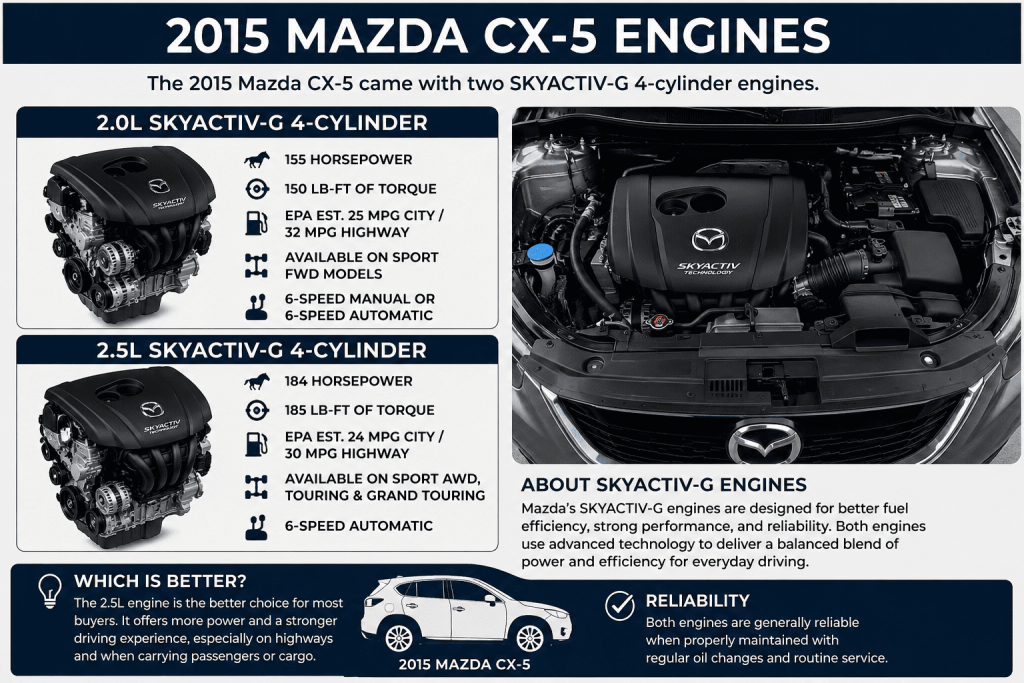
What Engine Does the 2015 Mazda CX-5 Have?

What Engine Does the 2015 Mazda CX-5 Have? The 2015 Mazda CX-5 came with two engine options in North America: a 2.0L SKYACTIV-G 4-cylinder engine and a 2.5L SKYACTIV-G 4-cylinder engine. The simple answer is this: most 2015 Mazda CX-5 models have the 2.5L SKYACTIV-G 4-cylinder engine, while the base Sport front-wheel-drive model could come with the smaller 2.0L SKYACTIV-G engine. Mazda’s official 2015 CX-5 specifications list the 2.0L engine at 155 horsepower and the 2.5L engine at 184 horsepower. Mazda 2015 CX-5 specs 2015 Mazda CX-5 Engine Options The 2015 Mazda CX-5 was offered with Mazda’s SKYACTIV-G gasoline engines. The smaller engine was a 2.0L SKYACTIV-G 4-cylinder. It produced 155 horsepower and was available on Sport front-wheel-drive models. Mazda offered it with either a 6-speed manual transmission or a 6-speed automatic transmission, depending on configuration. Mazda 2015 CX-5 specs The larger engine was a 2.5L SKYACTIV-G 4-cylinder. It produced 184 horsepower and was used on Sport AWD, Touring, and Grand Touring models. This engine came with a 6-speed automatic transmission. Mazda 2015 CX-5 specs Which 2015 CX-5 Engine Is More Common? The 2.5L engine is the more common and more desirable choice for most used buyers. It gives the CX-5 better acceleration, stronger highway passing power, and a more relaxed driving feel than the 2.0L engine. The 2.0L is fuel-efficient and simple, but it can feel underpowered, especially with passengers, cargo, hills, or highway merging. Edmunds notes that the 2015 Mazda CX-5 Sport front-wheel-drive model came with the 2.0L 4-cylinder engine making 155 horsepower and 150 lb-ft of torque, while other models used the stronger 2.5L 4-cylinder with 184 horsepower and 185 lb-ft of torque. Edmunds 2015 Mazda CX-5 2.0L Engine The 2.0L SKYACTIV-G engine was the entry-level engine. It made 155 horsepower and 150 lb-ft of torque. This engine was mainly found in the base Sport front-wheel-drive model. It could be paired with a 6-speed manual transmission or a 6-speed automatic transmission. This engine is fine if you want a basic, efficient used SUV and do not care much about quick acceleration. But for most buyers, the 2.5L engine is the better fit. 2015 Mazda CX-5 2.5L Engine The 2.5L SKYACTIV-G engine was the stronger option. It made 184 horsepower and 185 lb-ft of torque. It was standard on Touring and Grand Touring models and was also used on Sport AWD models. Edmunds lists the 2015 CX-5 Touring with a 2.5L inline-4 gas engine, 184 hp, 185 lb-ft of torque, and a 6-speed automatic transmission. Edmunds For most shoppers, this is the engine to look for. It gives the CX-5 a better balance of fuel economy and usable power. Is the 2015 Mazda CX-5 Engine Reliable? Yes, the 2015 Mazda CX-5 engines are generally considered reliable, especially when maintained properly. Mazda’s SKYACTIV-G engines are known for being efficient, relatively simple compared with turbocharged engines, and strong for daily driving. The 2015 CX-5 did not use a turbo engine in the North American market, which helps reduce complexity. As with any used vehicle, maintenance matters. Before buying a 2015 CX-5, check for regular oil changes, coolant condition, transmission service history, clean startup, no warning lights, no oil leaks, and no signs of overheating. Which 2015 Mazda CX-5 Engine Should You Buy? For most buyers, the 2.5L SKYACTIV-G engine is the better choice. It has more power, better real-world drivability, and is easier to recommend for highway driving, family use, and daily commuting. The 2.0L engine can still be a good option if the price is right and you want the simplest base model, but it is not as strong when the vehicle is loaded. If you are shopping used, focus more on condition than engine alone. A clean 2.0L CX-5 with full service records can be better than a neglected 2.5L model. FAQs About the 2015 Mazda CX-5 Engine What engine does the 2015 Mazda CX-5 have? The 2015 Mazda CX-5 has either a 2.0L SKYACTIV-G 4-cylinder engine or a 2.5L SKYACTIV-G 4-cylinder engine, depending on trim and drivetrain. Does the 2015 Mazda CX-5 have a V6? No, the 2015 Mazda CX-5 does not have a V6 engine. It only came with 4-cylinder gasoline engines in North America. How much horsepower does the 2015 Mazda CX-5 have? The 2.0L engine makes 155 horsepower, while the 2.5L engine makes 184 horsepower. Which 2015 Mazda CX-5 engine is better? The 2.5L SKYACTIV-G 4-cylinder is better for most buyers because it has more power and feels stronger in everyday driving. Is the 2015 Mazda CX-5 turbocharged? No, the 2015 Mazda CX-5 was not turbocharged in the North American market. Turbocharged CX-5 models came later. Final Thoughts: The 2.5L Is the One Most Buyers Want The 2015 Mazda CX-5 came with two engines: a 2.0L SKYACTIV-G 4-cylinder and a 2.5L SKYACTIV-G 4-cylinder. The 2.0L engine was mainly for base Sport front-wheel-drive models. The 2.5L engine was used in more trims and is the better choice for most shoppers because it offers stronger acceleration and better everyday drivability. If you are buying a used 2015 CX-5, look for the 2.5L engine, clean maintenance records, no warning lights, and a solid inspection. That combination gives you the best chance of getting a dependable compact SUV with Mazda’s sharp driving feel.