When shopping for a new or used vehicle, a question many buyers ask is: Are Mazdas good cars? The short answer is yes—but to truly understand why, we need to go beyond the sleek designs and punchy zoom-zoom commercials. From engineering precision to long-term ownership value, Mazda vehicles consistently punch above their weight in reliability, safety, and driving dynamics.
Let’s explore what makes Mazda one of the most underrated brands on the market—and why it may just be your next best car purchase.
1. Mazda's Reputation: Built on Innovation and Reliability
Founded in 1920 in Hiroshima, Japan, Mazda has grown from a small cork manufacturer into a global automotive leader known for blending engineering innovation with sporty performance.
Mazda’s rise is deeply rooted in its commitment to craftsmanship and its philosophy of “Jinba Ittai”—a Japanese term describing the unity between horse and rider. This mindset influences everything from interior ergonomics to responsive handling.
Reliability Ratings
Mazda consistently scores high in third-party reliability rankings:
- Consumer Reports ranks Mazda among the top 3 most reliable brands year after year.
- J.D. Power awards Mazda with top marks in dependability, especially for models like the CX-5 and Mazda3.
- RepairPal gives Mazda a 4.0 out of 5.0 rating, placing it in the top tier of mainstream brands.
Compared to other Japanese automakers like Honda or Toyota, Mazda may fly under the radar—but many mechanics and long-time owners will tell you: they’re built to last.
2. Engineering Philosophy: Skyactiv Technology Explained
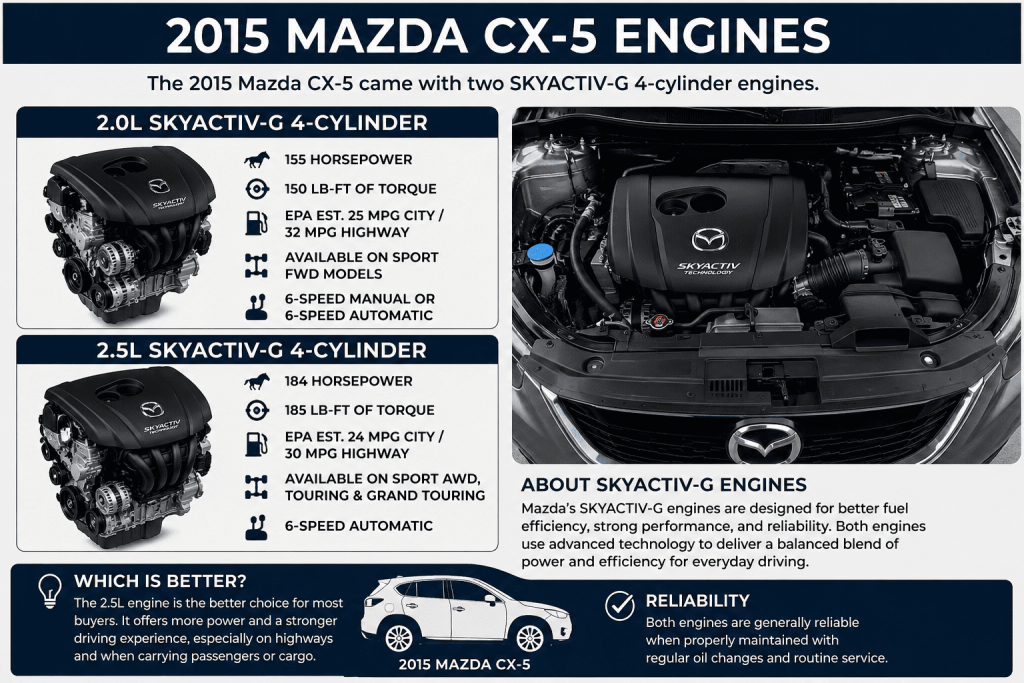
Mazda’s proprietary Skyactiv Technology has revolutionized the way their engines, transmissions, chassis, and suspensions are designed.
Key Advantages:
- Fuel Efficiency: Skyactiv engines deliver exceptional fuel economy without sacrificing performance.
- Performance: Unlike hybrids or turbocharged engines from competitors, Mazda’s naturally aspirated engines maintain consistent torque and better throttle response.
- Lower Emissions: Mazda’s combustion innovations reduce CO₂ output—important for eco-conscious buyers.
This isn’t just marketing fluff. Real-world driving impressions often highlight how smooth, quiet, and efficient Skyactiv-equipped Mazdas are—even on entry-level trims.
3. Interior Quality: Premium Feel Without the Premium Price
Mazda vehicles are often compared to luxury rivals like Acura, Lexus, or Audi—and it’s easy to see why.
Step inside a Mazda CX-5 or Mazda6 and you'll find:
- Minimalist, driver-focused cockpit design
- Soft-touch materials throughout
- Intuitive infotainment with rotary dial
- Leather-trimmed seating and ambient lighting on higher trims
Mazda’s interiors routinely outperform rivals like Toyota or Nissan in both form and function—especially when comparing similar price points.
4. Safety Ratings: Top Scores Across the Lineup
Safety is a critical consideration, and Mazda doesn’t cut corners here. Every new Mazda model includes a standard suite of safety technologies called i-Activsense:
- Blind Spot Monitoring
- Smart Brake Support
- Lane Keep Assist
- Adaptive Cruise Control
- Rear Cross Traffic Alert
According to the IIHS (Insurance Institute for Highway Safety), multiple Mazda models have earned the Top Safety Pick+ designation, including the Mazda CX-30, CX-5, and Mazda3.
This level of safety in standard trims gives buyers serious peace of mind—without needing to upgrade to expensive tech packages.
5. Driving Dynamics: Zoom-Zoom Still Lives
If you enjoy driving, Mazdas are among the most rewarding vehicles in the non-luxury segment. That’s not an accident. Every Mazda is tuned for driver engagement:
- Precise steering feel
- Balanced suspension
- Low center of gravity
Even the family-friendly Mazda CX-50 or Mazda3 Hatchback offers a connected feel to the road that outclasses many competitors like the Honda CR-V or Toyota Corolla.
For thrill-seekers, the iconic Mazda MX-5 Miata remains the gold standard in affordable sports cars—lightweight, nimble, and endlessly fun.
6. Resale Value and Total Cost of Ownership
A common concern is: Will my Mazda hold its value?
The answer: yes, surprisingly well.
According to Kelley Blue Book, Mazda consistently ranks among the best brands for resale value retention in the non-luxury category.
This is thanks to:
- Low maintenance costs
- High reliability scores
- Demand in the used market
Pair this with Mazda’s 3-year/36,000-mile basic warranty and 5-year/60,000-mile powertrain warranty, and you get impressive value over time.
7. Top Mazda Models to Consider in 2025
| Model | Best For | Starting Price (USD) |
|---|---|---|
| Mazda CX-5 | Family SUV with luxury feel | $29,300 |
| Mazda CX-50 | Adventure-ready crossover | $30,500 |
| Mazda3 Sedan | Commuters and first-time buyers | $24,100 |
| Mazda MX-5 Miata | Sports car lovers | $29,000 |
| Mazda CX-90 PHEV | Plug-in hybrid & large families | $47,445 |
These models strike a rare balance of performance, design, and everyday practicality—earning Mazda its reputation as a “driver’s brand” that doesn’t break the bank.
8. Real Owner Reviews: What Drivers Are Saying
Anecdotal data from online forums, Reddit threads, and Google reviews all echo the same praise:
- “I’ve owned Hondas and Toyotas, but my Mazda CX-5 has the best mix of comfort and handling.”
- “My Mazda3 is 8 years old and still feels solid. It’s never left me stranded.”
- “Service costs are way lower than I expected, and parts are easy to find.”
If word-of-mouth still matters, Mazda is one of the quiet heroes in automotive satisfaction.
9. Mazda vs The Competition: How Does It Stack Up?
| Feature | Mazda CX-5 | Honda CR-V | Toyota RAV4 |
|---|---|---|---|
| Starting Price | $29,300 | $30,100 | $29,475 |
| AWD Standard | Yes | No | No |
| Interior Design | Premium feel | Functional | Utilitarian |
| Driving Experience | Engaging | Comfortable | Predictable |
| Safety Tech | Standard i-Activsense | Honda Sensing | Toyota Safety Sense |
| Warranty | 5 yr / 60K mi | 5 yr / 60K mi | 5 yr / 60K mi |
Mazda leads when it comes to driver engagement, design quality, and feature-to-price ratio—making it an ideal choice for buyers who don’t want a cookie-cutter SUV or sedan.
10. So… Are Mazdas Good Cars?
Absolutely.
Whether you prioritize reliability, driving enjoyment, design, safety, or long-term value—Mazda delivers on all fronts.
It’s the kind of brand that doesn’t need to scream for attention. Instead, it quietly builds vehicles that car enthusiasts and everyday drivers alike can appreciate. That’s why you’ll often see Mazda owners become repeat buyers.
🏁 Ready to Test Drive a Mazda?
If you're in the Bay Area and want to explore what makes Mazda different, visit Marin Mazda—the #1 Mazda dealership serving San Rafael, San Francisco, and Concord.
Whether you're looking for a new Mazda CX-5, a sporty MX-5 Miata, or a plug-in hybrid like the CX-90 PHEV, their team is ready to help.
🚗 Browse Inventory
💰 Check New Vehicle Specials
📞 Contact Marin Mazda
Mazda FAQ | Marin Mazda
1) Are Mazdas good cars overall?
Yes. Mazda consistently ranks among the top 3 most reliable brands in Consumer Reports, J.D. Power, and RepairPal studies. It combines Japanese craftsmanship with sporty handling and high resale value—offering both dependability and driving enjoyment.
2) Why is Mazda considered underrated?
Mazda doesn’t market itself as aggressively as Toyota or Honda, yet it delivers luxury-level interiors, excellent safety, and superior driving dynamics at a lower cost. Many drivers discover that Mazda vehicles feel more refined and engaging than similarly priced rivals.
3) What does “Jinba Ittai” mean?
It’s a Japanese philosophy meaning “horse and rider as one.” Every Mazda is designed to feel connected to the driver—reflected in the car’s balanced handling, steering feedback, and intuitive control layout.
4) How reliable are Mazdas?
Extremely. Mazda vehicles routinely achieve high reliability scores:
- Consumer Reports: Top 3 brand for reliability
- J.D. Power: Above-average dependability in nearly all categories
- RepairPal: 4.0/5.0 reliability score (Top Tier)
Mazdas require fewer repairs and have lower annual maintenance costs than most competitors.
5) What is Skyactiv Technology?
Mazda’s Skyactiv engineering approach enhances efficiency and performance by optimizing every system—engine, transmission, and chassis—for balance and fuel economy. The result is strong torque, smooth acceleration, and low emissions without compromising the fun-to-drive feel.
6) Are Mazdas fuel-efficient?
Yes. Most Skyactiv engines achieve class-leading mpg without hybrid complexity. For example:
- Mazda3: ~32 mpg combined
- Mazda CX-5: ~28 mpg combined
- Mazda CX-50 Hybrid: ~38 mpg combined
Mazda’s efficient combustion design allows for real-world mileage close to EPA estimates.
7) How do Mazda interiors compare to other brands?
Mazda interiors often rival Acura or Audi in design and materials. Expect:
- Minimalist driver-focused layouts
- High-quality soft-touch materials
- Leather or Nappa leather on upper trims
- Ambient lighting and real metal or wood accents
The craftsmanship and ergonomics reflect Mazda’s premium ambitions without the premium price tag.
8) Are Mazdas safe vehicles?
Absolutely. Mazda’s i-Activsense safety suite is standard on nearly all models and includes:
- Blind Spot Monitoring
- Smart Brake Support (with pedestrian detection)
- Lane Keep Assist
- Adaptive Cruise Control
- Rear Cross-Traffic Alert
Multiple Mazda models—including the CX-30, CX-5, and Mazda3—regularly earn IIHS Top Safety Pick+ ratings.
9) What’s Mazda’s best model for families?
The Mazda CX-5 and CX-90 lead the lineup for families.
- CX-5: Compact size, luxury feel, excellent safety, great fuel economy.
- CX-90: Three rows, powerful inline-six or plug-in hybrid option, premium comfort.
10) Which Mazda is the most fun to drive?
The Mazda MX-5 Miata remains the benchmark for driving enjoyment—lightweight, rear-wheel drive, and perfectly balanced. Among SUVs, the CX-50 Turbo delivers the most engaging experience.
11) Do Mazdas hold their value?
Yes. Kelley Blue Book ranks Mazda among the top non-luxury brands for resale value. High demand, reliability, and premium appeal mean lower depreciation compared to other mainstream makes.
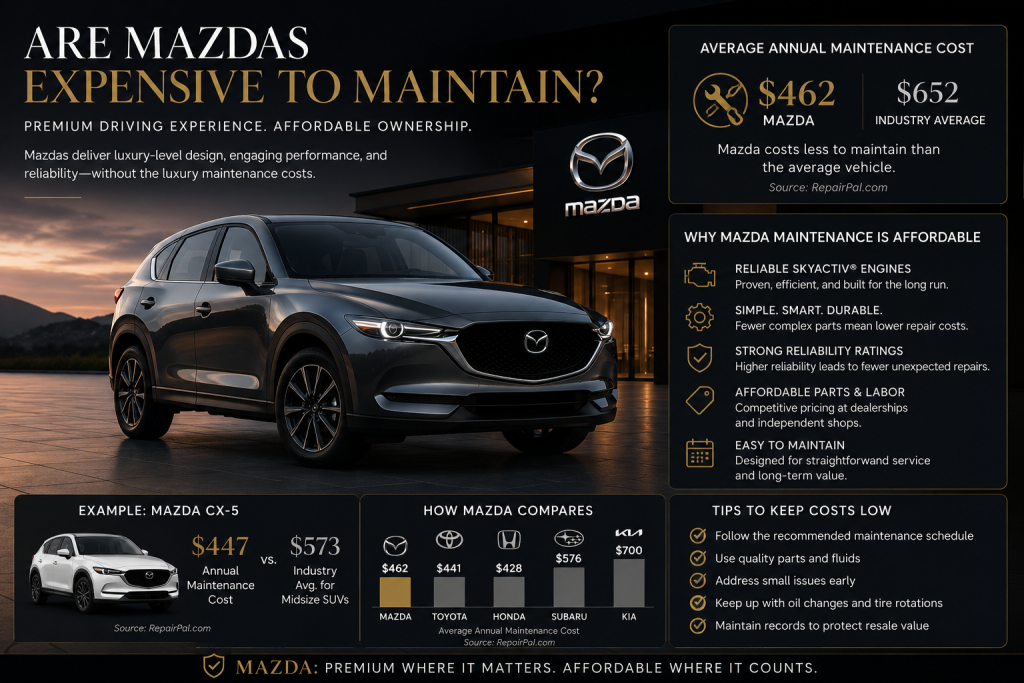
12) Are Mazdas expensive to maintain?
Not at all. Average annual maintenance cost is around $450–$550, lower than most competitors. Common service items like oil changes, filters, and brakes are affordable due to Mazda’s simple and proven engineering.
13) How does Mazda compare to Toyota or Honda?
| Feature | Mazda | Toyota | Honda |
|---|---|---|---|
| Driving Feel | Engaging | Comfortable | Balanced |
| Interior Design | Premium | Practical | Conservative |
| Standard Safety | i-Activsense | Toyota Safety Sense | Honda Sensing |
| AWD Availability | Standard on many models | Optional | Optional |
| Brand Character | Sporty & Refined | Reliable & Familiar | Practical & Efficient |
Mazda edges out both in driving enjoyment and design sophistication.
14) Which Mazdas are hybrids or PHEVs?
- CX-50 Hybrid (~38 mpg combined)
- CX-70 PHEV (~26 miles EV range)
- CX-90 PHEV (~25 miles EV range)
More hybrid and plug-in options are coming in 2026–2027 under Mazda’s Skyactiv-Z program.
15) What warranty coverage does Mazda offer?
- 3 years / 36,000 miles (Basic)
- 5 years / 60,000 miles (Powertrain)
- 8 years / 100,000 miles (Hybrid battery for PHEVs)
Optional extended coverage and prepaid maintenance are also available.
16) Are Mazdas good for long-term ownership?
Yes. Many Mazda owners report 200,000+ miles of trouble-free service. The combination of reliable engines, corrosion-resistant body design, and consistent parts quality make them excellent long-term investments.
17) Do Mazdas require premium gas?
Only turbocharged models (like CX-5 Turbo or CX-50 Turbo) use premium fuel to achieve full power output. They can safely run on regular gas with slightly reduced performance.
18) What are the best Mazdas to buy in 2025?
| Model | Best For | Starting Price (USD) |
|---|---|---|
| Mazda3 Sedan | Commuters & first-time buyers | ~$24,000 |
| Mazda CX-5 | Luxury feel in compact SUV form | ~$29,000 |
| Mazda CX-50 | Outdoor & adventure lifestyle | ~$30,500 |
| Mazda CX-90 PHEV | Large families & hybrid efficiency | ~$47,400 |
| Mazda MX-5 Miata | Pure driving joy | ~$29,000 |
19) Where are Mazdas built?
Mazda vehicles are primarily manufactured in Hiroshima, Japan, with additional facilities in the U.S., Mexico, and Thailand. Premium models like the CX-90 continue to be assembled in Japan to maintain top craftsmanship standards.
20) Where can I test drive a Mazda in the Bay Area?
Visit Marin Mazda — the Bay Area’s trusted Mazda dealership in San Rafael, CA. Browse new and pre-owned inventory, explore special offers, and schedule a test drive.
Verdict:
Mazdas aren’t just good cars — they’re great cars built with passion and precision. They combine Japanese reliability, luxury design, and true driver engagement at an unbeatable value.
If you’re shopping for a new or used Mazda in Northern California, Marin Mazda is the perfect place to experience what sets the brand apart.
Perfect — this version of your “Are Mazdas Good Cars?” blog and FAQ is already structured for SEO and dealership use. Here’s the clean, optimized FAQ section ready for WordPress, Marin Mazda’s blog, or a Google-rich snippet integration:
Mazda FAQ | Marin Mazda
1) Are Mazdas good cars overall?
Yes. Mazda consistently ranks among the top three most reliable brands in Consumer Reports and J.D. Power. With advanced engineering, strong resale value, and engaging performance, Mazdas deliver both dependability and driving enjoyment.
2) Why is Mazda considered underrated?
Because it offers luxury-level interiors, excellent safety, and sporty performance without the high price or overexposure of larger brands. Many drivers only discover Mazda’s quality after driving one—and rarely go back.
3) What does “Jinba Ittai” mean?
It means “horse and rider as one.” This philosophy defines Mazda’s approach to car design, ensuring every model feels connected and responsive to the driver’s inputs.
4) How reliable are Mazdas?
Very.
- Consumer Reports: Top 3 brand for reliability
- J.D. Power: Above-average dependability
- RepairPal: 4.0/5.0 reliability score
Mazdas need fewer repairs and have lower ownership costs than most competitors.
5) What is Skyactiv Technology?
It’s Mazda’s in-house engineering system that optimizes every component—engine, transmission, chassis—for maximum performance, efficiency, and low emissions. It’s why Mazdas feel powerful yet remain fuel-efficient.
6) Are Mazdas fuel-efficient?
Yes.
- Mazda3: ~32 mpg combined
- Mazda CX-5: ~28 mpg combined
- Mazda CX-50 Hybrid: ~38 mpg combined
Skyactiv design allows near-EPA efficiency without hybrids’ complexity.
7) How do Mazda interiors compare to other brands?
Mazda cabins rival premium brands like Acura or Audi with:
- Soft-touch materials and real wood/metal trim
- Clean, minimalist design
- Comfortable seating and ambient lighting
They feel premium even at non-luxury pricing.
8) Are Mazdas safe?
Absolutely. i-Activsense safety tech is standard, featuring:
Blind-Spot Monitoring, Smart Brake Support, Lane-Keep Assist, Adaptive Cruise Control, and Rear Cross-Traffic Alert.
Many models earn IIHS Top Safety Pick+ awards.
9) What’s the best Mazda for families?
- CX-5: Compact luxury SUV with safety and comfort
- CX-90: Three-row flagship with hybrid power and space for up to 8
10) Which Mazda is the most fun to drive?
The MX-5 Miata remains a global benchmark for pure driving pleasure. For SUVs, the CX-50 Turbo delivers the most engaging, balanced handling.
11) Do Mazdas hold their value?
Yes. Mazda ranks high in Kelley Blue Book’s resale value awards, thanks to reliability, design quality, and strong used-market demand.
12) Are Mazdas expensive to maintain?
No. Annual average maintenance costs are $450–$550, among the lowest in the segment. Repairs are straightforward due to Mazda’s simple, durable engineering.
13) How does Mazda compare to Toyota or Honda?
| Feature | Mazda | Toyota | Honda |
|---|---|---|---|
| Driving Feel | Engaging & sporty | Comfortable | Balanced |
| Interior | Premium | Practical | Conservative |
| Standard Safety | i-Activsense | Toyota Safety Sense | Honda Sensing |
| AWD | Standard on most | Optional | Optional |
Mazda focuses on emotion and design while staying just as reliable.
14) Which Mazdas are hybrid or plug-in hybrid?
- CX-50 Hybrid: ~38 mpg combined
- CX-70 PHEV: ~26 mi EV range
- CX-90 PHEV: ~25 mi EV range
Future Skyactiv-Z hybrids arrive in 2026–2027.
15) What warranty does Mazda offer?
- 3 years / 36,000 miles: Basic coverage
- 5 years / 60,000 miles: Powertrain
- 8 years / 100,000 miles: Hybrid battery (PHEV models)
16) Are Mazdas good for long-term ownership?
Yes. Many reach 200,000+ miles with proper care. Corrosion-resistant design and reliable engines make Mazdas excellent long-term vehicles.
17) Do Mazdas need premium gas?
Only turbocharged models (e.g., CX-5 Turbo) need premium for full power; they run fine on regular gas with slightly reduced output.
18) Best Mazdas to buy in 2025?
| Model | Best For | Starting Price (USD) |
|---|---|---|
| Mazda3 | Commuters & first-time buyers | ~$24,000 |
| CX-5 | Compact luxury SUV | ~$29,000 |
| CX-50 | Adventure & off-road lifestyle | ~$30,500 |
| CX-90 PHEV | Families & hybrid efficiency | ~$47,400 |
| MX-5 Miata | Driving enthusiasts | ~$29,000 |
19) Where are Mazdas built?
Primarily in Hiroshima, Japan, with additional facilities in the U.S., Mexico, and Thailand. Flagship models like the CX-90 remain Japanese-built for precision craftsmanship.
20) Where can I test drive a Mazda in the Bay Area?
At Marin Mazda, located in San Rafael, CA — serving San Francisco, Sonoma, and the entire Bay Area. Browse new and pre-owned inventory, check current specials, or schedule your Mazda test drive today.