

If you own (or are about to buy) a Chevy Silverado, GMC Sierra, Tahoe, Suburban, Yukon, Escalade, Camaro, or any GM truck/SUV with AFM or DFM, here’s the uncomfortable truth:

You’re gambling with a known weak point every time cylinder deactivation kicks in.
Why You Should Get an AFM / DFM Disabler (Plain, No-BS Comparison)
| Problem You’re Facing | What Happens If You Do NOTHING | What Happens When You Install the AFM/DFM Disabler |
|---|---|---|
| AFM/DFM lifter failure risk | Lifters constantly collapse/relock → higher chance of failure over time | AFM/DFM never activates → lifters stay in full-time V8 mode |
| $6,000–$12,000 repair bills | One collapsed lifter can wipe the cam and contaminate the engine | Cheap preventative step that drastically lowers risk |
| Engine constantly switching modes | V8 → V4 → V8 hundreds of times per drive | Full-time V8 operation = stable, predictable engine behavior |
| Throttle lag / hesitation | Delayed response when AFM/DFM engages or disengages | Immediate throttle response, smoother acceleration |
| Annoying vibration or shudder | Common during cylinder deactivation transitions | Eliminated because deactivation never happens |
| Oil consumption concerns | AFM/DFM operation can contribute to oil control issues | Many owners report reduced or stabilized oil usage |
| Warranty anxiety | Engine failure outside warranty = you pay everything | Plug-and-play, removable device = lower modification risk |
| Fear of tuning or ECU flashing | Tunes can be detected and permanently change the ECU | No tuning, no flashing, unplug anytime to return to stock |
| Cost to “fix it right” | Full AFM delete = thousands + engine teardown | ~$99, installs in under a minute |
| Peace of mind | Constantly waiting for “the tick” to start | Drive it like a normal V8 and stop worrying |
Collapsed lifters. Wiped camshafts. Bent pushrods. Oil consumption. Random misfires. $6,000–$12,000 repair bills.
And the worst part?
Most of these failures happen without warning — even on well-maintained trucks.
That’s why thousands of owners are no longer asking “should I disable AFM/DFM?”
They’re asking “why didn’t I do this sooner?”
The Hard Truth About AFM / DFM (No Sugarcoating)
AFM and DFM were never designed for longevity.
They were designed to satisfy fuel economy regulations.
To make cylinder deactivation work, GM added:
- Special collapsing lifters
- Locking pins
- Oil-pressure-controlled solenoids
- Extra complexity in the valvetrain
Every time the engine switches modes, those parts move, unlock, relock, and rely on perfect oil pressure.
Bottom Line (Decision Made Easy)
| Option | Cost | Risk |
|---|---|---|
| Do nothing | $0 now | High risk later |
| AFM/DFM Disabler | ~$99 | Low risk, high upside |
| Full AFM delete | $3,000–$6,000+ | Lowest risk, massive cost |
That’s fine on paper.
In the real world? That’s where failures start.
GM V8s ran reliably for decades before AFM existed.
The problems didn’t become common until after cylinder deactivation was introduced.
Why Disabling AFM/DFM Is the Smart Move (And Why Waiting Isn’t)
Here’s what matters most:
AFM/DFM lifters don’t usually fail because the engine is abused
They fail because they’re mechanically weaker than standard lifters.
Every AFM/DFM transition adds wear
More transitions = more chances for a lifter to stick or collapse.
Once a lifter fails, the damage snowballs
One bad lifter can:
- Destroy a camshaft
- Send metal through the engine
- Turn a simple fix into a full engine teardown
Disabling AFM/DFM dramatically reduces how often those failure-prone components are stressed.
Is it a 100% guarantee? No mechanical solution ever is.
But compared to doing nothing?
It’s not even close.
Why a Plug-and-Play AFM/DFM Disabler Is the Best First Step
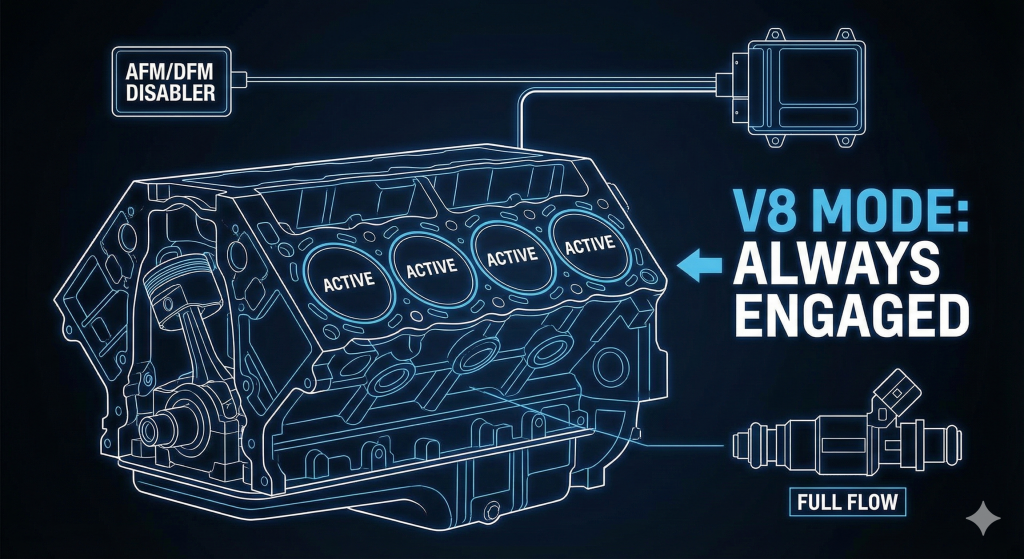
A full mechanical delete works — but it costs thousands, requires tearing the engine apart, and makes no sense unless the motor is already coming out.
A plug-and-play AFM/DFM disabler gives you:
- Immediate full-cylinder operation
- No permanent ECU changes
- No tuning required
- No engine teardown
- No learning curve
- Install in under 60 seconds
You plug it in.
Your engine stays in V8 mode.
You unplug it — you’re back to stock.
That’s it.
The AFM/DFM Disabler We Recommend (And Why)
Not all disablers are created equal.
The AFM/DFM Disabler (B0CTJNM7XQ) stands out because it’s:
- Designed specifically for GM AFM & DFM systems
- True plug-and-play OBD-II device
- No flashing, no tuning files, no laptop
- Leaves no permanent footprint when removed
- Works while driving — not just at startup
This is the kind of solution owners install and then forget about — because the truck simply drives better afterward.
What Owners Notice Immediately After Installing a Disabler
These are the most commonly reported changes:
Smoother driving
No more constant switching between cylinder modes.
Better throttle response
The truck feels more predictable and responsive.
Less vibration and hesitation
Especially at low speeds and light throttle.
Peace of mind
You’re no longer relying on fragile AFM/DFM lifters cycling hundreds of times per drive.
Some owners even report similar or slightly improved real-world MPG, depending on driving style — but that’s just a bonus.
The real win is reducing risk.
“But GM Fixed It, Right?” (Short Answer: No)
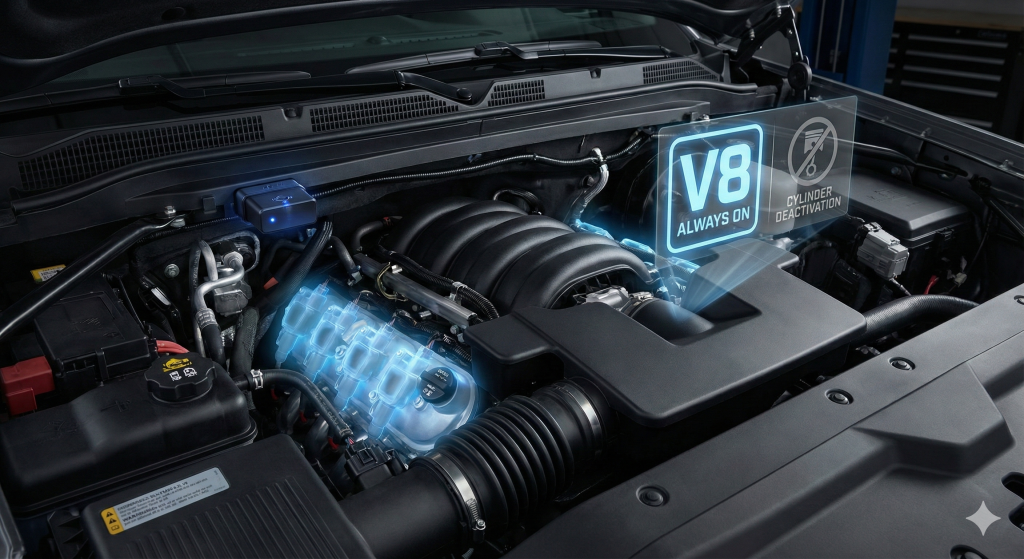
This is one of the most dangerous assumptions.
Yes, GM changed AFM.
Yes, GM introduced DFM.
Yes, GM refined the system.
But lifter failures still happen — even on newer trucks.
Ask any independent engine builder or GM technician off the record:
- AFM/DFM lifters are still a known failure point
- Disabling them early is cheaper than repairing them later
If the system were truly bulletproof, entire aftermarket companies wouldn’t exist just to disable it.
Cost Breakdown: Why This Is a No-Brainer
Let’s be real about the math:
- AFM/DFM disabler: ~$99
- Lifter + cam failure repair: $6,000–$12,000
- Full engine replacement: $10,000–$15,000+
Even if a disabler only reduces your risk, it pays for itself hundreds of times over.
This is not a performance mod.
This is cheap insurance.
Who Should Buy This Immediately
You should buy an AFM/DFM disabler now if:
- You plan to keep your GM truck long-term
- You’re out of warranty (or close)
- You tow, idle, or drive in stop-and-go traffic
- You’ve noticed ticking, hesitation, or odd shifts
- You simply don’t trust cylinder deactivation
Waiting does not improve your odds.
It only increases mileage on failure-prone components.
Final Verdict: Buy It Before You Regret It
If you’re serious about protecting your GM V8, the smartest move isn’t arguing on forums or hoping you’re “one of the lucky ones.”
It’s taking a simple, reversible step that thousands of owners already swear by.
Get the AFM/DFM Disabler here:
Install it once.
Drive with confidence.
And stop letting a fuel-economy gimmick decide the fate of your engine.
Reality Check: What Happens If You “Wait and See”
Most AFM/DFM failures don’t give you a warning light.
They don’t ask for permission.
And they don’t care how well you maintained your truck.
Here’s what usually happens in the real world:
- The truck drives perfectly fine… until it doesn’t
- A faint tick starts (or doesn’t)
- A lifter collapses suddenly
- The camshaft gets damaged
- Metal circulates through the engine
- What could’ve been prevented becomes a five-figure repair
By the time symptoms appear, it’s already too late.
An AFM/DFM disabler only works as prevention — not a cure.
Waiting for signs means you’ve already lost the advantage.
This is why experienced owners install one early, not after problems start.
AFM Disabler – Frequently Asked Questions
1. What is an AFM disabler?
An AFM disabler is a plug-and-play device that stops GM’s Active Fuel Management (AFM) or Dynamic Fuel Management (DFM) from turning off cylinders, keeping the engine in full-time V8 mode.
2. What does an AFM disabler do?
It prevents cylinder deactivation while driving, so the engine never switches between V8 and V4 (or partial cylinder modes).
3. Do AFM disablers really work?
Yes. When installed correctly, an AFM disabler reliably blocks AFM/DFM activation and keeps all cylinders firing.
4. Are AFM disablers safe?
Yes. Running a GM engine in full-cylinder mode is normal operation. AFM is for fuel economy—not engine survival.
5. Will an AFM disabler hurt my engine?
No. In fact, many owners install one to reduce stress on AFM lifters, which are a known weak point.
6. Is an AFM disabler worth it?
For most GM truck and SUV owners, yes. A ~$100 device can help reduce the risk of $6,000–$12,000 lifter and camshaft repairs.
7. What is AFM in a Chevy?
AFM (Active Fuel Management) is GM’s system that shuts off cylinders in Chevy vehicles to improve fuel economy during light driving.
8. What does AFM mean in cars?
AFM means the engine actively changes how many cylinders are firing based on driving conditions.
9. How does AFM work on GM engines?
AFM uses special hydraulic lifters and oil pressure to deactivate cylinders when cruising and reactivate them under load.
10. Which cylinders does AFM deactivate on a GM 6.2L V8?
AFM typically deactivates four cylinders, turning the engine into a V4 during light throttle conditions.
11. Do AFM disablers cause problems?
Quality AFM disablers do not cause engine problems. Cheap or poorly designed devices can cause warning lights, which is why buying a proven unit matters.
12. Does an AFM disabler affect fuel economy?
You may see a small MPG decrease, but many drivers report similar real-world mileage with much smoother driving.
13. What’s the difference between an AFM disabler and an AFM delete?
- AFM disabler: Plug-and-play, reversible, inexpensive
- AFM delete: Mechanical engine teardown, thousands of dollars
Most owners choose a disabler first.
14. Does an AFM disabler void warranty?
Because it does not flash or modify the ECU, it is far less risky than tuning. It can be unplugged at any time.
15. What is DFM and how is it different from AFM?
DFM (Dynamic Fuel Management) is a newer system that can deactivate different cylinder combinations dynamically instead of a fixed V4 mode.
16. Does an AFM disabler work on DFM engines?
Yes. Modern AFM/DFM disablers are designed to work on both AFM and DFM systems.
17. Can an AFM disabler fix lifter tick?
If damage already exists, no device can repair it. But installing one early can help prevent lifter issues from developing.
18. What years of GM engines should avoid AFM?
Many owners are cautious with 5.3L and 6.2L AFM-equipped engines, especially when planning long-term ownership.
19. Are AFM disablers better than tuning?
For most owners, yes. A disabler:
- Requires no tuning
- Leaves no permanent ECU changes
- Is reversible
- Takes under a minute to install
20. Why do so many GM owners buy AFM disablers?
Because AFM lifter failures are expensive, unpredictable, and common enough that preventative action makes sense.
Connect with us


