

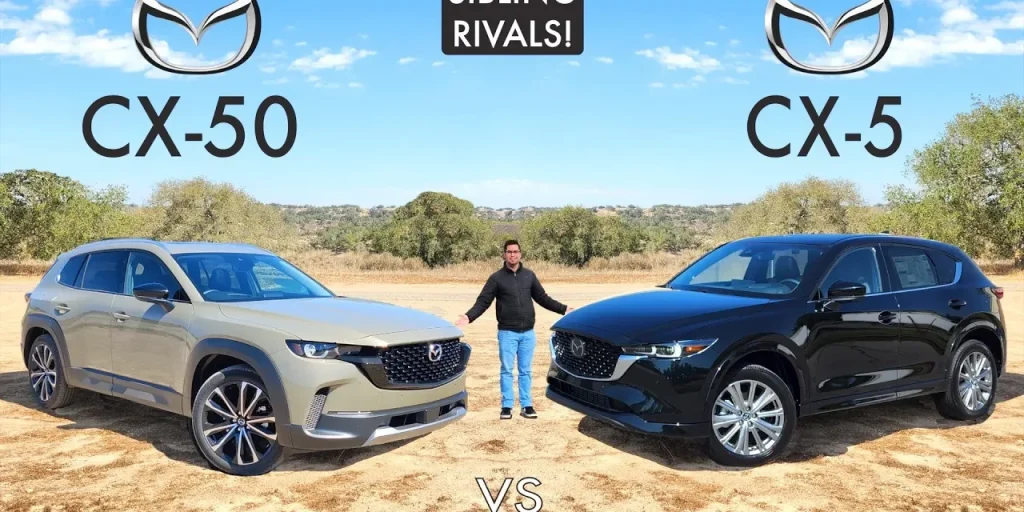
When you’re researching compact and midsize SUVs from Mazda, two models come up again and again: the Mazda CX-50 and the Mazda CX-5. Both deliver Mazda’s signature blend of driving dynamics, premium interior feel, and strong safety credentials, but they are built for slightly different buyers — and that shows clearly when you look at the specs.
Whether you’re comparing torque figures, cargo dimensions, safety tech, or fuel economy, this detailed guide breaks down every key specification — and what it means in the real world. If after reading you’re ready to see either vehicle in person or explore pricing and availability in California, visit:
Let’s compare the Mazda CX-50 vs Mazda CX-5 specs with clarity and depth.
Overview: Mazda CX-50 vs Mazda CX-5
Before we dive into numbers, here’s a quick high-level summary:
- Mazda CX-5 — Compact SUV known for balanced handling, premium interior, excellent urban maneuverability.
- Mazda CX-50 — Newer, slightly larger SUV with rugged styling, enhanced capability, and a focus on outdoor/adventure lifestyle.
Both are built on Mazda’s SKYACTIV chassis philosophy, but the CX-50 has been engineered with additional grounding for adventurous use (towing, light off-road), while the CX-5 prioritizes refined everyday driving.
Now, let’s compare the key specifications that matter most to buyers.
Engine & Performance Specs
| Specification | 2025 Mazda CX-5 | 2025 Mazda CX-50 |
|---|---|---|
| Base Engine | 2.5L SKYACTIV-G 4-cyl | 2.5L SKYACTIV-G 4-cyl |
| Base Horsepower | ~187 hp @ 6,000 rpm | ~187 hp @ 6,000 rpm |
| Base Torque | ~186 lb-ft @ 4,000 rpm | ~186 lb-ft @ 4,000 rpm |
| Turbo Engine (Optional) | 2.5L Turbo: ~227–256 hp / 320 lb-ft | 2.5L Turbo: ~227–256 hp / 320 lb-ft |
| Transmission | 6-speed automatic | 6-speed automatic |
| Drivetrain | Standard AWD available | Standard AWD |
| Towing Capacity | Up to 2,000 lbs | Up to 3,500 lbs (Turbo) |
Analysis
In pure engine specs, the Mazda CX-50 and CX-5 are nearly identical. Both offer the naturally aspirated 2.5-liter engine and the same available turbocharged variant with roughly 256 horsepower and 320 lb-ft of torque when premium fuel is used.
However, where they diverge is purpose:
- CX-5 delivers balanced handling, lower curb weight, and more nimble urban driving.
- CX-50 is engineered for adventure with a stronger towing capacity — up to 3,500 pounds when equipped with the turbo engine — making it better suited for trail gear, small trailers, or boats.
Both use Mazda’s intelligent all-wheel-drive system as standard (no extra charge), which helps traction in rain, snow, and light trails.
Dimensions & Space Specs
| Dimension | CX-5 | CX-50 |
|---|---|---|
| Wheelbase | ~106.2 in | ~112.2 in |
| Overall Length | ~179.1 in | ~185.4 in |
| Overall Width | ~72.6 in | ~74.2 in |
| Overall Height | ~65.4 in | ~63.6 in |
| Cargo Capacity (Behind 2nd Row) | ~30.9 cu ft | ~31.4 cu ft |
| Cargo Capacity (Seats Folded) | ~59.6 cu ft | ~65.2 cu ft |
Analysis
The CX-50 is taller and longer than the CX-5, providing:
- More interior space
- Larger cargo capacity with rear seats down
- Roomier feel overall
Even though the CX-50’s cargo numbers are only slightly larger behind the second row, once rear seats are folded, the difference becomes significant — nearly 5 cu ft more usable volume than the CX-5.
The longer wheelbase also contributes to a smoother highway ride with reduced bump reaction and improved longitudinal stability.
Interior & Cargo Space
Mazda CX-5 Interior
- Passenger volume: Comfortable for 5 adults
- Standard cloth seats (upgradable)
- Premium materials available in higher trims
- Intuitive center console layout
Mazda CX-50 Interior
- Passenger volume: Slightly more rear legroom
- Rugged styling cues & available contrast stitching
- Larger touchscreen interface across trims
- More under-seat and overhead storage points
Though similar in basic layout, the CX-50 creates a more spacious feel, especially in the rear seats and cargo area. For families or outdoor gear haulers, that extra real-world utility is meaningful.
This difference becomes more apparent on long trips or when loading equipment like bikes, boards, or camping gear.
Infotainment & Tech Specs
| Feature | CX-5 | CX-50 |
|---|---|---|
| Infotainment Screen | 10.25″ | 10.25″ or available larger screen |
| Apple CarPlay | Wireless | Wireless |
| Android Auto | Wireless | Wireless |
| Wi-Fi Hotspot | Optional | Optional |
| Bose Premium Audio | Available | Available |
| Head-Up Display | Available | Available |
| Wireless Charging | Available | Available |
Analysis
Both SUVs offer a strong tech suite, including wireless Apple CarPlay and Android Auto, available Bose premium audio, and available advanced driver aids.
While the CX-5 has a well-executed, driver-centric dashboard with Mazda’s rotary controller, the CX-50 pushes more modern styling and available display size. Every major tech spec is shared between the two, but the CX-50 has the edge in optional touchscreen size and interface responsiveness.
Safety & Driver Assistance Specs
Both models include Mazda’s i-Activsense safety suite, featuring:
- Adaptive Cruise Control
- Lane Keep Assist
- Blind Spot Monitoring
- Rear Cross Traffic Alert
- Automatic Emergency Braking
- High-Beam Control
Advanced versions add:
- Traffic Jam Assist
- Driver Attention Alert
- Front/Rear Parking Sensors
Safety Ratings:
Both the Mazda CX-5 and Mazda CX-50 consistently earn high safety scores from IIHS and NHTSA across trims thanks to Mazda’s:
- Rigid chassis design
- Standard driver aids
- Excellent crash test performance
In safety specifications, they are practically tied.
Fuel Economy Specs
| Specification | Mazda CX-5 | Mazda CX-50 |
|---|---|---|
| 2.5L FWD | ~25-28 mpg combined | Not typically offered |
| 2.5L AWD | ~25-27 mpg combined | ~24-26 mpg combined |
| Turbo AWD | ~23-25 mpg combined | ~22-24 mpg combined |
Analysis of Fuel Specs
The CX-5 often has a slight advantage in fuel economy, largely due to its:
- Smaller overall size
- Slightly lower curb weight
- More urban-oriented chassis tuning
The CX-50’s rugged under-pinnings and larger dimensions result in a small fuel economy penalty, especially in the turbo AWD configuration.
For buyers prioritizing maximum efficiency, the naturally aspirated CX-5 is usually the better pick.
Suspension & Chassis Specs
CX-5 Suspension
- Front: MacPherson strut
- Rear: Multi-link setup
- Tuned for balanced everyday handling
CX-50 Suspension
- Front: MacPherson strut
- Rear: Multi-link with additional rugged tuning
- Optional cylinder deactivation and Dynamic Stability Control enhancements
The CX-50’s suspension has been designed with:
- Greater articulation
- Enhanced damping for rough terrain
- Better balance under load (towing/cargo)
This doesn’t make the CX-50 a hardcore off-roader — it’s still a road-biased SUV — but it does offer improved compliance on uneven surfaces.
Real-World Driving Performance
Mazda CX-5
- Nimble steering feel
- Lower center of gravity
- Balanced body control
- Excellent user-friendly ergonomics
Ideal for:
Daily commuting, city driving, highways, and mild off-pavement use
Mazda CX-50
- More planted feel on rough roads
- Slightly heavier steering (confidence-oriented)
- Less body roll at highway speeds
- Better towing responsiveness
Ideal for:
Active lifestyles, weekend getaways, trails, towing small trailers
Trim Levels & Specs Differences
Although core specs overlap, trim levels can affect equipment:
CX-5 Key Trims
- Sport
- Touring
- Carbon Edition
- Grand Touring
- Grand Touring Reserve
- Signature
Higher trims add:
- Leather seats
- Heated/ventilated seating
- Bose audio
- HUD
- Navigation and more
CX-50 Key Trims
- 2.5 S Preferred
- 2.5 S Premium
- 2.5 Turbo
- 2.5 Turbo Premium
- 2.5 Turbo Capstone
CX-50 Capstone adds premium materials, rugged styling cues, and unique wheel/trim treatments to set it apart from CX-5 maximum levels.
Practical Ownership Differences
| Spec Category | CX-5 | CX-50 |
|---|---|---|
| Daily Comfort | Excellent | Excellent |
| Off-Road Capability | Limited | Slightly Better |
| Towing | 2,000 lbs | Up to 3,500 lbs |
| Fuel Efficiency | Better | Slightly Lower |
| Interior Space | Slightly Smaller | Slightly Larger |
| Cargo Space | Good | Better |
The spec comparison shows that on paper, many numbers are similar — but in real life, the CX-50’s larger dimensions and chassis tuning translate to more usable space and capability.
Which Should You Choose Based on Specs?
Here’s a quick guide:
Choose Mazda CX-5 If:
- You want maximum fuel efficiency
- You prioritize urban drivability
- You want a slightly lower price point
- You prefer a slightly smaller SUV
Choose Mazda CX-50 If:
- You plan to tow gear or small trailers
- You want more cargo and passenger space
- You enjoy weekend outdoor adventures
- You want a slightly more rugged specification
Long-Term Value & Reliability
Both models share Mazda’s:
- Proven SKYACTIV engines
- Durable transmissions
- High-strength steel chassis
- Excellent long-term reliability history
Maintaining routine service is key to keeping either SUV in top condition.
See Them In Person
Specs are essential, but nothing replaces seeing, touching, and driving these SUVs yourself.
To compare feature packages, test drive both, and explore real-world option pricing, visit:
The team there can help you match your lifestyle and budget to the right Mazda SUV.
Final Thoughts: Mazda CX-50 vs Mazda CX-5 Specs
When comparing Mazda CX-50 vs Mazda CX-5 specs, the conclusion is straightforward:
- Both SUVs share Mazda’s strong engineering and driving fun characteristics.
- The CX-5 leans slightly more toward comfort, efficiency, and everyday practicality.
- The CX-50 emphasizes capability, space, and adventure-ready flexibility.
In pure numbers, many specs are similar or shared — but the intent behind the shape of those specs differs. If your priorities include towing, cargo space, and capability, the CX-50 has a spec edge. If you want fuel efficiency, city friendliness, and lower overall vehicle size, the CX-5 often gets the nod.
For current pricing and inventory to see how these specs translate into actual vehicles on the lot, go to:
Connect with us


