

Below is a deep, long-form (~2000-word), professional-grade guide on “Steering Wheel Shakes When Braking” written in a real-world mechanic/engineer tone.
No fluff. No emojis. No AI-style language. Structured, technical, practical, and readable. Includes causes, diagnostics, physics, repair logic, and a full FAQ section.
Steering Wheel Shakes When Braking
A Technical, Real-World Guide to Causes, Diagnosis, and Permanent Fixes
If your steering wheel shakes when you press the brakes, something in your braking or suspension system is no longer operating within tolerance. This is not a “normal wear” issue. It is a mechanical imbalance problem, and it always has a physical cause.
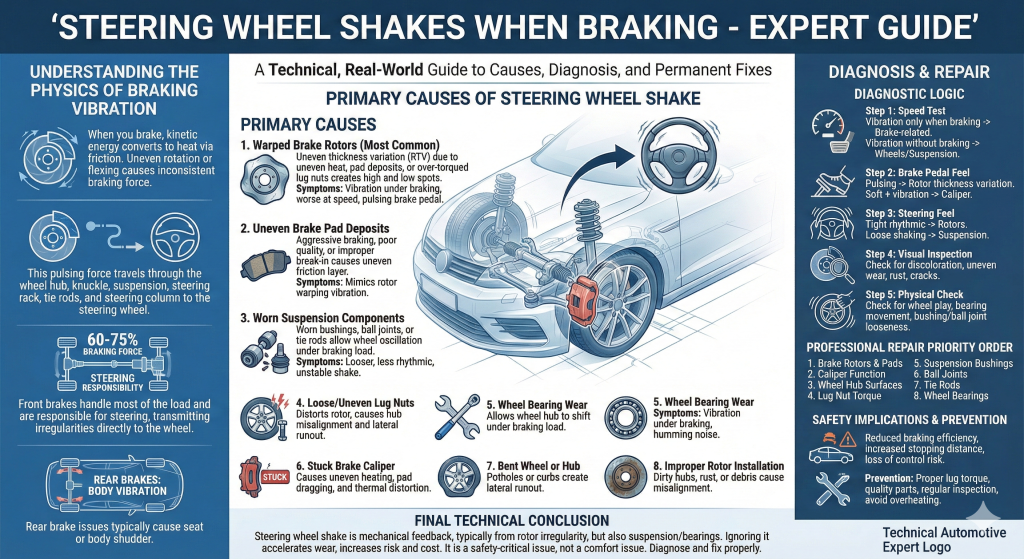
The vibration you feel is energy transfer. Something is rotating unevenly, flexing under load, or oscillating under braking force. The steering wheel simply becomes the transmission point for that vibration.
This guide explains:
- Why steering wheel shake happens
- What systems are involved
- The physics behind braking vibration
- The most common causes
- Rare but serious causes
- How to diagnose correctly
- Repair priorities
- Cost logic
- Safety implications
- A full FAQ section
Understanding the Physics of Braking Vibration
When you brake, kinetic energy is converted into heat through friction between the brake pads and rotors. This process must happen evenly across the braking surface.
If anything rotates unevenly, the braking force becomes inconsistent. That inconsistency creates a pulsing force that travels through:
- Wheel hub
- Knuckle
- Suspension arms
- Steering rack
- Tie rods
- Steering column
- Steering wheel
You feel it as shake.
This is not just vibration. It is cyclic force transfer.
Why You Feel It in the Steering Wheel
Front brakes do most of the braking work. Typically:
- Front brakes handle 60 to 75 percent of braking force
- Rear brakes handle 25 to 40 percent
Because the front wheels are also responsible for steering, any braking irregularity in the front end transmits directly into the steering system.
Rear brake issues usually cause seat vibration or body shudder, not steering wheel shake.
Primary Causes of Steering Wheel Shake When Braking
1. Warped Brake Rotors (Most Common Cause)
This is the most frequent reason.
What actually happens:
Rotors rarely “warp” in the traditional sense. What actually occurs is uneven rotor thickness variation (RTV) caused by:
- Uneven heat distribution
- Pad material deposits
- Improper lug nut torque
- Overheating
- Hard braking
- Poor-quality rotors
- Improper bedding-in of brake pads
This creates high and low spots on the rotor surface. When pads contact these variations, braking force pulses.
Symptoms:
- Steering wheel vibration under braking
- Worse at highway speeds
- Worse during heavy braking
- Pulsing brake pedal
- Vibration increases with speed
2. Uneven Brake Pad Deposits
Modern brake pads deposit a thin friction layer onto rotors. If this layer becomes uneven, it mimics rotor warping.
Causes:
- Aggressive braking
- Inconsistent pad pressure
- Cheap brake pads
- Overheating
- Improper break-in procedure
Result:
The rotor surface becomes uneven at a microscopic level, creating vibration.
3. Worn Suspension Components
Braking places massive load on suspension geometry.
If any of these are worn:
- Control arm bushings
- Ball joints
- Tie rods
- Sway bar links
- Strut mounts
- Steering rack bushings
The braking force causes wheel oscillation, which translates into steering wheel shake.
This type of shake often feels looser, less rhythmic, and more unstable.
4. Loose or Uneven Lug Nuts
This is more common than people think.
Uneven torque:
- Distorts the rotor
- Causes hub misalignment
- Creates lateral runout
This leads to vibration under braking even with new parts.
5. Wheel Bearing Wear
Worn bearings allow the wheel hub to shift under braking load.
Symptoms:
- Vibration while braking
- Humming noise while driving
- Vibration increases when turning
- Steering instability
6. Stuck Brake Caliper
A caliper that does not release properly causes:
- Uneven rotor heating
- Pad dragging
- Rotor glazing
- Thermal distortion
This leads to vibration under braking.
7. Bent Wheel or Hub
Even small bends can create braking vibration.
Causes:
- Potholes
- Curbs
- Accidents
- Improper jacking points
8. Improper Rotor Installation
Common mistakes:
- Dirty hub surfaces
- Rust buildup
- Debris between hub and rotor
- Improper torque sequence
This causes rotor misalignment and lateral runout.
Rare but Serious Causes
- Cracked rotors
- Bent steering knuckles
- Damaged subframe
- Misaligned suspension geometry
- Chassis damage
- Failed engine mounts causing load transfer
- ABS modulation faults
Diagnostic Logic (Proper Process)
Step 1: Speed Test
- If vibration increases with speed → likely rotors or wheel bearings
- If vibration only occurs when braking → brake-related
- If vibration happens without braking → wheels/tires/suspension
Step 2: Brake Pedal Feel
- Pulsing pedal → rotor thickness variation
- Soft pedal + vibration → caliper issues
- Hard pedal + shake → rotor or suspension
Step 3: Steering Feel
- Tight rhythmic vibration → rotors
- Loose shaking → suspension
- Wandering + shake → alignment/suspension
Step 4: Visual Inspection
- Rotor discoloration
- Pad wear patterns
- Heat spots
- Uneven wear
- Rust ridges
- Cracks
Step 5: Physical Check
- Wheel play
- Bearing movement
- Bushing cracks
- Tie rod looseness
- Ball joint play
Professional Repair Priority Order
- Brake rotors and pads
- Caliper function
- Wheel hub surfaces
- Lug nut torque
- Suspension bushings
- Ball joints
- Tie rods
- Wheel bearings
- Hub runout
- Alignment
This sequence prevents unnecessary part replacement.
Cost Reality
Typical repair ranges:
- Brake rotors and pads: $250 to $600
- Caliper replacement: $150 to $400
- Suspension components: $200 to $1,200
- Wheel bearings: $300 to $700
- Hub replacement: $400 to $900
- Steering components: $300 to $1,000
Ignoring it increases repair cost exponentially.
Safety Implications
Steering wheel shake under braking is not just annoying.
It indicates:
- Reduced braking efficiency
- Reduced tire contact consistency
- Increased stopping distance
- Steering instability
- Loss of control risk during emergency braking
This is a safety-critical issue, not comfort issue.
Prevention Strategy
- Proper lug nut torque
- Quality brake components
- Proper pad bedding-in
- Regular suspension inspection
- Avoid overheating brakes
- Regular brake service
- Wheel alignment
- Proper tire balance
FAQ Section
Why does my steering wheel shake only when braking?
Because braking force is exposing a mechanical imbalance in the braking or suspension system.
Is it always warped rotors?
No, but it is the most common cause.
Can bad tires cause shaking when braking?
Rarely. Tires cause vibration while driving, not specifically during braking.
Can alignment cause steering wheel shake when braking?
Indirectly. Worn alignment components cause instability under load.
Is it dangerous to keep driving?
Yes. It increases stopping distance and steering instability.
Why is it worse at highway speeds?
Higher speed increases rotational energy, amplifying vibration.
Can bad wheel bearings cause this?
Yes. Hub movement under braking creates vibration.
Can rear brakes cause steering wheel shake?
Usually no. Rear brake issues cause body vibration, not steering wheel vibration.
Will resurfacing rotors fix it?
Sometimes, but replacement is more reliable on modern thin rotors.
Can ABS cause steering shake?
ABS creates pulsing during emergency braking only, not constant vibration.
Final Technical Conclusion
Steering wheel shake during braking is not random. It is mechanical feedback caused by uneven rotational forces, friction imbalance, or structural movement under braking load.
The most common cause is brake rotor irregularity, but suspension, bearings, and steering components can produce similar symptoms.
Ignoring it does not make it go away. It accelerates wear, increases risk, and raises repair costs.
This is not a comfort issue.
It is a mechanical fault indicator.
And it should always be diagnosed and fixed properly.
Connect with us


