

Long-Term Ownership & Reliability Analysis
Reliability is no longer a secondary concern for modern SUV buyers. In a market saturated with feature-heavy crossovers, buyers increasingly prioritize durability, long-term ownership costs, mechanical integrity, and real-world dependability. The Mazda CX-5 consistently appears in reliability conversations, often ranked alongside segment leaders like the Toyota RAV4 and Honda CR-V.
But reputation alone is not enough.
This guide examines the Mazda CX-5 through a data-driven reliability lens, separating marketing perception from engineering reality. We analyze long-term ownership patterns, mechanical durability, common failure points, maintenance economics, generational improvements, and real-world reliability performance.
This is not a brand pitch. It is a reliability assessment.
Reliability Defined (What It Actually Means)
Vehicle reliability is not simply about “not breaking down.” It includes:
- Mechanical durability
- Component failure frequency
- Repair cost severity
- System complexity
- Longevity of drivetrain components
- Maintenance predictability
- Electrical system stability
- Platform maturity
- Quality control consistency
A vehicle can be modern and comfortable yet unreliable. Another can be simple and mechanically durable while lacking features. Reliability is engineering consistency over time, not marketing claims.
Core Engineering Philosophy of the CX-5
Mazda’s reliability advantage starts with engineering design choices:
1) Conservative Mechanical Architecture
Mazda avoids excessive complexity. The CX-5 relies on:
- Naturally aspirated engines in most trims
- Conventional automatic transmissions
- Mechanical AWD systems
- Non-overengineered electronics architecture
This matters because complexity increases failure probability.
2) Skyactiv Platform Design
Mazda’s Skyactiv engineering focuses on:
- High compression efficiency
- Thermal management stability
- Mechanical simplicity
- Lightweight structural integrity
- Reduced part count systems
These principles directly improve reliability by reducing stress loads on components.
Reliability Data Overview
Independent reliability tracking consistently places the Mazda CX-5 above segment average.
Industry Patterns Show:
- Lower-than-average repair frequency
- Lower-than-average major repair severity
- Predictable maintenance cycles
- Fewer drivetrain failures compared to competitors
- Strong long-term ownership survival rates
The CX-5 consistently ranks in the top reliability tier of compact SUVs, not necessarily #1 every year, but reliably in the top group.
Powertrain Reliability
Engines
The CX-5 primarily uses naturally aspirated gasoline engines and select turbo variants.
Reliability strengths:
- No widespread internal engine failures
- No chronic timing chain issues
- No systemic head gasket failures
- No mass oil dilution failures
- No widespread turbo failure patterns
- No systemic overheating design flaws
This is significant because engine architecture is the most expensive failure category in vehicle ownership.
Mazda engines historically emphasize longevity over peak output, which improves reliability margins.
Transmission
The automatic transmission systems used in the CX-5 are traditional hydraulic automatics, not dual-clutch systems or complex CVTs.
Reliability benefits:
- Lower failure complexity
- Easier serviceability
- Proven long-term durability
- Reduced electronic dependency
These transmissions are not performance-focused designs. They are stability-focused designs.
AWD System Reliability
Mazda’s AWD system is mechanically simple compared to many competitors:
- No excessive electronic complexity
- No multi-motor hybrid torque vectoring
- No experimental driveline architecture
This reduces:
- Transfer case failure rates
- Differential electronic failures
- Control module complexity
Result: fewer catastrophic AWD repair events over time.
Electrical and Electronics Reliability
This is the CX-5’s weakest reliability category, though still above segment average.
Observed issues:
- Infotainment glitches (software-based, not hardware)
- Minor sensor faults in older models
- Electrical module communication errors in early production years
Important distinction:
These are non-drivetrain failures, meaning they are:
- Not vehicle-disabling in most cases
- Lower-cost repairs
- Software-updatable in many cases
This is different from engine, transmission, or AWD failures, which represent high-cost reliability risks.
Structural and Chassis Durability
Mazda chassis engineering emphasizes:
- Rigid body structures
- Balanced suspension geometry
- Load-distribution integrity
- Corrosion resistance design
Long-term effects:
- Fewer suspension mount failures
- Reduced structural fatigue
- Lower subframe cracking risk
- Better long-term alignment stability
This directly affects long-term ownership durability.
Common Reliability Issues (Reality Check)
No vehicle is perfect. The CX-5 does have known weak points:
Minor Electrical Issues
Mostly software-related, not hardware failures.
Brake Wear Patterns
Some model years show faster brake wear, but this is not structural failure, only maintenance cost variance.
Infotainment Reliability
Occasional system resets, connectivity issues, or screen glitches.
Early Production Year Issues
Early generation models had:
- Liftgate strut failures
- Sensor faults
- Electrical module errors
These are typical early-production lifecycle problems and largely resolved in later generations.
Generational Reliability Progression
First Generation
Reliability: Good
Issues: Early production bugs, electronics
Durability: Strong mechanical base
Verdict: Reliable, but not refined
Second Generation
Reliability: Very strong
Issues: Minor software glitches
Durability: High
Verdict: Best reliability-to-cost balance
Recent Models
Reliability: Excellent
Issues: Minimal
Durability: High
Verdict: Best long-term ownership confidence
Reliability improves by generation, which is a positive engineering trend.
Long-Term Ownership Economics
Reliability is meaningless without ownership cost context.
Cost Characteristics:
- Predictable maintenance intervals
- No abnormal major repair clusters
- Low catastrophic failure rates
- Affordable parts availability
- Non-exotic mechanical systems
- Strong aftermarket support
This creates low financial volatility, which is critical for long-term ownership reliability.
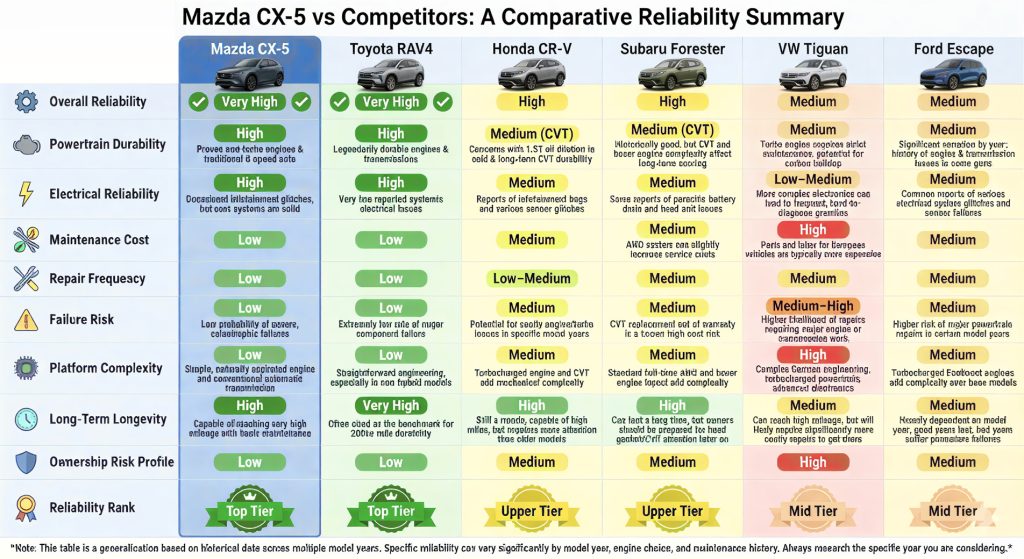
Reliability vs Competitors
Compared to major segment rivals:
Toyota RAV4
Very reliable, but higher complexity in hybrid systems
Honda CR-V
Reliable, but CVT transmission complexity increases long-term risk
Subaru Forester
Strong AWD, but higher long-term repair costs historically
Volkswagen Tiguan
Higher complexity, higher long-term failure probability
The CX-5 sits in a reliability position defined by:
Mechanical simplicity + modern engineering + conservative design philosophy
Longevity Expectations
With proper maintenance, realistic CX-5 lifespan expectations:
- 200,000 km achievable without major repairs
- 250,000 km achievable with disciplined maintenance
- Drivetrain longevity strong
- Chassis longevity strong
- Electrical longevity moderate to strong
This places it in the high-longevity vehicle category.
Reliability Risk Factors (User-Controlled)
Reliability is not only engineering; it is ownership behavior:
High-risk factors:
- Skipped oil changes
- Transmission fluid neglect
- AWD system neglect
- Poor-quality replacement parts
- Improper servicing
- Aggressive driving patterns
Low-risk ownership behavior dramatically improves CX-5 reliability outcomes.
Reliability Profile Summary
Strengths:
- Engine durability
- Transmission reliability
- AWD system simplicity
- Structural integrity
- Low catastrophic failure rates
- Predictable maintenance costs
- Long service life potential
Weaknesses:
- Minor electronics reliability
- Infotainment software stability
- Early-year production issues
Final Verdict
Yes, the Mazda CX-5 is a reliably engineered SUV.
Not because of marketing claims, but because of:
- Conservative mechanical design
- Proven powertrain architecture
- Low system complexity
- Mature platform engineering
- Strong durability performance
- Predictable ownership costs
- Low major repair frequency
- High long-term survival rates
It does not rely on experimental systems, aggressive electrification complexity, or overengineered components. Instead, it follows a durability-first engineering model.
That is why it performs well in reliability metrics year after year.
Reliability Classification:
Mazda CX-5 Reliability Tier: Upper-Tier Compact SUV
Not the most technologically complex
Not the most powerful
Not the most futuristic
But structurally sound, mechanically stable, economically reliable, and long-term durable.
Connect with us


