

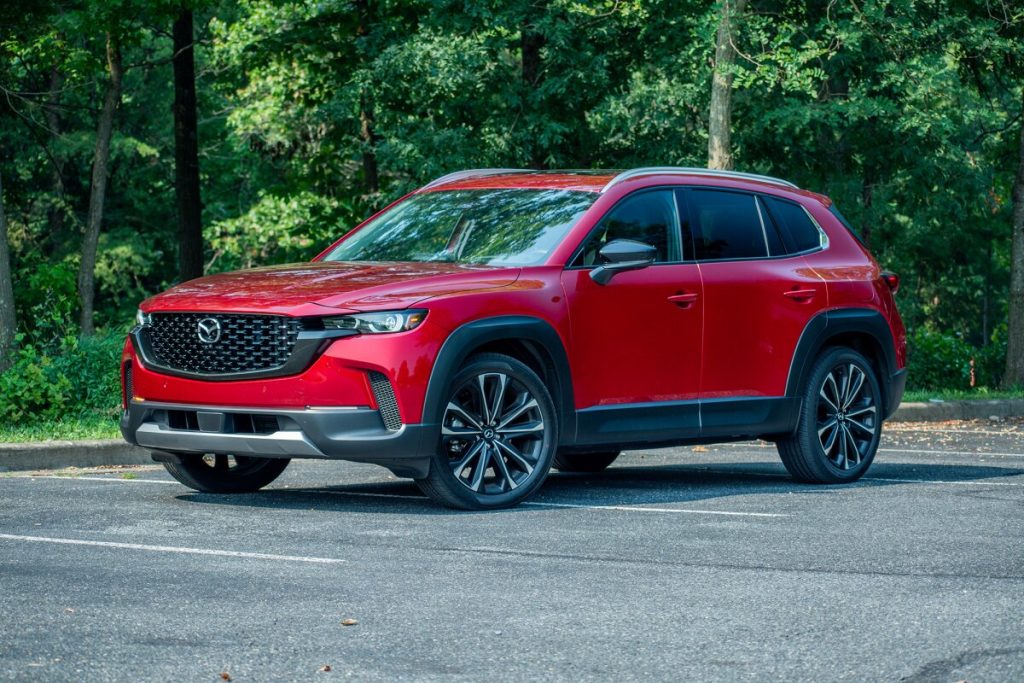
Real-World Winter Performance, Traction Systems, and Cold-Weather Capability
The Mazda CX-50 was engineered with a more rugged, outdoors-oriented identity than the CX-5, and winter performance is a major part of that design philosophy. Snow, ice, slush, and freezing temperatures place extreme demands on drivetrain systems, traction control logic, suspension geometry, and tire contact patches. For buyers in cold climates, the real question is not styling or features, but capability:
How well does the Mazda CX-50 actually perform in snow?
This guide breaks down the CX-50’s winter performance from a mechanical, systems, and real-world usability perspective.
Standard All-Wheel Drive: A Major Advantage
Unlike many compact SUVs that offer AWD as an option, the Mazda CX-50 comes standard with i-Activ All-Wheel Drive on all trims. This is a significant advantage for winter driving.
Mazda’s AWD system is not reactive only after wheelspin occurs. It uses predictive logic based on:
- Wheel speed sensors
- Throttle position
- Steering input
- Vehicle yaw
- Outside temperature
- Road condition estimation
The system continuously calculates traction availability and proactively distributes torque to the wheels with the most grip. This means that on snowy surfaces, torque is already being redirected before visible wheelspin occurs, improving stability, launch control, and directional confidence.
This type of AWD logic is particularly effective in:
- Slushy intersections
- Snow-packed residential roads
- Icy inclines
- Wet snow transitions
- Mixed-surface driving (dry patches + snow patches)
Mi-Drive and Snow Conditions
The Mazda CX-50 features Mi-Drive (Mazda Intelligent Drive Select), which includes multiple driving modes:
- Normal
- Sport
- Off-Road
- Towing (on turbo models)
While Mazda does not label a specific “Snow Mode,” the Off-Road Mode is designed for low-traction surfaces and uneven terrain. In snowy conditions, this mode alters:
- Throttle sensitivity
- Traction control intervention thresholds
- Torque delivery behavior
- Wheelspin tolerance at low speeds
This allows controlled wheelspin when needed for momentum in deep snow while still maintaining overall stability. It is particularly useful in:
- Unplowed roads
- Driveways
- Snowbanks
- Deep accumulation zones
- Rural winter driving
For normal city snow driving, the standard AWD system and traction control are usually sufficient without needing Off-Road Mode.
Ground Clearance and Snow Mobility
The CX-50 offers higher ground clearance than many compact SUVs, which directly improves snow performance.
Higher clearance helps with:
- Snowbank navigation
- Unplowed side roads
- Packed snow buildup
- Avoiding underbody drag
- Maintaining mobility in deeper accumulation
This makes the CX-50 more capable in environments where snow depth becomes a physical obstacle, not just a traction issue.
Stability and Chassis Behavior on Snow
Mazda’s chassis tuning prioritizes balance and predictability rather than aggressive torque delivery. In winter conditions, this translates into:
- Smooth weight transfer
- Predictable cornering behavior
- Controlled throttle modulation
- Stable steering response
- Reduced overcorrection tendencies
The CX-50 does not feel abrupt or twitchy in low-traction conditions. Traction control intervention is progressive, not harsh, which improves driver confidence on slippery surfaces.
This is especially noticeable during:
- Lane changes on snow
- Highway merges in winter
- Corner exits on icy roads
- Mixed-traction surfaces
Braking and Control in Winter Conditions
It is important to understand a core winter driving principle:
AWD improves traction and acceleration — not braking.
The CX-50’s braking performance in snow is determined primarily by:
- Tire compound
- Tire tread design
- Road surface
- ABS calibration
- Driver input
The vehicle’s stability control and ABS systems help maintain directional control during braking, but stopping distance is dominated by tire grip. This is true for all vehicles, regardless of drivetrain.
Tire Choice: The Most Important Factor
No AWD system can compensate for poor tires in winter.
For the CX-50, winter performance improves dramatically with:
- Dedicated winter tires
- Snow-rated compounds
- Cold-temperature rubber formulations
- Aggressive winter tread patterns
With winter tires:
- Braking distance improves significantly
- Cornering stability increases
- Ice traction improves
- Control during emergency maneuvers improves
- Confidence on hills improves
With all-season tires:
- AWD helps with movement
- Stability is reduced
- Braking distances increase
- Ice traction is limited
For true winter capability, winter tires are essential.
Real-World Snow Use Cases
Urban Winter Driving
The CX-50 performs very well in:
- Slushy intersections
- Snow-covered side streets
- Urban plowing conditions
- Wet snow accumulation
- Stop-and-go winter traffic
AWD engagement is smooth and unobtrusive.
Highway Winter Driving
Stability at speed is strong, especially in:
- Snow-packed highways
- Wind-blown snow
- Mixed-traction surfaces
- Black ice conditions
Traction control and AWD work together to maintain composure.
Rural and Unplowed Conditions
The CX-50 shows its strongest advantage in:
- Gravel-snow mixed roads
- Unplowed areas
- Driveways
- Backroads
- Cottage roads
- Trails and access roads
Ground clearance + AWD + Off-Road Mode combine for practical winter mobility.
Limitations in Severe Winter Conditions
No vehicle is immune to physics. The CX-50 still faces limitations in:
- Deep unplowed snow beyond ground clearance
- Ice without proper tires
- Extreme freezing rain
- Heavy snowdrifts
- Severe blizzard conditions
AWD helps with movement, not stopping. Tires determine grip. Clearance determines mobility.
Comfort and Usability in Winter
Winter driving is not only about traction. The CX-50 also offers winter usability features such as:
- Heated seats
- Heated steering wheel (select trims)
- Remote start capability
- Efficient cabin heating
- Defrosting systems
- Visibility enhancements
These improve winter driving comfort and practicality but do not affect traction directly.
Who the CX-50 Is Best For in Snow
The Mazda CX-50 is well-suited for drivers who:
- Live in snow-prone regions
- Drive in mixed urban and rural winter environments
- Want standard AWD without trim restrictions
- Prefer predictive traction systems
- Value stability over aggressive performance
- Use proper winter tires
- Need moderate off-road winter mobility
Final Verdict
The Mazda CX-50 is highly capable in snow.
It delivers strong winter performance through:
- Standard i-Activ AWD
- Predictive torque distribution
- Traction and stability control integration
- Available Off-Road drive mode
- Increased ground clearance
- Balanced chassis tuning
While it does not use a labeled “Snow Mode” button, the CX-50 achieves the functional effect of snow mode automatically through its drivetrain and traction systems.
With proper winter tires, the CX-50 becomes a confident, stable, and capable winter vehicle suitable for urban snow, highway winter driving, and moderate off-road winter conditions.
It is not marketed as a hardcore winter truck or extreme off-road SUV, but as a compact SUV, its snow performance is above average, well-engineered, and confidence-inspiring.
Connect with us


