

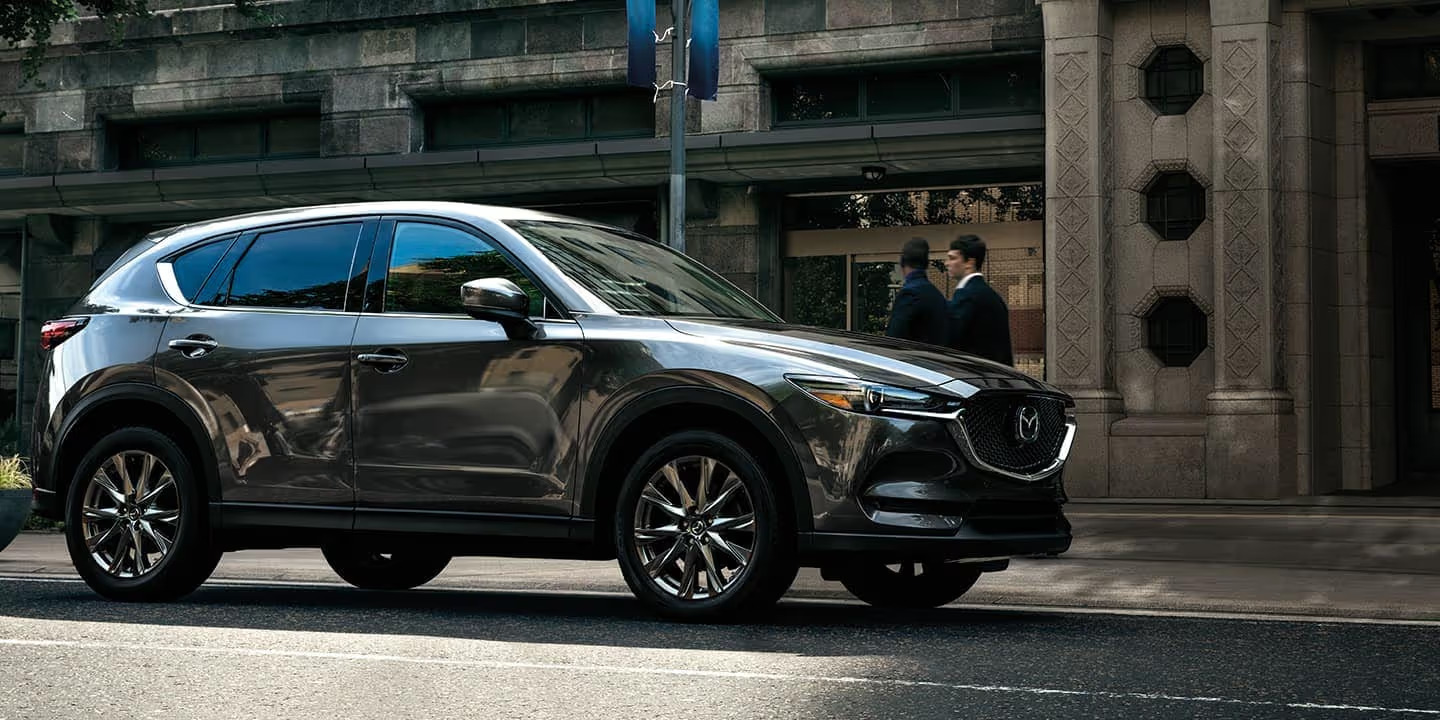
When it comes to compact SUVs, fuel efficiency is a top consideration for California drivers. The Mazda CX‑5 has long been a standout in the segment for its refined handling and premium design — but how does it hold up at the gas pump?
In this guide, Marin Mazda breaks down the official EPA fuel economy ratings of the 2025 CX‑5, compares them to real-world driver reports, and explores what you can expect depending on your driving habits and engine choice.
Official EPA MPG Ratings (2025 Mazda CX‑5)
| Engine Type | Drivetrain | MPG (City/Highway/Combined) |
|---|---|---|
| 2.5L I4 (non-turbo) | AWD | 25 / 31 / 28 |
| 2.5L Turbocharged I4 | AWD | 22 / 27 / 24 |
Since all 2025 Mazda CX‑5 models now come standard with all-wheel drive, the EPA ratings reflect that drivetrain. The naturally aspirated (non-turbo) engine offers stronger fuel economy across the board, especially for city commuters.
Real-World MPG: What Drivers Actually Report
While EPA numbers provide a baseline, actual mileage depends on driving style, terrain, and climate. Based on owner reviews and third-party testing:
- 2.5L Non-Turbo Models: Drivers often report 26–30 MPG combined, which aligns closely with EPA estimates. In city-heavy traffic, mileage may drop closer to 23–24 MPG, while highway travel at steady speeds can yield 30–32 MPG.
- 2.5L Turbo Models: Owners frequently average 21–25 MPG combined, particularly if they drive more aggressively or use premium fuel (recommended for full performance). Urban MPG tends to be slightly lower than EPA, especially with spirited driving.
Fuel Economy vs. Performance: A Trade-Off
The CX‑5’s turbocharged engine delivers 227 hp (regular fuel) and 256 hp (premium fuel), making it one of the quickest SUVs in its class. However, this added power comes with a fuel economy trade-off. For buyers who prioritize acceleration or plan to tow, the turbo is well worth it — but fuel-conscious drivers may prefer the base engine.
How the CX‑5 Compares to Competitors
| Model | Drivetrain | MPG (Combined) |
|---|---|---|
| Mazda CX‑5 (2.5L NA AWD) | AWD | 28 |
| Honda CR-V (1.5T AWD) | AWD | 30 |
| Toyota RAV4 (2.5L AWD) | AWD | 30 |
| Subaru Forester (2.5L AWD) | AWD | 29 |
The CX‑5 trails slightly behind the RAV4 and CR-V in fuel economy, but it compensates with a more engaging driving experience and a more upscale interior. For drivers willing to trade a few MPG for comfort and dynamics, it’s a strong contender.
How to Maximize Fuel Efficiency in Your CX‑5
Here are a few ways to get the best fuel economy from your Mazda CX‑5:
- Use the correct tire pressure (underinflation reduces MPG)
- Drive in Normal Mode (Sport mode increases RPMs and fuel usage)
- Avoid aggressive acceleration
- Keep up with oil changes and air filter replacements
- Use premium fuel only if driving a turbo model and aiming for full horsepower
Is the Mazda CX‑5 a Fuel-Efficient SUV?
Yes — especially for drivers seeking a balance between power, comfort, and fuel economy. While it’s not the absolute leader in MPG, the CX‑5’s refinement, AWD standardization, and real-world reliability make it an efficient and enjoyable daily driver in California traffic and beyond.
See the 2025 Mazda CX‑5 at Marin Mazda
Want to experience the CX‑5’s efficiency for yourself? Visit us for a test drive and explore our available trim levels, turbo options, and financing incentives.
Marin Mazda
807 Francisco Blvd E, San Rafael, CA 94901
Phone: (415) 454‑7000
Browse our latest inventory at www.marinmazda.net


