

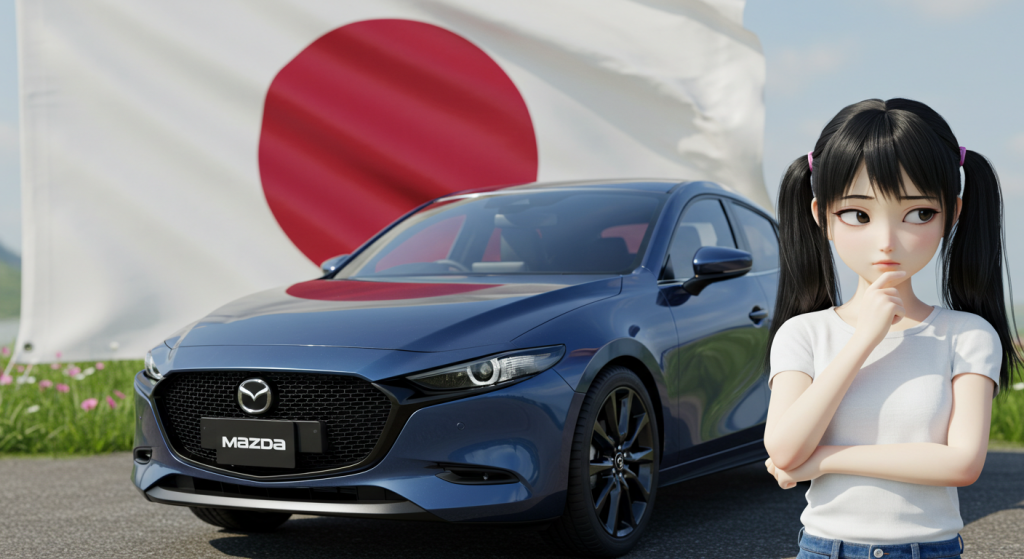
When you search “Is Mazda Japanese?” you’re really asking about more than geography — you’re exploring how a carmaker’s culture, craft, and philosophy shape every vehicle it builds
Mazda’s story is unmistakably Japanese, from its origins in Hiroshima nearly a century ago to the Jinba Ittai driving spirit that lives in every modern CX-5, CX-50, or MX-5 Miata.
And if you’re curious how that legacy translates into the SUVs and crossovers available today, you can explore current models and specials right now at Marin Mazda — a dealership that brings this proud heritage to local drivers every day.
Mazda may build some cars abroad, but its soul has never left Japan. From meticulous design studios in Hiroshima to cutting-edge research labs in Yokohama, the brand blends craft, technology, and emotion in a uniquely Japanese way. Whether you’re drawn to the sculpted curves of a CX-90 or the effortless efficiency of the CX-30, you can see how this Japanese DNA comes alive in every offer listed on Marin Mazda’s specials page.
A Brief History of Mazda’s Japanese Roots
Mazda began in 1920 as the Toyo Cork Kogyo Company in Hiroshima, producing industrial goods before turning to vehicles in 1931 with the tiny three-wheeled “Mazda-Go.” The brand’s very name came from Ahura Mazda — a symbol of wisdom and harmony — and its founders’ desire to unite practical engineering with spiritual balance.
Over the decades, Mazda endured wartime destruction, rebuilt alongside Hiroshima’s renaissance, and rose to international prominence through innovation. By 1967 it became one of the few automakers in the world to master the rotary engine, an icon of Japanese engineering daring.
The Japanese Philosophy Behind Every Mazda
Mazda’s designers often speak of “KODO — Soul of Motion.” This design philosophy captures the grace of living movement, inspired by calligraphy, martial arts, and the quiet discipline found throughout Japanese culture. Look at a Mazda’s body line: it’s meant to feel alive, not just aerodynamic.
Equally integral is Jinba Ittai, the horse-and-rider unity that guides Mazda’s chassis tuning and steering response. Engineers spend years perfecting how a driver’s smallest input translates into motion — an ethos rooted in centuries of Japanese craftsmanship, where harmony matters more than brute force.
Inside, Mazda cabins embody “Takumi” artisan quality — minimalist, tactile, and centered around balance. Every stitch and switch placement reflects the Japanese concept of omotenashi: hospitality that anticipates your needs.
Japanese Engineering Meets Global Production
Though unmistakably Japanese in spirit, Mazda now operates worldwide. Manufacturing plants exist in Japan, Mexico, China, Thailand, and the United States. Yet all major engineering development, powertrain design, and final quality benchmarks still originate in Japan.
- Headquarters: Hiroshima, Japan
- Primary R&D centers: Hiroshima and Yokohama
- Design centers: Hiroshima and Irvine, California (for regional input)
- Production plants: Japan (Hiroshima & Yamaguchi) plus global partners
Every new model — from the latest CX-70 Hybrid to the upcoming electric line — passes through Hiroshima’s proving grounds before release. That means whether your Mazda is assembled in Alabama or Hofu, it’s built to Japanese specifications, reflecting Mazda’s uncompromising standards.
Cultural DNA in Modern Mazdas
Mazda’s attention to detail mirrors Japanese arts like pottery and woodworking: mastery through repetition and humility before the craft. Designers use clay modeling by hand, even in the age of digital simulation, believing touch reveals subtleties machines can’t replicate.
Lighting design follows ma — the Japanese sense of space and timing — ensuring every headlamp and cabin reflection feels calm rather than flashy. Paintwork employs proprietary Takuminuri layering, hand-polished to mirror-grade smoothness. It’s not marketing — it’s modern Japanese artistry on four wheels.
The Hiroshima Influence
Mazda’s headquarters remain in Hiroshima — a city that symbolizes resilience and reinvention. After 1945, Mazda helped revive the region’s industry, exporting vehicles that would later introduce Japan’s craftsmanship to the world. That spirit of endurance still defines Mazda’s culture: thoughtful progress, human empathy, and quiet pride.
Every engineer who trains at Hiroshima’s proving grounds absorbs this mindset. Many executives describe it as “a responsibility to represent Japanese precision with warmth.” It’s a national identity translated into motion.
Global Recognition of Japanese Quality
Reviewers consistently note that Mazda cars feel more premium than their price suggests. That refinement comes from Japanese manufacturing discipline — obsessive attention to tolerances and the Kaizen approach of constant improvement.
Even small details, like the click of a climate-control dial or the soft detent of a gear selector, are tuned by sound engineers to convey confidence and serenity — qualities deeply rooted in Japanese aesthetics.
When you step into a Mazda showroom or visit your local dealer, that quiet excellence is evident. To experience it firsthand, browse the current Japanese-crafted SUVs and crossovers featured on Marin Mazda’s specials page.
Japanese Innovation: Rotary Engines to Skyactiv Technology
Mazda’s reputation for bold engineering choices began with the rotary engine — lightweight, compact, and remarkably smooth. Though rotary production paused in 2012, the spirit of experimentation lived on in Skyactiv Technology, a suite of powertrain and chassis innovations focused on real-world efficiency.
Skyactiv engines achieve higher compression ratios without sacrificing drivability — a nod to Japan’s obsession with harmony between mechanical systems and nature’s laws. Pair that with Mazda’s responsive steering and the result is efficiency without numbness.
Newer systems like Skyactiv-X and Mazda’s hybrid collaborations continue this Japanese-led pursuit of balance — power meeting responsibility, emotion meeting intellect.
Design Language as Cultural Expression
Where other brands use sharp creases and loud surfaces, Mazda prefers restraint. Its designers often describe each model as a living creature poised in motion. The subtle curvature of a CX-5’s fender or MX-5’s hood is intentional — capturing fleeting beauty, much like brushstrokes in Japanese ink painting.
Inside, horizontal layouts and natural textures evoke shibui: understated elegance. Every Mazda aims to calm rather than overwhelm — a design language born of Japanese serenity, not Western excess.
Mazda in North America: A Bridge Between Cultures
While Mazda remains proudly Japanese, its American operations in Irvine, California and its new joint factory in Huntsville, Alabama demonstrate how a Japanese ethos can thrive globally. North American engineers adapt suspension tuning and climate performance for local roads, but the emotional core still traces back to Hiroshima.
That’s why enthusiasts describe Mazdas as “driver’s cars” — they blend Japanese precision with Western practicality. The result: vehicles that feel universal yet unmistakably Japanese at their core.
If you’re in California and curious to see this philosophy in metal, you can schedule a test drive or review current offers directly through Marin Mazda’s specials section.
The Future of a Japanese Icon
Mazda’s next chapter remains rooted in Japan even as it goes electric. The upcoming generations of Skyactiv-EV and Skyactiv-Hybrid powertrains are being developed in Hiroshima with help from Japanese suppliers and universities. These will gradually appear across models like the CX-70 PHEV and the CX-90 Plug-in Hybrid, marrying traditional driving feel with sustainable performance.
Mazda’s leaders describe this shift as “engineering with a Japanese conscience” — progress that respects nature while honoring craftsmanship. The company’s new sustainability goals aim for full carbon neutrality by 2050, guided by the same cultural integrity that’s shaped it since 1920.
Why Mazda Still Feels Uniquely Japanese
Even as globalization blurs borders, Mazda stands out for how deeply Japanese its mindset remains:
- Harmony over haste — Every decision balances efficiency, beauty, and emotion.
- Craftsmanship as identity — Real humans refine what machines build.
- Respect for environment and people — Design follows empathy.
- Perfection through imperfection — The Japanese idea of wabi-sabi informs Mazda’s minimalist interiors and natural materials.
- Continuous self-improvement — The Kaizen philosophy ensures no detail is ever final.
This isn’t corporate branding — it’s cultural continuity.
The Answer: Yes, Mazda Is Japanese — and Proudly So
Mazda is as Japanese as the artistry that inspired it. Its cars are global, its assembly may span continents, but its spirit, discipline, and emotional depth are born of Japan. Every curve, engine note, and ergonomic detail reflects the country that built it — precise yet poetic, efficient yet soulful.
And if you’d like to feel that spirit for yourself, explore the latest lineup inspired by Japanese engineering at Marin Mazda. Whether you’re considering a CX-30, CX-50 Hybrid, or the flagship CX-90, each one carries Hiroshima’s heart in its chassis and craftsmanship in its stitching.
Conclusion: Japan’s Gift to the Road
So, is Mazda Japanese? Absolutely — not just by birth, but by belief. It’s a company that proves technology can coexist with humanity, and precision can express emotion. Mazda’s story is the story of Japan itself: disciplined, inventive, quietly confident.
From the hand-formed fenders to the carefully tuned steering, every Mazda reminds us that driving can still be an art form. The answer to “Is Mazda Japanese?” is written not in a passport, but in the way a Mazda moves.
To experience that heritage firsthand and see today’s offers, visit Marin Mazda’s specials page — where Japanese craftsmanship meets California roads.
FAQ: Is Mazda Japanese? | Marin Mazda
1) Is Mazda a Japanese company?
Yes. Mazda Motor Corporation is a Japanese automaker headquartered in Hiroshima, Japan. Founded in 1920 as Toyo Cork Kogyo Co., Mazda’s heart, design, and engineering philosophy remain deeply rooted in Japanese culture.
2) Where are Mazda cars made?
While Mazda builds vehicles in multiple countries — including Japan, the U.S., Mexico, China, and Thailand — its primary engineering, design, and R&D centers are still located in Hiroshima and Yokohama, Japan. Every global plant follows Japanese standards and quality benchmarks.
3) What does the name “Mazda” mean?
The name derives from Ahura Mazda, the ancient Persian god of wisdom and harmony. It also echoes the surname of the company’s founder, Jujiro Matsuda. This blend of symbolism reflects Mazda’s mission to unite technology with balance and humanity — a core Japanese value.
4) How does Japanese culture influence Mazda’s design?
Mazda design embodies several Japanese philosophies:
- KODO – Soul of Motion: Vehicles are sculpted to look alive, capturing movement even at rest.
- Jinba Ittai: “Horse and rider as one” — the seamless connection between car and driver.
- Omotenashi: Anticipating the driver’s needs through intuitive, human-centered design.
- Takumi Craftsmanship: Hand-finished details that celebrate precision and care.
5) Are all Mazdas still engineered in Japan?
Yes. Even though assembly may occur globally, every Mazda’s platform, engine, and software are engineered in Japan. Every model — from the CX-5 to the CX-90 — undergoes final validation at Mazda’s Hiroshima proving grounds.
6) What is Mazda’s headquarters address?
Mazda Motor Corporation’s global headquarters are located in Aki-gun, Hiroshima Prefecture, Japan, the city that has shaped Mazda’s spirit of resilience and craftsmanship.
7) Why is Hiroshima significant to Mazda’s identity?
Mazda helped rebuild Hiroshima after World War II, becoming a symbol of perseverance and innovation. That heritage still defines Mazda’s culture today — emphasizing humility, precision, and respect for progress.
8) What is KODO design language?
“KODO” translates to “Soul of Motion.” Inspired by Japanese calligraphy and traditional martial arts, it expresses vitality and grace in every line and surface — a living, breathing aesthetic seen across all Mazda models.
9) What does “Jinba Ittai” mean in Mazda’s context?
It’s the Japanese principle of harmony between horse and rider. Mazda engineers design every car to respond intuitively to the driver’s inputs — resulting in balance, control, and connection that feels natural, not mechanical.
10) What makes Mazda interiors feel Japanese?
Mazda cabins embrace minimalism and balance, guided by Japanese ideas like shibui (understated beauty) and ma (the space between elements). Every control, surface, and stitch is placed with intention to create calm and focus.
11) Does Mazda still use Japanese artisans in its design process?
Yes. Mazda continues to employ Takumi modelers — master Japanese craftspeople who sculpt every design in clay by hand before it’s digitized. This ensures warmth and emotion in every curve.
12) Are Mazdas as reliable as other Japanese brands?
Absolutely. Mazda consistently ranks among the top three most reliable automakers, often surpassing Toyota and Honda in independent studies. Japanese engineering discipline ensures long-term durability and performance.
13) Does Mazda build cars in America?
Yes. Mazda operates a joint plant with Toyota in Huntsville, Alabama, producing models like the CX-50 for North American drivers. However, all quality and design processes remain under Japanese supervision.
14) How does Japanese engineering influence Mazda performance?
Mazda’s Skyactiv Technology embodies Japanese harmony — optimizing engine, transmission, and chassis as one system. The result: better fuel efficiency, sharper handling, and a natural driving feel.
15) What is “Takuminuri” paint technology?
“Takuminuri” means “artisan painting” in Japanese. Mazda’s painters and robots apply multiple ultra-thin layers and hand-polish them to create deep, mirror-like finishes — such as Soul Red Crystal and Machine Gray Metallic.
16) What are some key Mazda values rooted in Japanese culture?
- Kaizen: Continuous self-improvement in every process.
- Wabi-sabi: Finding beauty in simplicity and imperfection.
- Harmony (Wa): Balance between performance, comfort, and sustainability.
These principles shape every Mazda vehicle, from design to driving dynamics.
17) Is Mazda still independent as a Japanese brand?
Yes. Mazda remains an independent Japanese automaker, though it collaborates with Toyota and other partners for electrification and hybrid systems. Independence lets Mazda preserve its unique driving character.
18) How does Mazda’s Japanese heritage affect its customer experience?
Mazda dealerships — including Marin Mazda — reflect omotenashi, or Japanese hospitality. From intuitive design to personalized service, every step aims to anticipate rather than react to customer needs.
19) What are examples of Japanese innovation in Mazda vehicles?
- Rotary Engine (1967–2012): Lightweight, high-revving engineering marvel.
- Skyactiv-X Engine: Combines spark and compression ignition for peak efficiency.
- G-Vectoring Control: Subtle torque adjustments that improve handling harmony.
20) So, is Mazda Japanese?
Yes — in heritage, philosophy, and spirit.
Even as production spans the globe, Mazda remains a distinctly Japanese automaker, defined by craftsmanship, emotional design, and the pursuit of driving joy.
To experience this legacy firsthand, explore the latest Mazda SUVs and sedans at Marin Mazda — where Japanese engineering meets California roads.
Connect with us


