

What the J.D. Power Data Actually Reveals About Brand Dependability
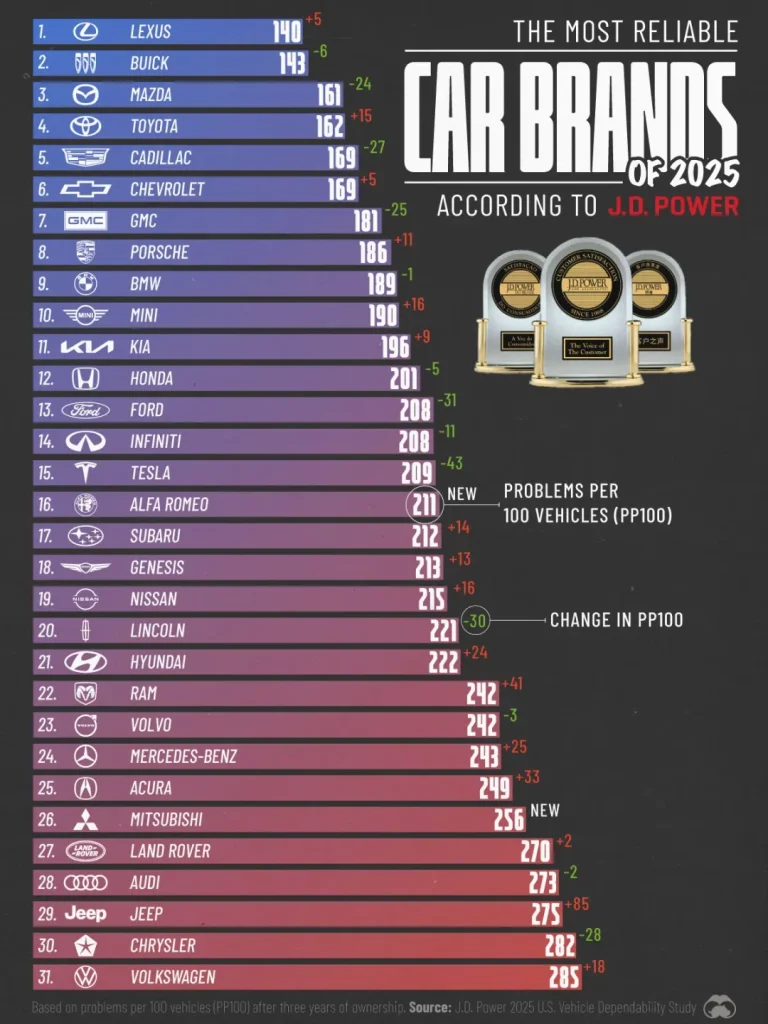
Reliability is no longer about perception. It is about measurable data. The J.D. Power 2025 U.S. Vehicle Dependability Study ranks car brands based on Problems Per 100 Vehicles (PP100) after three years of ownership. Lower PP100 means fewer reported problems and higher long-term reliability.
This ranking provides a rare look at real-world dependability, not marketing claims, not brand loyalty, and not showroom impressions. It reflects ownership reality: defects, failures, system issues, and long-term durability.
The results reveal a clear pattern — and several surprises.
Understanding the Metric: PP100
PP100 (Problems Per 100 Vehicles) measures how many problems owners report per 100 vehicles after three years of ownership.
- Lower number = higher reliability
- Higher number = lower reliability
This includes mechanical issues, electrical faults, infotainment failures, drivetrain problems, interior quality issues, and system malfunctions.
This is not warranty data.
This is not early ownership data.
This is long-term ownership reliability.
Top Tier Reliability Brands of 2025
1. Lexus — 140 PP100
Lexus leads the industry in reliability. This is consistent with long-term trends. Toyota-based engineering, conservative powertrain design, and mature manufacturing processes continue to deliver class-leading dependability.
2. Buick — 143 PP100
Buick’s position is one of the most overlooked stories in modern reliability rankings. Strong platform standardization and simplified drivetrain architectures have significantly improved long-term dependability.
3. Mazda — 161 PP100
Mazda’s placement in the top three confirms what long-term owners already know. Conservative engineering, durable engines, simple transmissions, and low system complexity translate into strong reliability performance.
4. Toyota — 162 PP100
Toyota remains a reliability leader, although no longer uncontested at the top. Its reliability is still excellent, but competition from Mazda and Buick reflects shifting industry performance.
5. Cadillac — 169 PP100
Cadillac’s improvement reflects better quality control, platform consolidation, and improved manufacturing consistency.
Strong Reliability Tier
These brands remain solid performers with good long-term dependability:
- Chevrolet — 169 PP100
- GMC — 181 PP100
- Porsche — 186 PP100
- BMW — 189 PP100
- MINI — 190 PP100
- Kia — 196 PP100
- Honda — 201 PP100
This group reflects acceptable to strong reliability, though not class-leading. Many of these brands trade complexity, performance, or technology integration for increased system failure probability.
Middle Tier Reliability
These brands show moderate reliability performance:
- Ford — 208 PP100
- Infiniti — 208 PP100
- Tesla — 209 PP100
- Alfa Romeo — 211 PP100
- Subaru — 212 PP100
- Genesis — 213 PP100
- Nissan — 215 PP100
- Lincoln — 221 PP100
- Hyundai — 222 PP100
This tier represents mixed reliability profiles. Some models perform well, others underperform, leading to average brand-level scores.
Lower Reliability Tier
These brands show elevated problem rates:
- Ram — 242 PP100
- Volvo — 242 PP100
- Mercedes-Benz — 243 PP100
- Acura — 249 PP100
- Mitsubishi — 256 PP100
This reflects increasing system complexity, higher electronic integration, and higher technology density, which statistically increases failure probability over time.
Lowest Reliability Tier
These brands rank at the bottom of dependability:
- Land Rover — 270 PP100
- Audi — 273 PP100
- Jeep — 275 PP100
- Chrysler — 282 PP100
- Volkswagen — 285 PP100
These brands consistently struggle with long-term reliability due to:
- Complex electronics
- Platform fragmentation
- High system integration
- Software dependency
- Drivetrain complexity
- Manufacturing variability
The Mazda Position: Why It Matters
Mazda ranking 3rd overall is not accidental.
Mazda achieves this through:
- Conservative powertrain design
- Proven engine platforms
- Conventional automatic transmissions
- Low electronic system complexity
- Predictable mechanical architecture
- Focus on durability over novelty
- Stable manufacturing quality control
Mazda does not chase:
- Extreme performance
- Excessive digitalization
- Experimental platforms
- Over-integrated infotainment ecosystems
- Aggressive tech stacking
This strategy produces fewer long-term failures.
Reliability is not about innovation speed.
It is about engineering stability.
The Bigger Pattern in the Rankings
A clear reliability pattern emerges:
High Reliability Brands:
- Conservative engineering
- Simple mechanical systems
- Mature platforms
- Proven drivetrains
- Low software dependency
Low Reliability Brands:
- Complex electronics
- High software integration
- Platform fragmentation
- Performance-driven architectures
- Over-engineered systems
- Heavy digital dependency
This is not brand-specific bias. It is engineering reality.
Complexity increases failure probability.
Change in PP100: What It Signals
The image also shows change in PP100, indicating whether brands improved or worsened year-over-year.
Positive change = more problems
Negative change = fewer problems
Brands like Tesla, Ford, Infiniti, and Lincoln show large negative changes, meaning improvement.
Brands like Jeep and Mercedes-Benz show significant increases, meaning worsening reliability.
This highlights that reliability is dynamic, not static.
What This Means for Buyers
If long-term reliability is your priority:
Best Reliability Strategy
Choose brands that prioritize:
- Simplicity
- Proven systems
- Conservative design
- Mechanical durability
- Low tech saturation
Avoid Risk Factors
High risk reliability profiles include:
- Heavy infotainment dependency
- Complex hybrid systems
- Over-integrated digital platforms
- Performance-focused architectures
- Experimental drivetrain designs
Final Interpretation
The 2025 rankings confirm a fundamental truth:
Reliability is engineered, not marketed.
Brands at the top of the list do not chase trends.
They chase consistency.
Mazda’s position near the top reflects:
- Smart engineering choices
- Durable powertrain platforms
- Conservative system integration
- Long-term reliability strategy
- Quality over hype
This is why Mazda ranks alongside Lexus, Buick, and Toyota — not by marketing power, but by engineering discipline.
Final Verdict
The J.D. Power 2025 dependability data clearly shows:
- Reliability leaders are conservative engineers
- Reliability losers are complexity builders
- Mazda is now officially a top-tier reliability brand
- Simplicity beats innovation when it comes to durability
- Long-term ownership matters more than short-term features
This ranking does not measure excitement.
It does not measure design.
It does not measure technology.
It measures dependability over time.
And by that standard, the data is clear:
Mazda is no longer underrated — it is statistically proven reliable.
Connect with us


