

Why Mazda Stands Out as the Smartest Long-Term Used-Car Buy
Reliability matters more in the used-car market than anywhere else. New cars benefit from warranties, dealer support, and manufacturer incentives. Used cars rely on something far more important: engineering durability. When vehicles reach 5 to 10 years old, marketing disappears and only build quality remains.
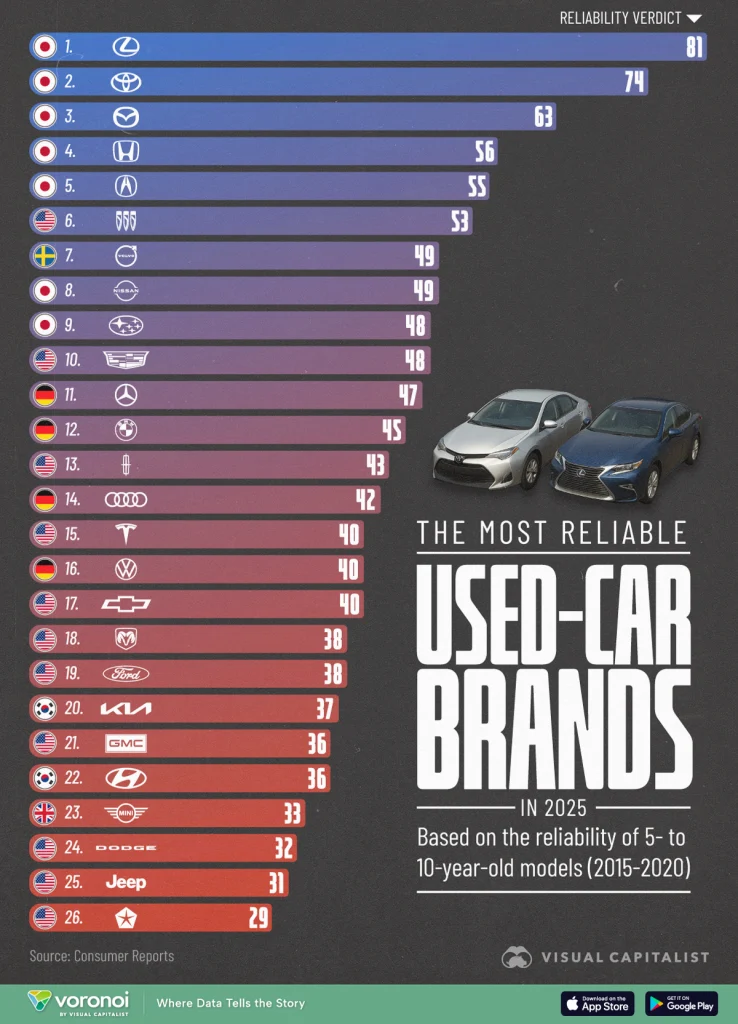
According to the 2025 reliability rankings for used vehicles (2015–2020 models), Mazda ranks 3rd overall among the most reliable used car brands in the market. Only Lexus and Toyota rank higher.
This is not a branding award.
This is not a perception study.
This is a long-term durability ranking.
And Mazda’s position is not accidental.
The Top Reliability Tier (Used Market 2025)
Based on the ranking:
- Lexus – Reliability Score: 81
- Toyota – Reliability Score: 74
- Mazda – Reliability Score: 63
- Honda – 56
- Acura – 55
- Buick – 53
These brands represent the top tier of used-car reliability, where long-term ownership stability is strongest and risk is lowest.
Mazda’s placement at #3 puts it above Honda, Acura, Buick, Volvo, Nissan, Subaru, BMW, Mercedes-Benz, Tesla, Volkswagen, and Audi in used-car dependability.
That is significant.
Why Mazda Performs So Well in the Used Market
Mazda’s strength in used-car reliability comes from engineering strategy, not marketing strategy.
1. Conservative Powertrain Design
Mazda avoids over-engineering its engines. Its powertrains are:
- Naturally aspirated in most trims
- Conservatively tuned
- Thermally stable
- Mechanically simple
- Built for long service life
This reduces long-term failure risk in used vehicles, where stress accumulation becomes critical.
2. Conventional Transmissions
Mazda relies primarily on traditional automatic transmissions, not complex dual-clutch systems or high-failure-rate CVTs.
This matters in the used market because:
- Conventional automatics age more predictably
- Maintenance costs are lower
- Failure patterns are more manageable
- Serviceability is better
- Replacement costs are lower
Transmission failure is one of the most expensive used-car repairs. Mazda avoids that risk category.
3. Low System Complexity
Mazda vehicles from 2015–2020 (the years analyzed) are not overloaded with:
- Experimental electronics
- Over-integrated infotainment systems
- Heavy software dependency
- Over-digitized controls
- Excessive sensor networks
Lower complexity = fewer long-term failure points.
Used cars fail at the system level, not the design level. Mazda minimizes system risk.
4. Balanced Engineering Philosophy
Mazda engineers for:
- Durability
- Consistency
- Longevity
- Predictable aging
- Structural integrity
Not for:
- Extreme performance
- Experimental tech
- Rapid innovation cycles
- Feature saturation
- Trend chasing
This creates vehicles that age well, which is the core requirement for used-car reliability.
Why Mazda Beats Many “Luxury” Brands in Used Reliability
Mazda outranks brands like:
- BMW
- Mercedes-Benz
- Audi
- Tesla
- Volkswagen
- Volvo
This is not because Mazda is more luxurious.
It is because Mazda is less complex.
Luxury brands often suffer in the used market due to:
- High electronic system integration
- Complex drivetrains
- Software dependency
- Expensive proprietary parts
- High sensor density
- Advanced but fragile systems
These technologies age poorly without constant maintenance and expensive repairs.
Mazda’s simpler architecture ages better.
Mazda vs Honda in the Used Market
Mazda ranks higher than Honda in this dataset.
This reflects:
- Lower system complexity
- Fewer CVT failures
- Simpler drivetrain architecture
- Lower long-term repair frequency
- Better mechanical aging patterns
Honda still performs well, but Mazda’s conservative engineering gives it an edge in long-term durability.
Mazda vs Toyota in the Used Market
Toyota still ranks higher overall, but Mazda’s gap is smaller than most people expect.
The difference:
- Toyota benefits from massive scale and platform standardization
- Mazda benefits from engineering discipline and simplicity
Mazda achieves near-Toyota reliability without Toyota-level production volume.
That is a major achievement.
Why Mazda Is a Smart Used-Car Buy
From a buyer’s perspective, Mazda offers a rare combination:
- High reliability
- Lower resale pricing than Toyota/Lexus
- Strong build quality
- Good availability in the used market
- Manageable repair costs
- Strong parts availability
- Durable engines
- Stable transmissions
This creates high reliability per dollar spent, which is the true metric of used-car value.
Reliability by Brand Tier (Used Market)
Elite Tier (Lowest Risk)
- Lexus
- Toyota
- Mazda
High Tier
- Honda
- Acura
- Buick
Medium Tier
- Volvo
- Nissan
- Subaru
- Cadillac
- Mercedes-Benz
- BMW
High Risk Tier
- Tesla
- Volkswagen
- Chevrolet
- Ram
- Ford
- Kia
- GMC
- Hyundai
Lowest Reliability Tier
- MINI
- Dodge
- Jeep
- Chrysler
What Mazda’s Ranking Actually Means
Mazda’s #3 ranking means:
- Lower long-term repair frequency
- Lower catastrophic failure probability
- Better mechanical aging
- Fewer system-level failures
- More predictable ownership costs
- Higher long-term dependability
For used-car buyers, this translates into:
- Fewer surprise repairs
- Lower long-term cost volatility
- Better reliability confidence
- Lower ownership stress
- Higher resale stability
Strategic Interpretation
Mazda does not chase market dominance.
It does not chase tech hype.
It does not chase feature overload.
It does not chase trend cycles.
Mazda chases:
- engineering quality
- mechanical stability
- durability
- long-term performance
- reliability consistency
That strategy does not produce viral popularity.
It produces long-term reliability rankings.
Final Verdict
The used-car reliability rankings confirm a clear truth:
Mazda is one of the safest used-car brands you can buy in 2025.
Not because it is flashy.
Not because it is hyped.
Not because it is trendy.
But because it is:
- engineered conservatively
- mechanically durable
- system-stable
- structurally reliable
- designed to age well
Ranking #3 overall, Mazda proves that long-term reliability is not about brand size or marketing dominance. It is about engineering discipline.
For used-car buyers who prioritize dependability, Mazda is no longer an underrated option.
It is a top-tier reliability brand.
1) Why does Mazda rank so high in used-car reliability rankings?
Mazda ranks high because of conservative engineering choices. Its vehicles use simple, proven engines, conventional automatic transmissions, and low system complexity. Fewer electronic systems, fewer experimental technologies, and durable mechanical platforms allow Mazda vehicles to age more predictably and reliably than many competitors in the used market.
2) Is a used Mazda more reliable than a used Honda or Nissan?
In many reliability studies, used Mazdas now rank equal to or higher than Honda and significantly higher than Nissan. This is largely due to Mazda avoiding CVT transmissions and complex drivetrain systems, which are common long-term failure points in used vehicles. Mazda’s mechanical simplicity gives it an advantage in long-term ownership.
3) How long do Mazda engines typically last in used vehicles?
With proper maintenance, Mazda engines commonly last 200,000 to 250,000 miles, and many exceed 300,000 miles in real-world ownership. Longevity depends on service history, driving conditions, and maintenance discipline, but Mazda engines are known for long service life and low catastrophic failure rates.
4) Are used Mazdas expensive to maintain?
No. Used Mazdas are generally affordable to maintain compared to many competitors. Parts availability is strong, repair complexity is low, and most systems use conventional mechanical designs. This keeps repair costs predictable and prevents extreme maintenance expenses over time.
5) What makes Mazda a smart used-car buy compared to luxury brands?
Mazda often outperforms luxury brands in used-car reliability because it avoids high-complexity systems, heavy software integration, and fragile electronics. Luxury vehicles may offer more features, but those features increase long-term failure risk. Mazda’s simpler design philosophy results in better durability, lower repair risk, and more stable ownership costs in the used market.
Connect with us


