


For drivers who’ve been eyeing a sleek Mazda SUV or sedan, few words sound better than “0% APR.” It’s not just a financing rate — it’s a symbol of opportunity: the chance to bring home world-class Japanese engineering with zero interest, no hidden catch, and full confidence in value.
Right now, Mazda’s 0% APR offers make it easier than ever to experience the precision, style, and soul that define the brand. Whether you’re shopping for a CX-5, CX-50, or CX-90, there’s never been a better moment to act. You can check current 0% financing deals and model-specific incentives directly at Marin Mazda’s specials page — or see which trims qualify this season through Marin Mazda’s exclusive offers.
What 0% APR Really Means for Mazda Buyers
An APR (Annual Percentage Rate) represents the cost of borrowing — in other words, the interest you pay on a loan. A 0% APR offer means you pay no interest at all during the financing term. Every dollar of your monthly payment goes directly toward your vehicle, not bank fees.
That’s not just marketing; it’s math in your favor. On a $35,000 Mazda financed for 60 months, even a modest 4.9% rate could add over $4,500 in interest. At 0% APR, that money stays in your pocket.
Mazda offers these promotions seasonally on select new models, rewarding buyers with top credit scores and strong lender qualifications. It’s one of the most transparent, value-rich programs in the auto industry — especially when combined with loyalty or conquest bonuses that Mazda often stacks on top.
Why Mazda Offers 0% APR
Mazda’s not just competing on price — it’s competing on philosophy. The brand has built its name on premium design, efficient performance, and trust. By offering 0% APR, Mazda signals confidence in both its vehicles and its customers.
Unlike many brands that offset low APRs with inflated pricing or hidden fees, Mazda’s approach is simple: earn your loyalty through genuine value. It’s part of the Japanese principle of omotenashi — hospitality through honesty.
When you finance through Mazda Financial Services, you’re working directly with the manufacturer’s trusted partner. The process is streamlined, transparent, and personalized.
Which Mazda Models Qualify for 0% APR
Eligibility can vary based on timing and inventory, but traditionally, Mazda extends 0% APR deals on its most popular new models, including:
- Mazda CX-5: The refined compact SUV that blends sophistication, safety, and handling like no rival in its class.
- Mazda CX-50: Rugged, wide-stance design and hybrid efficiency with 0% financing options during select promotional periods.
- Mazda CX-90: The flagship 3-row SUV — luxurious, powerful, and occasionally featured in 0% APR event offers.
- Mazda3 Sedan & Hatchback: Sporty, efficient, and ideal for first-time Mazda buyers.
- Mazda MX-5 Miata: The iconic roadster that proves driving joy should never come with compromise — sometimes even available with low-APR financing during seasonal campaigns.
For the latest qualifying models, view the live 0% APR promotions at Marin Mazda’s specials page.
How to Qualify for Mazda’s 0% APR
Mazda’s 0% offers are typically reserved for well-qualified buyers through Mazda Financial Services. While every case is unique, here are the common steps:
- Strong Credit Score: Generally, applicants with FICO scores of 700 or higher qualify for promotional APRs.
- Proof of Income & Residency: Standard lender documentation is required.
- Vehicle Eligibility: Offers apply only to select new, unregistered models during active promotional periods.
- Loan Term Selection: Common 0% terms range between 36 and 60 months.
- Timing: Promotions are limited-time, often tied to seasonal events like Mazda Spring Drive or Year-End Sales.
If you’re unsure whether you qualify, speak directly with Marin Mazda’s finance experts — they’ll help assess your eligibility and uncover additional incentives like loyalty bonuses or lease-to-loan credits.
Why Mazda Financing Beats Third-Party Lenders
Many car buyers instinctively shop for outside financing — but Mazda’s in-house programs often deliver stronger total value. Here’s why:
- 0% APR is exclusive to Mazda Financial Services — third-party banks can’t match it.
- Bundled incentives: Mazda often adds loyalty rebates or cash bonuses to internal financing.
- Streamlined approval: Mazda’s system integrates with dealership sales directly, minimizing paperwork.
- Faster delivery: Vehicles can be secured and delivered the same day approval arrives.
So while you could chase rates elsewhere, Mazda’s own financing often outperforms even competitive bank offers — especially when the interest rate is zero.
The Power of Mazda Value Retention
Mazda vehicles hold their value better than many mainstream competitors. Combine that with a 0% interest rate, and you’re maximizing both equity growth and savings.
Over a five-year period, that can make a substantial difference. Not only do you pay off the vehicle faster (since every cent goes toward principal), but the resale value remains strong — particularly for models like the CX-5, CX-50, and MX-5.
That long-term reliability and resale strength make Mazda’s 0% APR offers among the smartest financial moves in the automotive market.
Real-World Example: What You Save
Let’s take a quick comparison between standard financing and Mazda’s 0% APR:
| Vehicle | Price | Term | Interest Rate | Total Interest Paid | Savings with 0% |
|---|---|---|---|---|---|
| 2025 Mazda CX-5 | $35,000 | 60 mo | 5.9% | $5,500 | $5,500 saved |
| 2025 Mazda CX-50 | $37,000 | 60 mo | 6.4% | $6,320 | $6,320 saved |
| 2025 Mazda3 | $27,000 | 48 mo | 4.9% | $2,765 | $2,765 saved |
It’s straightforward math — Mazda’s zero-interest financing can save thousands, freeing you to add accessories, choose higher trims, or simply enjoy lower payments.
Mazda’s 0% APR + Bonus Cash Offers
Mazda sometimes combines 0% financing with additional perks:
- Loyalty Rebates: Returning Mazda owners can receive up to $500 in bonus savings.
- Conquest Incentives: Trade in a non-Mazda vehicle and qualify for extra credit toward your purchase.
- Seasonal Promotions: Year-end events and new-model launches often feature extended 0% APR periods.
These stackable benefits make timing your purchase around active campaigns even more rewarding.
To explore the latest combinations, visit Marin Mazda’s specials page — updated continuously with real-time dealer incentives and national Mazda finance events.
Models That Shine Under 0% APR
Let’s highlight three current Mazda models that pair beautifully with 0% financing:
Mazda CX-5
Elegant, balanced, and crafted to feel like a luxury SUV without the price tag. 0% APR programs make the CX-5 an unbeatable daily driver — refined inside, confident outside.
Mazda CX-50
Rugged stance, premium power, and now with available hybrid efficiency. A 0% APR CX-50 deal combines long-term savings with genuine performance.
Mazda CX-90
Mazda’s flagship — available with inline-six turbo and plug-in hybrid powertrains. When financed at 0%, this SUV redefines attainable luxury.
Whichever model suits you best, you can secure limited-time 0% APR financing at Marin Mazda while supplies last.
Why Now Is the Right Time
Auto financing trends fluctuate, and interest rates across most industries remain elevated. That’s why Mazda’s 0% APR offers stand out — they’re rare, time-sensitive, and genuinely valuable.
As Mazda rolls out hybrid and plug-in models, it often uses 0% events to introduce new nameplates. That means early adopters get both advanced engineering and the lowest possible financing cost.
Combine that with current trade-in values holding strong, and timing couldn’t be better for Mazda buyers seeking maximum return.
The Human Side: Mazda’s “Feel Good to Own” Experience
Mazda ownership goes beyond driving — it’s about pride of craftsmanship. The Mazda Financial Services team shares that philosophy, offering flexible options and transparent communication. You won’t find gimmicks or small print games — just clean, customer-focused terms.
And because Marin Mazda operates with the same values, the process stays seamless from showroom to driveway. Every specialist you meet is trained to align Mazda’s premium ethos with your financial comfort.
Understanding the Fine Print
While 0% APR is as straightforward as it sounds, here’s what to keep in mind:
- It applies only to new, eligible Mazda vehicles.
- It requires approved credit through Mazda Financial Services.
- It cannot always be combined with lease offers or certain rebates.
- Terms vary (usually 36–60 months).
- Offers expire at the end of each campaign cycle.
Marin Mazda’s finance experts can walk you through every option to ensure you maximize both your savings and flexibility.
Why Marin Mazda Makes It Even Better
While 0% APR comes from Mazda’s national program, Marin Mazda takes it further with dealership-level perks:
- Transparent pricing and local approval support
- Fast financing turnaround — often same-day delivery
- Complimentary trade-in appraisals
- VIP test drive scheduling
- Dedicated follow-up service and maintenance packages
In short: Marin Mazda makes Mazda’s best offers even easier to own.
Final Thoughts: The Beauty of 0%
The Mazda 0% APR opportunity represents more than a financing deal — it’s a gateway into one of the most rewarding ownership experiences in the industry.
Every Mazda, from the sporty CX-30 to the flagship CX-90, carries Japan’s legacy of precision and artistry. Pair that with zero-interest financing, and you have a purchase that makes emotional and financial sense.
So if you’ve been waiting for the right time to upgrade, the moment has arrived. Visit Marin Mazda’s specials page to see which models qualify for 0% APR, compare trims, and secure a payment plan that’s as smart as it is satisfying.
Zero interest. Zero hesitation. 100% Mazda.
Marin Mazda 0% APR Financing FAQ
1) What does 0% APR mean when financing a Mazda?
A 0% APR (Annual Percentage Rate) offer means you pay no interest on your auto loan during the term. Every payment goes directly toward your Mazda’s price rather than interest fees — maximizing savings and equity growth.
2) Which Mazda models currently qualify for 0% APR at Marin Mazda?
Eligibility changes based on inventory and promotions, but Mazda often includes:
- Mazda CX-5 – Refined, efficient compact SUV.
- Mazda CX-50 – Rugged, wide-stance crossover with hybrid options.
- Mazda CX-90 – Flagship 3-row luxury SUV.
- Mazda3 Sedan & Hatchback – Sporty and fuel-efficient.
- Mazda MX-5 Miata – Iconic lightweight roadster.
Check the latest offers on the Marin Mazda Specials page for real-time updates.
3) Who qualifies for Mazda’s 0% APR financing?
0% APR offers are typically for well-qualified buyers through Mazda Financial Services. Approval depends on:
- Credit score (usually 700+)
- Proof of income and residency
- Eligible new, unregistered Mazda models
- Loan term (usually 36–60 months)
If you’re unsure, Marin Mazda’s finance experts can pre-qualify you quickly with no obligation.
4) How much can I save with 0% APR financing?
On a $35,000 vehicle financed for 60 months, 0% APR could save you $4,000–$6,000 compared to a 5–6% interest loan. Every dollar goes toward your principal, not the bank — meaning faster payoff and stronger resale value.
5) Can I combine 0% APR with other Mazda offers?
Yes, often. Mazda allows stacking of:
- Loyalty Rebates (for returning Mazda owners)
- Conquest Bonuses (for switching from another brand)
- Seasonal Promotions (such as Year-End or Spring Drive events)
Marin Mazda can confirm which combinations apply to your purchase.
6) What credit score do I need for 0% APR?
While Mazda doesn’t publish a strict minimum, a FICO score of 700 or higher typically qualifies for promotional rates. Applicants below that may still qualify for low APRs or alternate financing options through Marin Mazda’s lender network.
7) Does 0% APR apply to leases too?
No — 0% APR applies to financing (purchases) only, not leases. However, Marin Mazda often runs low-payment lease specials on popular models like the CX-5 or CX-50 with minimal due-at-signing.
8) How long are 0% APR promotions available?
Mazda’s 0% APR offers are limited-time events, typically running for 30–60 days during seasonal campaigns. Once they expire, interest rates revert to standard levels. Check Marin Mazda’s current specials to confirm timing.
9) Is 0% APR financing through a bank or Mazda directly?
All 0% offers go through Mazda Financial Services, the brand’s official financing arm. This ensures faster approvals, exclusive rebates, and seamless coordination with the dealership — benefits banks can’t match.
10) Can I still trade in my old vehicle with 0% APR?
Yes. Marin Mazda accepts trade-ins of all makes and models. You can apply your vehicle’s trade-in value toward your new Mazda to reduce your financed amount or down payment. Use the Value Your Trade tool for an instant estimate.
11) Are there hidden fees with Mazda’s 0% financing?
No. Mazda’s 0% APR is a true zero-interest offer, with no hidden markups or back-end fees. Taxes, license, and documentation fees still apply, as with any purchase.
12) How long are typical 0% APR terms?
Most Mazda 0% APR programs offer 36, 48, or 60-month terms depending on the model and promotion. Longer terms may include slightly higher interest rates. Marin Mazda’s finance team can calculate both options for you.
13) Can first-time buyers qualify for 0% APR?
Yes, in some cases. With strong income and credit, first-time buyers may be eligible. If not, Marin Mazda can still secure competitive rates through partner lenders.
14) What’s the benefit of financing with Mazda instead of a bank?
- Exclusive 0% APR offers unavailable through third-party lenders.
- Faster approval process integrated with the dealership.
- Bundled loyalty and cash incentives.
- Simplified paperwork and same-day delivery options.
15) Does 0% APR affect my warranty or coverage?
No. All Mazda models financed at 0% APR come with the standard factory warranty:
- 3-year / 36,000-mile New Vehicle Limited Warranty
- 5-year / 60,000-mile Powertrain Warranty
- 24/7 Roadside Assistance
16) Can I pay off my Mazda early?
Yes. There are no prepayment penalties with Mazda Financial Services. You can pay off your balance early without fees or added interest.
17) What happens if I don’t qualify for 0% APR?
Marin Mazda’s finance team can still offer low-interest alternatives, including Mazda loyalty APR discounts and third-party bank programs. Many customers with average credit still secure attractive rates.
18) Does 0% APR affect resale value?
Yes — positively. Since 0% APR accelerates principal payoff, you build equity faster. Mazda vehicles already retain strong value, especially the CX-5, CX-50, and MX-5 Miata, making this a smart long-term investment.
19) When is the best time to buy a Mazda with 0% APR?
Mazda’s best 0% events typically happen during:
- Spring Drive Sales Event
- Summer Inventory Clearance
- Year-End Sales Event
Visiting Marin Mazda during these periods can unlock extra rebates and extended 0% terms.
20) How can I apply for Mazda 0% APR financing today?
You can get started online or in person:
📍 Marin Mazda — 807 Francisco Blvd E, San Rafael, CA 94901
📞 Call: (415) 454-7000
🔗 Apply for Financing
🔗 View Mazda Specials
Drive home your next Mazda — with 0% interest, zero stress, and 100% confidence from Marin Mazda.
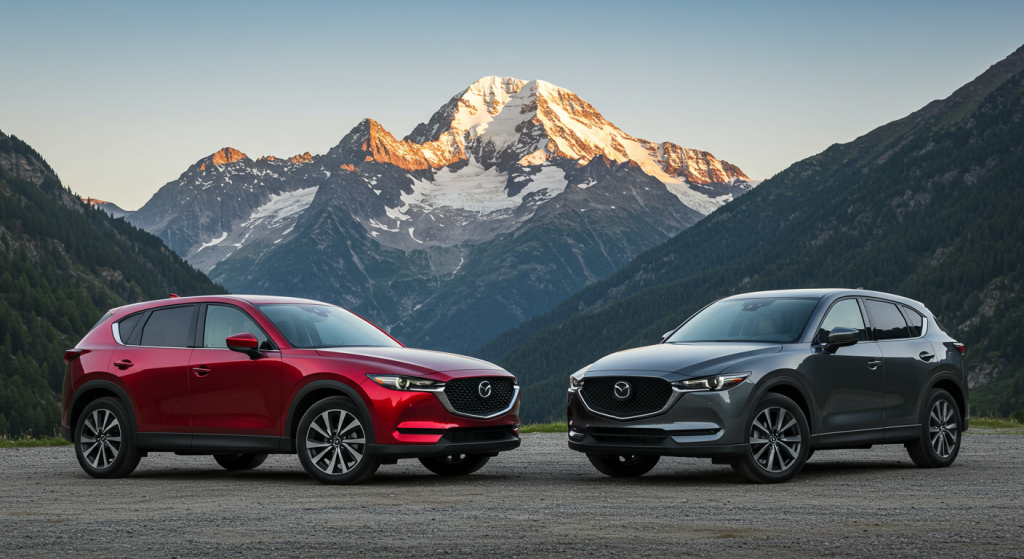
When you start comparing the Mazda CX-50 vs CX-5, it’s easy to assume they’re just twins in different suits. After all, both share engines, technology, and Mazda’s unmistakable design DNA. Yet beneath the sheet metal lie two personalities — the CX-5, the elegant everyday performer, and the CX-50, the bold new explorer.
Both are deeply rooted in Mazda’s Japanese craftsmanship and Jinba Ittai spirit, that horse-and-rider connection that makes every Mazda feel alive. If you’re deciding which to bring home, this guide walks you through every difference — from design and driving feel to pricing and purpose. And if you’d rather see them side by side in person, you can check current CX-5 and CX-50 offers right now on Marin Mazda’s specials page or browse exclusive dealership incentives directly through Marin Mazda to see which fits your lifestyle best.
Design & Philosophy: Urban Elegance vs Outdoor Confidence
Mazda didn’t create the CX-50 to replace the CX-5 — it built it to complement it. Both SUVs embody KODO — Soul of Motion design, but they channel it differently.
- CX-5: Smooth, sophisticated lines emphasize grace and proportion. It looks at home downtown or in a high-end driveway.
- CX-50: Wider, lower, and more muscular. Pronounced fender arches and a bolder stance announce its adventurous intent.
Where the CX-5 wears a tailored suit, the CX-50 wears a technical jacket. Mazda’s strategy is simple — the CX-5 continues serving refined daily drivers, while the CX-50 attracts weekend explorers.
Engines & Performance
Both models share Mazda’s proven Skyactiv-G 2.5-liter four-cylinder, producing around 187 horsepower and 186 lb-ft of torque, paired with a smooth 6-speed automatic and standard i-Activ AWD.
Step-Up Turbo Power
For those wanting extra punch, the available Skyactiv-G 2.5 Turbo transforms either SUV into a torque-rich performer:
- Up to 256 horsepower on premium fuel
- 0-60 mph in roughly 6.5 seconds
- Sharp throttle response with the unmistakable Mazda linear feel
Hybrid Advantage (CX-50 Only)
Here’s the big divergence: the CX-50 Hybrid joins the lineup with an efficient 2.5-liter gas engine plus electric motors delivering about 219 hp and nearly 38 mpg combined. It’s Mazda’s first step toward electrified SUVs — smooth, quiet, and ready for long drives.
In short: both perform like Mazdas should, but the CX-50 Hybrid brings next-generation efficiency, while the CX-5 Turbo remains the purist’s pick for performance.
Driving Dynamics: Mazda’s Magic in Two Flavors
Mazda’s mastery of chassis tuning shows in both vehicles, yet their personalities diverge slightly.
- CX-5: Tuned for balance and comfort. The ride is composed, steering precise, and suspension absorbs imperfections effortlessly.
- CX-50: Wider track and stiffer setup create a planted, confident stance on highways and gravel alike. Steering feels heavier, lending the impression of a sportier SUV.
Both SUVs deliver the Jinba Ittai feeling — the sense that car and driver move as one. But if your roads involve rougher terrain or spirited backroads, the CX-50’s tuning feels more adventurous.
Interior Craftsmanship
Mazda interiors are benchmarks for this class — premium, minimalist, and purposeful. Both cabins reflect Japanese restraint, using high-quality materials and intuitive ergonomics.
- CX-5: Offers a brighter, more open cabin with slightly taller seating and extra headroom. It feels airy and sophisticated.
- CX-50: Feels cockpit-like — snug, focused, and driver-centric. Horizontal dash lines emphasize width, while contrasting trims and stitching add rugged flair.
Both share Mazda’s latest infotainment system with a 10.25-inch display, Apple CarPlay®/Android Auto™, and available Bose® audio. Higher trims introduce ventilated leather seats, power liftgate, and panoramic moonroof.
In feel alone, the CX-5 channels city chic; the CX-50, mountain confidence.
Space & Practicality
Despite near-identical footprints, interior packaging differs slightly:
| Measurement | CX-5 | CX-50 |
|---|---|---|
| Passenger Volume | 103 cu ft | 100 cu ft |
| Cargo Space (seats up) | ~30.9 cu ft | ~31.4 cu ft |
| Ground Clearance | 7.9 in | 8.3 in |
| Towing (when turbo) | 3,500 lbs | 3,500 lbs |
The CX-5’s taller roof gives slightly more headroom, while the CX-50’s lower stance aids handling and roof-rack loading. Both accommodate families easily — but the CX-50’s subtle extra clearance suits those who venture beyond pavement.
Efficiency & Fuel Economy
Mazda’s Skyactiv engineering maximizes output while sipping fuel:
- CX-5 2.5 L: ~28 mpg combined
- CX-5 Turbo: ~25 mpg combined
- CX-50 2.5 L: ~28 mpg combined
- CX-50 Hybrid: ~38 mpg combined
The hybrid’s electric assistance shines in stop-and-go driving, delivering smooth torque and impressive range. For long-distance cruising, both gasoline versions perform within a few mpg of each other — excellent numbers given standard AWD.
Safety & Technology
Mazda’s i-Activsense suite comes standard across both models, featuring:
- Adaptive cruise control
- Lane-keep assist and departure warning
- Blind-spot monitoring with rear cross-traffic alert
- Smart brake support
- Driver attention alert
Both the CX-5 and CX-50 consistently earn IIHS Top Safety Pick+ honors, reflecting Mazda’s Japanese engineering precision and emphasis on occupant protection.
Trim Breakdown & Pricing Outlook
While pricing varies slightly by region, both lineups offer clear hierarchy:
Mazda CX-5 Trims:
- 2.5 S Select – affordable entry with premium touches
- Preferred – adds leather and moonroof
- Carbon Edition – distinct styling and black accents
- Turbo Premium Plus – flagship power and luxury
Mazda CX-50 Trims:
- 2.5 S Preferred Plus – elegant baseline
- Meridian Edition – trail-ready looks and tires
- Turbo – performance punch
- Hybrid Premium Plus – eco meets luxury
Pricing overlaps — CX-5s start lower, CX-50s stretch higher for hybrid or Meridian editions. Whichever route you choose, both deliver more features than typical rivals.
To explore real-time pricing and dealer-exclusive incentives, visit Marin Mazda’s specials page and see which trim aligns with your priorities.
Ride Comfort & Noise
Mazda invests heavily in ride refinement. In the latest generation, engineers reduced road vibration and tuned insulation to rival premium brands.
- CX-5: Plush yet controlled — perfect for commuting or highway drives.
- CX-50: Slightly firmer to enhance stability and feedback, but still impressively quiet.
Wind and tire noise are minimal in both, and the doors close with the reassuring thud of luxury engineering.
The Emotional Factor
Numbers tell one story, feel tells another. Behind the wheel, the CX-5 and CX-50 share Mazda’s distinct steering feel — light on center, eager in corners, with confidence-building balance.
The CX-5 appeals to those who see driving as artful efficiency — smooth, composed, timeless.
The CX-50 suits those who crave adventure — the confidence to turn down an unpaved road just because it looks interesting.
Both deliver that unmistakable Mazda “alive” sensation that makes even errands enjoyable.
Reliability & Ownership
Mazda’s reputation for dependability continues with both models. Their engines are time-tested, transmissions bulletproof, and build quality outstanding. Maintenance costs remain moderate, and real-world owners routinely exceed 150,000 miles with minimal issues.
Mazda backs both with:
- 3-year/36,000-mile basic warranty
- 5-year/60,000-mile powertrain coverage
- Available extended protection plans
Add in Mazda’s award-winning dealer service and high resale values, and ownership feels as stress-free as the drive itself.
For a closer look at current Certified Pre-Owned and new CX-5/CX-50 inventory, review current listings through Marin Mazda’s specials page.
CX-50 vs CX-5: Which Is Right for You?
| Driver Type | Recommended Model | Why It Fits |
|---|---|---|
| Urban commuter | CX-5 | Quieter ride, refined design for city streets |
| Weekend explorer | CX-50 | Higher clearance, tougher look, available Hybrid |
| Performance enthusiast | CX-50 Turbo | Sportier handling and engine response |
| Family-first buyer | CX-5 | Slightly taller cabin and more rear headroom |
| Efficiency seeker | CX-50 Hybrid | 38 mpg combined and smooth electric assist |
The beauty is that there’s no wrong answer — both deliver unmistakable Mazda emotion.
The Future: Two Icons Evolving Together
Mazda has confirmed that both SUVs will continue alongside each other. The CX-5 will soon evolve toward a slightly larger, more luxurious successor, while the CX-50 expands electrification and rugged editions. Together, they showcase Mazda’s dual mastery — refinement and adventure.
No matter which direction you lean, you can experience both at Marin Mazda’s specials page — where Japanese craftsmanship meets California driving.
Final Verdict
When it comes to Mazda CX-50 vs CX-5, think personality, not hierarchy. The CX-5 is the classic Mazda crossover refined to perfection — sleek, comfortable, and timeless. The CX-50 is the evolution — bolder, more efficient, and purpose-built for active lifestyles.
Both are unmistakably Mazda: stylish without shouting, responsive without harshness, premium without pretense.
The real question isn’t which is better — it’s which one reflects you.
To find yours, visit Marin Mazda’s specials page and experience both sides of Mazda’s SUV excellence — crafted in Japan, perfected for every road you’ll take.
Mazda CX-50 vs. CX-5 FAQ | Marin Mazda
1) What’s the main difference between the Mazda CX-50 and CX-5?
The Mazda CX-5 focuses on urban refinement, while the CX-50 emphasizes rugged adventure. Both share engines, tech, and design DNA, but the CX-50 rides wider, lower, and tougher — ideal for active lifestyles.
2) Does the CX-50 replace the CX-5?
No. Mazda sells both side by side. The CX-5 remains the refined daily SUV, and the CX-50 adds off-road style and capability for those who want more adventure.
3) Which looks better — CX-50 or CX-5?
It depends on your taste.
- CX-5: Elegant, smooth, and sophisticated — perfect for city and suburban streets.
- CX-50: Muscular and bold, with wide fenders and rugged accents designed for outdoor appeal.
4) Are the CX-50 and CX-5 engines the same?
Yes, both offer Mazda’s 2.5-L Skyactiv-G engine (187 hp, 186 lb-ft torque) and an available 2.5-L Turbo (up to 256 hp on premium fuel). Both come standard with i-Activ AWD.
5) Which Mazda SUV has a hybrid option?
Only the CX-50 currently offers a hybrid version, delivering around 219 horsepower and 38 mpg combined — Mazda’s first step toward electrified performance.
6) Which drives better?
Both deliver Mazda’s signature Jinba Ittai “driver and machine as one” feel.
- CX-5: Tuned for comfort and balance — ideal for highways and daily commutes.
- CX-50: Feels sportier and more planted, with firmer suspension for backroads or trails.
7) Which is bigger — CX-5 or CX-50?
They’re close in size, but the CX-50 is slightly longer and wider, with a lower roof and higher ground clearance (8.3 in vs 7.9 in). The CX-5 offers a touch more interior headroom.
8) How does cargo space compare?
Cargo capacity is nearly identical:
- CX-5: ~30.9 cu ft (rear seats up)
- CX-50: ~31.4 cu ft (rear seats up)
Both fold flat for larger items, and the CX-50’s wider opening helps load bulky gear.
9) Which is more fuel efficient?
Fuel economy is very similar, except for the hybrid:
- CX-5 / CX-50 (2.5 L gas): ~28 mpg combined
- Turbo versions: ~25 mpg combined
- CX-50 Hybrid: ~38 mpg combined
10) Which Mazda SUV is quieter and more comfortable?
The CX-5 rides softer and quieter, tuned for luxury-like smoothness. The CX-50 feels firmer and sportier but remains well-insulated and refined.
11) Are safety features the same?
Yes. Both include Mazda’s full i-Activsense suite:
- Adaptive Cruise Control
- Blind-Spot Monitoring
- Lane-Keep Assist
- Rear Cross-Traffic Alert
- Smart Brake Support
Both are IIHS Top Safety Pick + winners.
12) What are the key trim levels?
CX-5: 2.5 S Select, Preferred, Carbon Edition, Turbo Premium Plus
CX-50: 2.5 S Preferred Plus, Meridian Edition, Turbo, Hybrid Premium Plus
13) How much do they cost?
Pricing overlaps. The CX-5 starts lower (around the low $30,000 range), while the CX-50 runs slightly higher for its newer design and hybrid options.
14) Which Mazda SUV to choose for city driving?
Go with the CX-5 — it’s easier to park, smoother in traffic, and has a refined cabin for daily commutes.
15) Which suits outdoor or adventure lifestyles?
Pick the CX-50 — higher clearance, bolder styling, available Meridian Edition with off-road tires, and optional hybrid efficiency for long weekend trips.
16) Which has better resale value?
Both Mazdas retain excellent resale value. The CX-5 benefits from long-term reputation; the CX-50 adds novelty and hybrid tech that keep demand strong.
17) How reliable are they?
Extremely. Both share Mazda’s proven engines and transmissions. Owners often report 150,000 + miles with minimal maintenance issues.
18) What warranties do they come with?
- 3-year / 36,000-mile New-Vehicle Warranty
- 5-year / 60,000-mile Powertrain Warranty
- Optional extended coverage through Mazda Protection Plans
19) Can I test-drive both at Marin Mazda?
Yes. You can compare the CX-5 and CX-50 side-by-side at Marin Mazda, located at 807 Francisco Blvd E, San Rafael, CA 94901. Schedule a test drive online or call (415) 454-7000.
20) Where can I find current CX-5 and CX-50 specials?
Visit the Marin Mazda Specials page to view exclusive offers, 0 % APR financing events, and lease incentives on both SUVs.
Final Insight:
If you value elegance and comfort — choose the CX-5.
If you crave boldness, capability, and the latest hybrid tech — go with the CX-50.
Whichever you prefer, both deliver Mazda’s signature balance of performance, craftsmanship, and emotion — ready to test-drive today at Marin Mazda.
Here’s a clean, SEO-friendly FAQ section for your Mazda CX-50 vs CX-5 article—concise, keyword-optimized, and ready to drop under the main post on Marin Mazda’s blog:
Mazda CX-50 vs CX-5 FAQ | Marin Mazda
1. What’s the biggest difference between the CX-50 and CX-5?
The CX-5 delivers refined city comfort and smooth luxury-like handling.
The CX-50 is tuned for outdoor confidence, with a wider stance, extra ground clearance, and bolder styling.
2. Does the CX-50 replace the CX-5?
No. Mazda builds both. The CX-5 remains the elegant daily SUV; the CX-50 adds rugged appeal and optional hybrid efficiency.
3. Do they share engines?
Yes. Each uses Mazda’s 2.5 L Skyactiv-G (187 hp) and optional 2.5 L Turbo (up to 256 hp on premium fuel) with standard i-Activ AWD.
4. Is there a hybrid model?
Only the CX-50 Hybrid—about 219 hp and 38 mpg combined—Mazda’s first electrified SUV in the U.S.
5. Which drives better?
Both feel connected through Mazda’s Jinba Ittai philosophy.
CX-5: Comfort-tuned for commuting.
CX-50: Firmer, sportier, and more stable on rough roads.
6. Which is larger?
The CX-50 is slightly longer and wider with 8.3 in of ground clearance (vs 7.9 in on CX-5). Interior space is nearly identical.
7. How much cargo room do they have?
CX-5 ≈ 30.9 cu ft | CX-50 ≈ 31.4 cu ft.
Both fold flat for larger items; the CX-50’s hatch opening is wider.
8. Fuel-economy comparison
CX-5 / CX-50 2.5 L ≈ 28 mpg combined
Turbo ≈ 25 mpg combined
CX-50 Hybrid ≈ 38 mpg combined
9. Are safety features the same?
Yes. Each includes Mazda i-Activsense: Adaptive Cruise Control, Blind-Spot Monitoring, Lane-Keep Assist, Smart Brake Support, and more. Both earn IIHS Top Safety Pick +.
10. How much can they tow?
When properly equipped with the Turbo engine, both tow up to 3,500 lbs.
11. Which rides quieter?
The CX-5 offers the plushest, quietest ride.
The CX-50 feels more planted and sporty while staying well-insulated.
12. Trim levels
CX-5: 2.5 S Select · Preferred · Carbon Edition · Turbo Premium Plus
CX-50: 2.5 S Preferred Plus · Meridian Edition · Turbo · Hybrid Premium Plus
13. Pricing overview
CX-5 starts in the low $30 Ks; CX-50 costs slightly more for its newer design and Hybrid powertrain. Check Marin Mazda for current lease and 0 % APR offers.
14. Which suits city drivers?
Choose CX-5 — smaller footprint, softer ride, and easier parking.
15. Which fits outdoor lifestyles?
Go with CX-50 — extra clearance, Meridian Edition off-road tires, and available Hybrid range for weekend getaways.
16. Reliability & warranty
Both share Mazda’s proven drivetrains and offer:
- 3 yr / 36 K mi basic coverage
- 5 yr / 60 K mi powertrain warranty
- Optional extended protection plans
17. Where can I test-drive them?
Visit Marin Mazda at 807 Francisco Blvd E, San Rafael, CA 94901 or call (415) 454-7000 to compare CX-5 and CX-50 side by side.
18. Where to find current specials?
Explore exclusive CX-5 and CX-50 offers on the Marin Mazda Specials page.
When you search “Is Mazda Japanese?” you’re really asking about more than geography — you’re exploring how a carmaker’s culture, craft, and philosophy shape every vehicle it builds
Mazda’s story is unmistakably Japanese, from its origins in Hiroshima nearly a century ago to the Jinba Ittai driving spirit that lives in every modern CX-5, CX-50, or MX-5 Miata.
And if you’re curious how that legacy translates into the SUVs and crossovers available today, you can explore current models and specials right now at Marin Mazda — a dealership that brings this proud heritage to local drivers every day.
Mazda may build some cars abroad, but its soul has never left Japan. From meticulous design studios in Hiroshima to cutting-edge research labs in Yokohama, the brand blends craft, technology, and emotion in a uniquely Japanese way. Whether you’re drawn to the sculpted curves of a CX-90 or the effortless efficiency of the CX-30, you can see how this Japanese DNA comes alive in every offer listed on Marin Mazda’s specials page.
A Brief History of Mazda’s Japanese Roots
Mazda began in 1920 as the Toyo Cork Kogyo Company in Hiroshima, producing industrial goods before turning to vehicles in 1931 with the tiny three-wheeled “Mazda-Go.” The brand’s very name came from Ahura Mazda — a symbol of wisdom and harmony — and its founders’ desire to unite practical engineering with spiritual balance.
Over the decades, Mazda endured wartime destruction, rebuilt alongside Hiroshima’s renaissance, and rose to international prominence through innovation. By 1967 it became one of the few automakers in the world to master the rotary engine, an icon of Japanese engineering daring.
The Japanese Philosophy Behind Every Mazda
Mazda’s designers often speak of “KODO — Soul of Motion.” This design philosophy captures the grace of living movement, inspired by calligraphy, martial arts, and the quiet discipline found throughout Japanese culture. Look at a Mazda’s body line: it’s meant to feel alive, not just aerodynamic.
Equally integral is Jinba Ittai, the horse-and-rider unity that guides Mazda’s chassis tuning and steering response. Engineers spend years perfecting how a driver’s smallest input translates into motion — an ethos rooted in centuries of Japanese craftsmanship, where harmony matters more than brute force.
Inside, Mazda cabins embody “Takumi” artisan quality — minimalist, tactile, and centered around balance. Every stitch and switch placement reflects the Japanese concept of omotenashi: hospitality that anticipates your needs.
Japanese Engineering Meets Global Production
Though unmistakably Japanese in spirit, Mazda now operates worldwide. Manufacturing plants exist in Japan, Mexico, China, Thailand, and the United States. Yet all major engineering development, powertrain design, and final quality benchmarks still originate in Japan.
- Headquarters: Hiroshima, Japan
- Primary R&D centers: Hiroshima and Yokohama
- Design centers: Hiroshima and Irvine, California (for regional input)
- Production plants: Japan (Hiroshima & Yamaguchi) plus global partners
Every new model — from the latest CX-70 Hybrid to the upcoming electric line — passes through Hiroshima’s proving grounds before release. That means whether your Mazda is assembled in Alabama or Hofu, it’s built to Japanese specifications, reflecting Mazda’s uncompromising standards.
Cultural DNA in Modern Mazdas
Mazda’s attention to detail mirrors Japanese arts like pottery and woodworking: mastery through repetition and humility before the craft. Designers use clay modeling by hand, even in the age of digital simulation, believing touch reveals subtleties machines can’t replicate.
Lighting design follows ma — the Japanese sense of space and timing — ensuring every headlamp and cabin reflection feels calm rather than flashy. Paintwork employs proprietary Takuminuri layering, hand-polished to mirror-grade smoothness. It’s not marketing — it’s modern Japanese artistry on four wheels.
The Hiroshima Influence
Mazda’s headquarters remain in Hiroshima — a city that symbolizes resilience and reinvention. After 1945, Mazda helped revive the region’s industry, exporting vehicles that would later introduce Japan’s craftsmanship to the world. That spirit of endurance still defines Mazda’s culture: thoughtful progress, human empathy, and quiet pride.
Every engineer who trains at Hiroshima’s proving grounds absorbs this mindset. Many executives describe it as “a responsibility to represent Japanese precision with warmth.” It’s a national identity translated into motion.
Global Recognition of Japanese Quality
Reviewers consistently note that Mazda cars feel more premium than their price suggests. That refinement comes from Japanese manufacturing discipline — obsessive attention to tolerances and the Kaizen approach of constant improvement.
Even small details, like the click of a climate-control dial or the soft detent of a gear selector, are tuned by sound engineers to convey confidence and serenity — qualities deeply rooted in Japanese aesthetics.
When you step into a Mazda showroom or visit your local dealer, that quiet excellence is evident. To experience it firsthand, browse the current Japanese-crafted SUVs and crossovers featured on Marin Mazda’s specials page.
Japanese Innovation: Rotary Engines to Skyactiv Technology
Mazda’s reputation for bold engineering choices began with the rotary engine — lightweight, compact, and remarkably smooth. Though rotary production paused in 2012, the spirit of experimentation lived on in Skyactiv Technology, a suite of powertrain and chassis innovations focused on real-world efficiency.
Skyactiv engines achieve higher compression ratios without sacrificing drivability — a nod to Japan’s obsession with harmony between mechanical systems and nature’s laws. Pair that with Mazda’s responsive steering and the result is efficiency without numbness.
Newer systems like Skyactiv-X and Mazda’s hybrid collaborations continue this Japanese-led pursuit of balance — power meeting responsibility, emotion meeting intellect.
Design Language as Cultural Expression
Where other brands use sharp creases and loud surfaces, Mazda prefers restraint. Its designers often describe each model as a living creature poised in motion. The subtle curvature of a CX-5’s fender or MX-5’s hood is intentional — capturing fleeting beauty, much like brushstrokes in Japanese ink painting.
Inside, horizontal layouts and natural textures evoke shibui: understated elegance. Every Mazda aims to calm rather than overwhelm — a design language born of Japanese serenity, not Western excess.
Mazda in North America: A Bridge Between Cultures
While Mazda remains proudly Japanese, its American operations in Irvine, California and its new joint factory in Huntsville, Alabama demonstrate how a Japanese ethos can thrive globally. North American engineers adapt suspension tuning and climate performance for local roads, but the emotional core still traces back to Hiroshima.
That’s why enthusiasts describe Mazdas as “driver’s cars” — they blend Japanese precision with Western practicality. The result: vehicles that feel universal yet unmistakably Japanese at their core.
If you’re in California and curious to see this philosophy in metal, you can schedule a test drive or review current offers directly through Marin Mazda’s specials section.
The Future of a Japanese Icon
Mazda’s next chapter remains rooted in Japan even as it goes electric. The upcoming generations of Skyactiv-EV and Skyactiv-Hybrid powertrains are being developed in Hiroshima with help from Japanese suppliers and universities. These will gradually appear across models like the CX-70 PHEV and the CX-90 Plug-in Hybrid, marrying traditional driving feel with sustainable performance.
Mazda’s leaders describe this shift as “engineering with a Japanese conscience” — progress that respects nature while honoring craftsmanship. The company’s new sustainability goals aim for full carbon neutrality by 2050, guided by the same cultural integrity that’s shaped it since 1920.
Why Mazda Still Feels Uniquely Japanese
Even as globalization blurs borders, Mazda stands out for how deeply Japanese its mindset remains:
- Harmony over haste — Every decision balances efficiency, beauty, and emotion.
- Craftsmanship as identity — Real humans refine what machines build.
- Respect for environment and people — Design follows empathy.
- Perfection through imperfection — The Japanese idea of wabi-sabi informs Mazda’s minimalist interiors and natural materials.
- Continuous self-improvement — The Kaizen philosophy ensures no detail is ever final.
This isn’t corporate branding — it’s cultural continuity.
The Answer: Yes, Mazda Is Japanese — and Proudly So
Mazda is as Japanese as the artistry that inspired it. Its cars are global, its assembly may span continents, but its spirit, discipline, and emotional depth are born of Japan. Every curve, engine note, and ergonomic detail reflects the country that built it — precise yet poetic, efficient yet soulful.
And if you’d like to feel that spirit for yourself, explore the latest lineup inspired by Japanese engineering at Marin Mazda. Whether you’re considering a CX-30, CX-50 Hybrid, or the flagship CX-90, each one carries Hiroshima’s heart in its chassis and craftsmanship in its stitching.
Conclusion: Japan’s Gift to the Road
So, is Mazda Japanese? Absolutely — not just by birth, but by belief. It’s a company that proves technology can coexist with humanity, and precision can express emotion. Mazda’s story is the story of Japan itself: disciplined, inventive, quietly confident.
From the hand-formed fenders to the carefully tuned steering, every Mazda reminds us that driving can still be an art form. The answer to “Is Mazda Japanese?” is written not in a passport, but in the way a Mazda moves.
To experience that heritage firsthand and see today’s offers, visit Marin Mazda’s specials page — where Japanese craftsmanship meets California roads.
FAQ: Is Mazda Japanese? | Marin Mazda
1) Is Mazda a Japanese company?
Yes. Mazda Motor Corporation is a Japanese automaker headquartered in Hiroshima, Japan. Founded in 1920 as Toyo Cork Kogyo Co., Mazda’s heart, design, and engineering philosophy remain deeply rooted in Japanese culture.
2) Where are Mazda cars made?
While Mazda builds vehicles in multiple countries — including Japan, the U.S., Mexico, China, and Thailand — its primary engineering, design, and R&D centers are still located in Hiroshima and Yokohama, Japan. Every global plant follows Japanese standards and quality benchmarks.
3) What does the name “Mazda” mean?
The name derives from Ahura Mazda, the ancient Persian god of wisdom and harmony. It also echoes the surname of the company’s founder, Jujiro Matsuda. This blend of symbolism reflects Mazda’s mission to unite technology with balance and humanity — a core Japanese value.
4) How does Japanese culture influence Mazda’s design?
Mazda design embodies several Japanese philosophies:
- KODO – Soul of Motion: Vehicles are sculpted to look alive, capturing movement even at rest.
- Jinba Ittai: “Horse and rider as one” — the seamless connection between car and driver.
- Omotenashi: Anticipating the driver’s needs through intuitive, human-centered design.
- Takumi Craftsmanship: Hand-finished details that celebrate precision and care.
5) Are all Mazdas still engineered in Japan?
Yes. Even though assembly may occur globally, every Mazda’s platform, engine, and software are engineered in Japan. Every model — from the CX-5 to the CX-90 — undergoes final validation at Mazda’s Hiroshima proving grounds.
6) What is Mazda’s headquarters address?
Mazda Motor Corporation’s global headquarters are located in Aki-gun, Hiroshima Prefecture, Japan, the city that has shaped Mazda’s spirit of resilience and craftsmanship.
7) Why is Hiroshima significant to Mazda’s identity?
Mazda helped rebuild Hiroshima after World War II, becoming a symbol of perseverance and innovation. That heritage still defines Mazda’s culture today — emphasizing humility, precision, and respect for progress.
8) What is KODO design language?
“KODO” translates to “Soul of Motion.” Inspired by Japanese calligraphy and traditional martial arts, it expresses vitality and grace in every line and surface — a living, breathing aesthetic seen across all Mazda models.
9) What does “Jinba Ittai” mean in Mazda’s context?
It’s the Japanese principle of harmony between horse and rider. Mazda engineers design every car to respond intuitively to the driver’s inputs — resulting in balance, control, and connection that feels natural, not mechanical.
10) What makes Mazda interiors feel Japanese?
Mazda cabins embrace minimalism and balance, guided by Japanese ideas like shibui (understated beauty) and ma (the space between elements). Every control, surface, and stitch is placed with intention to create calm and focus.
11) Does Mazda still use Japanese artisans in its design process?
Yes. Mazda continues to employ Takumi modelers — master Japanese craftspeople who sculpt every design in clay by hand before it’s digitized. This ensures warmth and emotion in every curve.
12) Are Mazdas as reliable as other Japanese brands?
Absolutely. Mazda consistently ranks among the top three most reliable automakers, often surpassing Toyota and Honda in independent studies. Japanese engineering discipline ensures long-term durability and performance.
13) Does Mazda build cars in America?
Yes. Mazda operates a joint plant with Toyota in Huntsville, Alabama, producing models like the CX-50 for North American drivers. However, all quality and design processes remain under Japanese supervision.
14) How does Japanese engineering influence Mazda performance?
Mazda’s Skyactiv Technology embodies Japanese harmony — optimizing engine, transmission, and chassis as one system. The result: better fuel efficiency, sharper handling, and a natural driving feel.
15) What is “Takuminuri” paint technology?
“Takuminuri” means “artisan painting” in Japanese. Mazda’s painters and robots apply multiple ultra-thin layers and hand-polish them to create deep, mirror-like finishes — such as Soul Red Crystal and Machine Gray Metallic.
16) What are some key Mazda values rooted in Japanese culture?
- Kaizen: Continuous self-improvement in every process.
- Wabi-sabi: Finding beauty in simplicity and imperfection.
- Harmony (Wa): Balance between performance, comfort, and sustainability.
These principles shape every Mazda vehicle, from design to driving dynamics.
17) Is Mazda still independent as a Japanese brand?
Yes. Mazda remains an independent Japanese automaker, though it collaborates with Toyota and other partners for electrification and hybrid systems. Independence lets Mazda preserve its unique driving character.
18) How does Mazda’s Japanese heritage affect its customer experience?
Mazda dealerships — including Marin Mazda — reflect omotenashi, or Japanese hospitality. From intuitive design to personalized service, every step aims to anticipate rather than react to customer needs.
19) What are examples of Japanese innovation in Mazda vehicles?
- Rotary Engine (1967–2012): Lightweight, high-revving engineering marvel.
- Skyactiv-X Engine: Combines spark and compression ignition for peak efficiency.
- G-Vectoring Control: Subtle torque adjustments that improve handling harmony.
20) So, is Mazda Japanese?
Yes — in heritage, philosophy, and spirit.
Even as production spans the globe, Mazda remains a distinctly Japanese automaker, defined by craftsmanship, emotional design, and the pursuit of driving joy.
To experience this legacy firsthand, explore the latest Mazda SUVs and sedans at Marin Mazda — where Japanese engineering meets California roads.
Mazda CX-50 Hybrid MPG: The Real-World Numbers Behind Mazda’s Most Efficient Adventure SUV
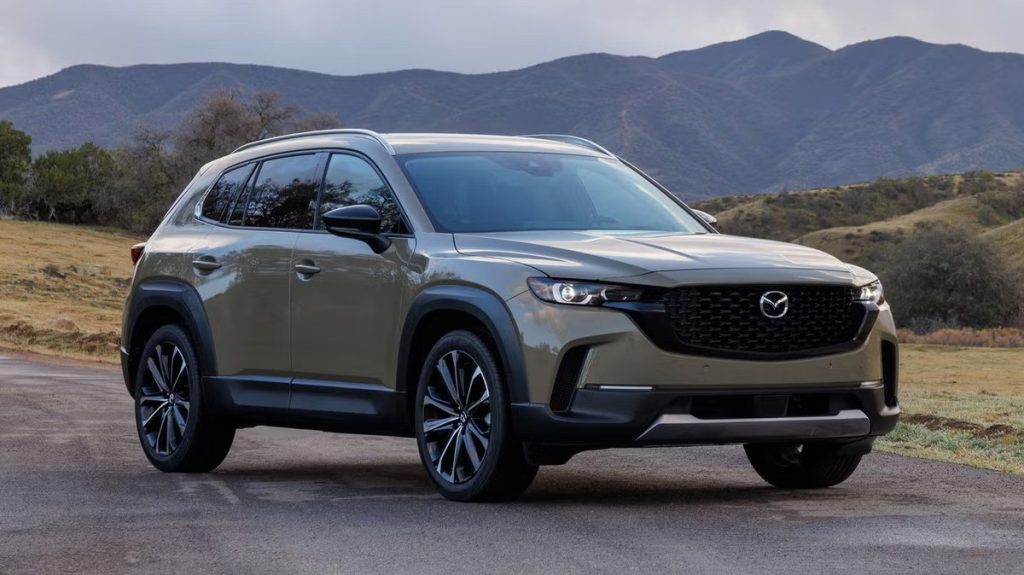
When Mazda unveiled the CX-50 Hybrid, it wasn’t just adding another efficient crossover — it was expanding its soul. For decades, Mazda has been defined by Jinba Ittai — the horse-and-rider connection — a philosophy built around intuitive control and emotional driving feel. Translating that into a hybrid SUV isn’t easy. Yet the CX-50 Hybrid manages to stay true to the brand’s DNA while delivering the kind of fuel economy that turns heads.
If you’ve been wondering about Mazda CX-50 hybrid mpg, how it performs in real life, and whether it’s worth choosing over the gas-powered versions, this detailed breakdown has you covered.
The Numbers: Official MPG Ratings
The 2025 Mazda CX-50 Hybrid is rated at approximately 38 mpg combined, making it one of the most fuel-efficient all-wheel-drive compact SUVs in its class. That breaks down to roughly 39 mpg in city driving and 37 mpg on the highway, depending on trim and conditions.
By comparison, the standard gas-powered CX-50 delivers about 28 mpg combined, while the turbocharged model hovers closer to 25 mpg. The Hybrid’s 10-to-12-mpg advantage is a significant improvement, particularly for a vehicle with full-time AWD capability.
Powertrain Overview: How the CX-50 Hybrid Achieves Its Efficiency
Under the hood, the CX-50 Hybrid pairs a 2.5-liter naturally aspirated four-cylinder engine with a trio of electric motors and a compact lithium-ion battery pack. Combined system output is around 219 horsepower, channeled through an electronic continuously variable transmission (e-CVT) and electric all-wheel drive.
This setup allows the SUV to use electric propulsion at low speeds or under gentle throttle, then blend in the gasoline engine when more power is required. The transition between the two power sources is nearly seamless, maintaining Mazda’s signature smoothness and responsiveness.
Other efficiency-focused features include:
- Regenerative braking, which captures energy normally lost during deceleration.
- Auto stop/start to eliminate idling fuel use.
- Smart throttle mapping that prioritizes electric drive when cruising at steady speeds.
Mazda’s engineers didn’t chase class-leading EV-only range — instead, they aimed for a natural driving feel that doesn’t betray its hybrid roots.
Real-World MPG Results
Official numbers tell only half the story. In real-world conditions, most CX-50 Hybrid owners report mid-30s mpg averages, sometimes even touching 40 mpg in warm weather or city-heavy driving.
- City Driving: Expect 38–41 mpg, especially in mild climates where the engine can stay off longer.
- Highway Driving: Around 33–35 mpg at 70–75 mph.
- Mixed Driving: A realistic combined average of 36–38 mpg for most owners.
Those who frequently drive in cold weather or take short trips may see figures dip into the low 30s, but that’s still well above the non-hybrid model’s average.
In practical terms, a single tank of fuel gives roughly 500–550 miles of total range, depending on terrain and load — impressive for a compact SUV with all-wheel drive.
How It Compares to the Non-Hybrid CX-50
Mazda offers three distinct powertrains across the CX-50 lineup:
| Powertrain | Horsepower | Combined MPG | Towing Capacity | Transmission |
|---|---|---|---|---|
| 2.5L Gas | ~187 hp | ~28 mpg | 2,000 lbs | 6-speed automatic |
| 2.5L Turbo | up to 256 hp | ~25 mpg | 3,500 lbs | 6-speed automatic |
| 2.5L Hybrid | 219 hp | ~38 mpg | 1,500 lbs | e-CVT |
The hybrid isn’t the quickest, but it’s far from slow. It delivers brisk acceleration thanks to instant electric torque, while maintaining composure and predictability. The trade-off comes in towing: the hybrid’s limit drops to about 1,500 lbs due to drivetrain design and cooling limits.
Still, for most daily driving scenarios — commuting, school runs, weekend trips — the efficiency far outweighs that drawback.
Driving Character: Still a Mazda at Heart
The biggest surprise about the CX-50 Hybrid isn’t its mpg — it’s how familiar it feels behind the wheel. Unlike some hybrids that isolate the driver from the experience, Mazda kept the steering, chassis, and balance deliberately engaging.
The steering is precise, with real feedback. The suspension tuning feels taut but controlled. Even though the Hybrid carries extra weight from its electric components, Mazda’s engineers tuned the dampers and spring rates to maintain a natural rhythm.
Noise levels are impressively low, too. The hybrid system’s electric mode glides through parking lots silently, while the gasoline engine hums smoothly under load. The e-CVT avoids the droning that plagues many hybrids by simulating stepped ratios under acceleration.
In short: the CX-50 Hybrid still drives like a Mazda — composed, connected, and genuinely enjoyable.
Interior and Comfort
Step inside, and it’s easy to forget this is a mainstream compact SUV. Mazda’s interior design philosophy favors simplicity and craftsmanship over clutter.
- Soft-touch materials and genuine stitching create an upscale feel.
- The 10.25-inch center display handles infotainment, now with wireless Apple CarPlay and Android Auto.
- Heated seats, panoramic moonroof, and Bose audio are available on higher trims.
- A digital driver display and clean analog gauges keep information intuitive.
Because the hybrid system’s battery sits beneath the rear seat, passenger and cargo space remain nearly identical to the gas models. Rear-seat comfort is good for two adults, and the cargo area (just under 30 cubic feet with seats up) can handle weekend gear or grocery hauls easily.
Safety and Reliability
Mazda’s i-Activsense safety suite comes standard across the CX-50 range. It includes adaptive cruise control, lane-keeping assist, blind-spot monitoring, rear cross-traffic alert, and automatic emergency braking.
Mazda’s hybrids are built on proven mechanicals, sharing components with its well-tested gasoline models. Warranty coverage typically includes:
- 3 years / 36,000 miles basic coverage
- 5 years / 60,000 miles powertrain coverage
- 8 years / 100,000 miles hybrid battery warranty
With conservative engineering and high-quality materials, the CX-50 Hybrid should age gracefully, just like its conventional siblings.
Pros and Cons: A Balanced View
Pros:
- Excellent fuel economy (mid-30s to upper-30s mpg)
- Standard AWD on all trims
- Premium interior design and materials
- Quiet, smooth operation
- Long driving range on a single tank
Cons:
- Lower towing capacity than gas versions
- Slightly slower acceleration than the turbo model
- Firm ride on rough roads
- Small battery means limited EV-only driving range
These trade-offs are mild, and most buyers will find the efficiency and refinement well worth it.
The Ideal Driver Profile
Who should buy the CX-50 Hybrid?
- Commuters: Its city mpg advantage pays off daily, especially if you face traffic.
- Families: Standard AWD and strong safety tech make it dependable year-round.
- Adventurers: Its raised stance and terrain-ready tuning handle weekend trails without punishing fuel costs.
- Eco-minded drivers: Offers hybrid efficiency without losing driving excitement.
If your routine includes both weekday commuting and weekend escapes, the CX-50 Hybrid fits perfectly — saving you fuel Monday through Friday, then delivering confidence and comfort on Saturday drives.
Price and Trim Overview
Pricing for the CX-50 Hybrid typically starts in the mid-$30,000s, with higher trims approaching $41,000 when fully loaded. Each trim level builds logically:
- Preferred Hybrid: Excellent value, well-equipped for daily driving.
- Premium Hybrid: Adds luxury touches like upgraded seating and moonroof.
- Premium Plus Hybrid: The top-tier choice with Bose audio, panoramic roof, and full suite of assists.
All models include AWD and the same hybrid powertrain.
Considering the standard features, fuel savings, and resale value, the Hybrid trim offers strong overall value within the CX-50 family.
Fuel Efficiency in Context
Mazda’s hybrid doesn’t chase Prius-level efficiency, but that’s not its goal. Instead, it strikes a balance: delivering near-40-mpg efficiency while keeping the personality that defines the brand.
The CX-50 Hybrid’s real-world fuel economy means:
- Fewer fill-ups per month.
- Lower annual fuel costs.
- Significantly reduced emissions versus the turbo model.
It’s the kind of efficiency that rewards both your wallet and your sense of purpose — without giving up the pleasure of driving.
Looking Ahead: Mazda’s Hybrid and EV Future
The CX-50 Hybrid is just the start of Mazda’s electrified era. The brand’s next-generation Skyactiv-Z hybrid system and new plug-in models are under development, promising even better mpg and stronger performance.
For now, the CX-50 Hybrid serves as a bridge between Mazda’s past and its future — blending traditional craftsmanship with modern sustainability.
Final Thoughts
The Mazda CX-50 Hybrid doesn’t just improve mpg; it refines what it means to drive efficiently. With around 38 mpg combined, engaging dynamics, and standard all-wheel drive, it’s proof that you don’t need to sacrifice excitement for economy.
If you’re searching for detailed specs, real offers, or want to experience the Hybrid’s smoothness firsthand, explore current specials and inventory at Marin Mazda — your local destination for the latest Mazda CX-50 models.
The numbers might draw you in, but the drive will win you over.
Mazda CX-50 Hybrid FAQ | Marin Mazda
1) What is the MPG for the Mazda CX-50 Hybrid?
The 2025 Mazda CX-50 Hybrid delivers an estimated 38 mpg combined, with around 39 mpg city and 37 mpg highway. Real-world driving often yields between 36–40 mpg, depending on conditions and driving style.
2) How does the CX-50 Hybrid compare to the gas version?
It’s roughly 10–12 mpg more efficient than the standard CX-50 (28 mpg combined) and 13–15 mpg better than the turbo version (25 mpg combined). That makes it one of the most fuel-efficient AWD crossovers in its class.
3) What engine does the CX-50 Hybrid use?
The hybrid pairs a 2.5-liter 4-cylinder engine with three electric motors and a lithium-ion battery, producing about 219 horsepower. Power is managed through an e-CVT transmission with standard electric AWD.
4) Does it drive like a traditional Mazda?
Yes. Despite its hybrid system, the CX-50 Hybrid retains Mazda’s signature Jinba Ittai feel — intuitive steering, composed handling, and excellent body control. It’s engaging, balanced, and confident in corners.
5) How far can it go on a tank of gas?
With a 500–550-mile range per tank, most drivers can travel well over 500 miles between fill-ups, depending on load, temperature, and terrain.
6) Does the hybrid offer EV-only driving?
Yes, but only for short distances at low speeds. Mazda prioritized smooth transitions and natural driving feel over extended electric range, focusing on balance rather than gimmicks.
7) What’s the towing capacity?
The CX-50 Hybrid can tow up to 1,500 lbs, compared to 2,000 lbs for the base gas model and 3,500 lbs for the turbocharged version.
8) How does it perform in city driving?
Exceptionally well. In urban traffic, the hybrid system frequently operates in electric mode, achieving up to 40 mpg in stop-and-go driving while staying quiet and refined.
9) What about highway performance?
On highways, it averages around 33–35 mpg at 70–75 mph. Acceleration is smooth and responsive thanks to instant electric torque.
10) Is the CX-50 Hybrid quiet?
Yes. The cabin is well-insulated and serene, with electric drive near-silence at low speeds. The engine engages seamlessly and avoids the “rubber band” noise common in other hybrids.
11) What trims are available for the CX-50 Hybrid?
- Preferred Hybrid – Core features, excellent value.
- Premium Hybrid – Adds upgraded seating and moonroof.
- Premium Plus Hybrid – Top trim with Bose audio, panoramic roof, and advanced driver aids.
12) How much does the Mazda CX-50 Hybrid cost?
Pricing starts around the mid-$30,000 range and climbs to about $41,000 for fully equipped trims. All include AWD and the same hybrid powertrain.
13) Is cargo space affected by the hybrid system?
Barely. The battery sits under the rear seats, preserving most of the 30 cu. ft. of cargo space found in the gas models. Passenger comfort remains identical.
14) What interior features stand out?
- 10.25-inch infotainment display with wireless Apple CarPlay/Android Auto
- Heated seats (available ventilated in higher trims)
- Optional Bose® 12-speaker audio
- Panoramic moonroof
- Premium stitching and minimalist design inspired by Japanese craftsmanship
15) What safety features come standard?
Mazda’s i-Activsense suite includes:
- Adaptive cruise control
- Lane-keeping assist
- Blind-spot monitoring
- Rear cross-traffic alert
- Automatic emergency braking
All trims come with standard AWD and top-tier crash safety ratings.
16) Is the hybrid system reliable?
Yes. The hybrid setup uses proven technology shared with Mazda’s global partners, paired with Mazda’s long-standing Skyactiv durability standards. It’s backed by an 8-year / 100,000-mile hybrid battery warranty.
17) What are the pros of the CX-50 Hybrid?
- 38 mpg combined efficiency
- Standard AWD
- Premium, quiet cabin
- Long driving range
- Smooth, natural hybrid feel
18) Any downsides?
- Lower towing capacity (1,500 lbs)
- Slightly firmer suspension
- Limited EV-only range
These are small trade-offs for such a capable, efficient SUV.
19) Who should buy the CX-50 Hybrid?
Ideal for commuters, families, and outdoor enthusiasts who want efficiency without giving up Mazda’s fun-to-drive dynamics. It’s a perfect fit for drivers balancing weekday mileage and weekend adventures.
20) Where can I test drive or find CX-50 Hybrid offers?
Visit Marin Mazda in San Rafael, California, to explore current CX-50 Hybrid lease and finance specials. You can also view updated incentives and inventory anytime through the Marin Mazda Specials Page.
Verdict:
The Mazda CX-50 Hybrid blends near-40-mpg efficiency with genuine driving pleasure — proof that sustainability and soul can coexist. If you want a hybrid SUV that feels like a Mazda should, this is the one to drive.
Mazda CX-50 Hybrid FAQ | Marin Mazda
1) What is the MPG for the Mazda CX-50 Hybrid?
The 2025 Mazda CX-50 Hybrid achieves around 38 mpg combined (≈ 39 city / 37 highway). Real-world drivers often see 36–40 mpg depending on conditions and driving style.
2) How does it compare to the gas CX-50?
It’s 10–12 mpg more efficient than the standard model (≈ 28 mpg) and 13–15 mpg better than the Turbo (≈ 25 mpg), making it one of the most fuel-efficient AWD crossovers in its class.
3) What engine powers the CX-50 Hybrid?
A 2.5-L four-cylinder engine paired with three electric motors and a lithium-ion battery producing ≈ 219 hp, managed by an e-CVT with electric AWD.
4) Does it still drive like a Mazda?
Yes. It keeps the brand’s Jinba Ittai balance with precise steering, composed suspension, and natural response rare in hybrids.
5) What’s the driving range per tank?
Typically 500–550 miles, depending on terrain and climate—excellent for an AWD compact SUV.
6) Can it run on electric power only?
Yes, for short distances at low speeds. Mazda tuned it for smooth, automatic transitions rather than long EV-only range.
7) How much can it tow?
Up to 1,500 lbs, versus 2,000 lbs for the gas and 3,500 lbs for the Turbo version.
8) Is the CX-50 Hybrid quiet?
Extremely. Electric operation is silent, and the engine engages smoothly without the drone common in other hybrids.
9) Is cargo space reduced?
Barely—its battery sits beneath the rear seat, so cargo stays near 30 cu ft, matching the gas model.
10) What trims are offered?
Preferred Hybrid, Premium Hybrid, and Premium Plus Hybrid—all AWD with the same hybrid powertrain.
11) What’s the price range?
Roughly mid-$30 Ks to about $41 K, depending on trim and options.
12) Which features stand out inside?
10.25-inch display with wireless Apple CarPlay/Android Auto, heated seats, available Bose® audio, panoramic moonroof, and premium stitching throughout.
13) What safety technology comes standard?
Mazda i-Activsense suite: Adaptive Cruise Control, Lane-Keep Assist, Blind-Spot Monitoring, Rear Cross-Traffic Alert, and Automatic Emergency Braking.
14) How reliable is the hybrid system?
Very. It uses proven technology and is protected by an 8-year / 100,000-mile battery warranty plus Mazda’s 5-year powertrain coverage.
15) Who should buy the CX-50 Hybrid?
Drivers who want hybrid efficiency without losing Mazda’s driving spirit—ideal for commuters, families, and weekend explorers.
16) Where can I test drive or find offers?
Visit Marin Mazda, 807 Francisco Blvd E, San Rafael, CA 94901.
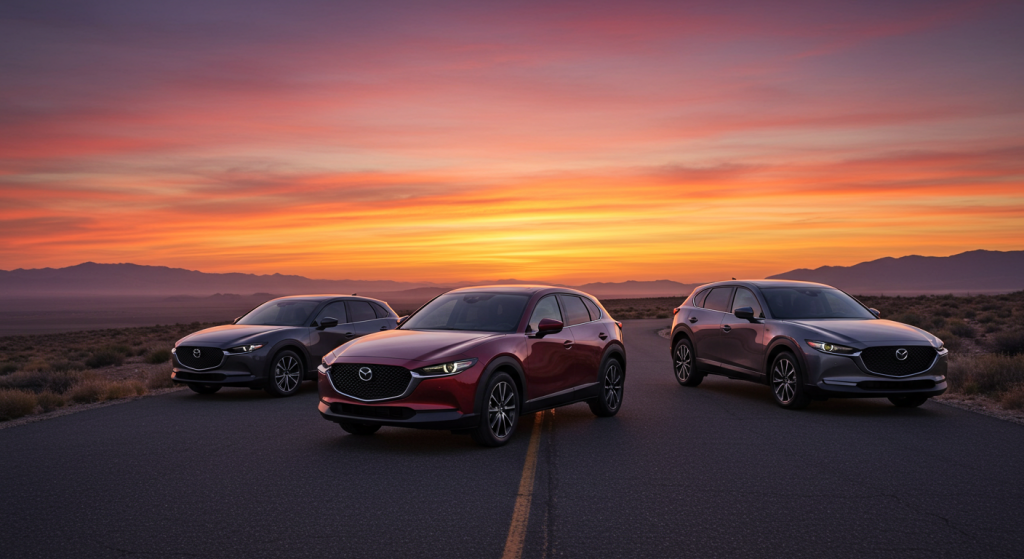
There’s a moment when driver and machine stop being separate. When every curve of the road, every weight shift in a corner, feels intuitive — like a shared heartbeat. That moment defines Mazda’s philosophy of Jinba Ittai, the “horse and rider as one.”
Even as the world shifts toward electrification and crossovers, Mazda continues to build SUVs that feel alive in your hands. Across its 2025 and 2026 lineup, the brand blends craftsmanship, balance, and design purity with modern tech and powertrains. From the nimble CX-30 to the commanding CX-90, and now with hybrid and plug-in variants, Mazda’s latest SUVs prove that driving emotion and practicality can coexist.
This in-depth guide explores every major Mazda SUV for 2025 and 2026 — highlighting key specs, features, updates, and which one best fits your lifestyle.
Mazda’s 2025–2026 SUV Lineup at a Glance
Mazda’s North American SUV portfolio now includes:
- CX-30 – Compact crossover for urban agility
- CX-5 – All-new for 2026 with bolder styling and added tech
- CX-50 – Rugged adventure-oriented compact SUV, now with hybrid power
- CX-70 – Two-row midsize luxury SUV (gas and plug-in hybrid)
- CX-90 – Flagship three-row SUV, Mazda’s most powerful and premium model
Each model reflects Mazda’s KODO design language — simple, elegant, yet expressive. The lineup ranges from everyday crossovers to luxury-leaning models with inline-six engines and plug-in hybrid systems.
CX-30: The Compact Mazda with a Big Personality
The CX-30 remains Mazda’s entry point into its SUV family, yet it feels anything but basic. Built for those who want nimble dynamics and upscale design in a small footprint, the 2025 CX-30 still ranks among the most engaging compact crossovers on sale.
Highlights:
- Engine: 2.5-liter Skyactiv-G four-cylinder
- Power: 187 hp / 186 lb-ft of torque
- Transmission: 6-speed automatic
- Drivetrain: Standard all-wheel drive
- Fuel economy: 25–28 mpg combined
- Starting MSRP: Around $24,000–$27,000
Inside, the CX-30 offers a cabin that feels closer to an Audi than an entry-level crossover. The design is minimalist yet warm, materials are rich, and every control feels carefully placed.
Pros: Agile handling, standard AWD, premium build quality.
Cons: Tight rear seats and modest cargo space.
Best for: City drivers who crave sophistication without upsizing to a bigger SUV.
CX-5: Mazda’s Core SUV, All-New for 2026
The CX-5 has long been Mazda’s best-seller, known for its balance of comfort, control, and design. But the compact SUV market has evolved, and Mazda responded with a complete redesign for 2026.
2025 CX-5 (Outgoing Model)
Still a strong choice, the 2025 CX-5 features:
- 2.5-liter four-cylinder: 187 hp
- Optional 2.5-liter turbo: up to 256 hp and 320 lb-ft (on premium fuel)
- AWD standard across trims
- 6-speed automatic transmission
- Fuel economy: up to 31 mpg highway
- MSRP: ~$28,500 and up
The 2025 CX-5 delivers a near-luxury driving experience, precise steering, and top-tier safety ratings. But interior space and tech were beginning to show their age.
2026 CX-5 (Redesigned Model)
Mazda’s July 2025 reveal confirmed a complete rework for 2026. The new CX-5 gains roughly four inches in length and a longer wheelbase, translating to a roomier back seat and improved cargo area.
Notable upgrades:
- Standard AWD
- 12.9-inch infotainment screen (up to 15.6 inches on higher trims)
- More sculpted KODO styling with slimmer lights and bolder stance
- Revised suspension for smoother ride quality
- Expected MSRP: Slightly above $30,000
While the initial engine lineup continues with the familiar 2.5-liter four-cylinder (187 hp), a hybrid version is reportedly coming for 2027.
Pros: Modern design, better rear-seat space, upgraded tech, improved refinement.
Cons: No hybrid yet, only one engine at launch, aging 6-speed automatic.
Best for: Families or commuters wanting Mazda’s driving DNA with a touch of luxury.
CX-50: Rugged Refinement, Now with a Hybrid Option
When Mazda introduced the CX-50, it carved a new path — a crossover for people who actually use their SUVs outdoors. Wider, lower, and tougher than the CX-5, the CX-50 blends off-road cues with Mazda’s road-handling finesse.
2025 CX-50 Gasoline Models
- 2.5-liter four-cylinder: 187 hp
- Optional 2.5-liter turbo: 256 hp / 320 lb-ft (on premium)
- AWD standard
- 6-speed automatic
- Fuel economy: 25–28 mpg combined
- Towing: Up to 3,500 lbs
- MSRP: Around $30,000–$43,000
Car and Driver praised the CX-50’s “rugged but refined” character and its near-luxury cabin quality. Edmunds called it one of the best compact crossovers for enthusiasts.
2025 CX-50 Hybrid
New for 2025, Mazda added a hybrid version co-developed with Toyota. It uses a 2.5-liter gas engine plus three electric motors for a total of 219 hp and up to 38 mpg combined — a major efficiency leap.
Performance is brisk, with 0–60 mph in about 7.6 seconds. The hybrid’s battery placement reduces cargo volume slightly, and the CVT transmission sacrifices a bit of the crisp engagement of Mazda’s standard automatic.
Hybrid starting price: ~$35,800
Pros: Great fuel economy, AWD standard, high-end cabin.
Cons: CVT droning at high speeds, smaller cargo hold, less towing ability (1,500 lbs).
Best for: Outdoor enthusiasts or commuters who want efficiency without losing Mazda’s dynamic feel.
Imagine a weekend trip through California’s coastal backroads in a CX-50 Hybrid — silent electric glides through redwood canyons, then turbo torque for steep mountain passes. It’s that blend of tranquility and control that defines Mazda’s new direction.
CX-70: The Sweet Spot Between Space and Performance
Mazda’s CX-70 targets buyers who don’t need three rows but want something bigger, faster, and more refined than a compact SUV. It rides on the same rear-wheel-drive platform as the CX-90, sharing powertrains but in a sportier, two-row format.
Powertrains
- 3.3-liter turbocharged inline-six (mild hybrid): 280 hp in base form, 340 hp in S trims
- Plug-in hybrid (PHEV): 2.5-liter engine + electric motor = 323 hp total, 26 miles EV range
- Transmission: 8-speed automatic
- AWD standard
- Starting MSRP: Around $40,400
The CX-70’s long hood, low stance, and clean proportions give it near-luxury presence. Inside, stitched leather, wood trims, and a wide digital display reinforce that impression.
Driving Character
The inline-six engine delivers effortless torque and refinement, rivaling European luxury rivals like BMW’s X5. The PHEV variant offers both strong acceleration and meaningful electric range for short commutes.
2026 Updates
Mazda plans pricing adjustments for 2026, lowering the PHEV’s entry point by roughly $10,000 to make it more accessible. Minor updates include new blacked-out trim and improved EV-only drive control.
Pros: Smooth and powerful inline-six, luxury-level refinement, hybrid option, large cabin for five.
Cons: Heavy curb weight, modest EV range, premium price.
Best for: Couples or small families who want performance and luxury without the bulk of a three-row SUV.
CX-90: Mazda’s Flagship Family SUV
The CX-90 stands as Mazda’s boldest move yet — a three-row SUV that aims to bridge mainstream and luxury. It replaces the CX-9 and signals Mazda’s ambition to challenge premium brands directly.
2025 CX-90 Overview
- 3.3-liter turbo inline-six (mild hybrid): 280 hp base, 340 hp in high-output trims
- Plug-in Hybrid (PHEV): 2.5-liter + electric motor, 323 hp, 25 miles EV range
- Transmission: 8-speed automatic
- AWD standard (rear-biased)
- Fuel economy: 24–28 mpg combined for gas models, 56 MPGe equivalent for PHEV
- Towing: 3,500–5,000 lbs
- Starting MSRP (2026): ~$38,800
The CX-90’s interior could pass for a luxury car: available Nappa leather, wood accenting, ambient lighting, and a minimalist dashboard design. The cabin feels calm and cohesive — quintessential Mazda.
Car and Driver lauded its “dynamic polish and premium ride,” while the IIHS named it a Top Safety Pick+.
On the Road
The CX-90 doesn’t feel like a bulky family hauler. Thanks to its balanced chassis and rear-drive bias, it’s one of the most composed large SUVs to drive. Kinematic Posture Control — first seen in the MX-5 Miata — subtly brakes the inside wheel in corners to reduce body roll, keeping the SUV planted and poised.
Weaknesses
The PHEV version is efficient but can feel heavy under hard acceleration. The third row is tight for adults, and cargo space behind it (about 15 cubic feet) is modest compared to rivals.
Pros: Luxurious interior, strong performance, available PHEV, excellent driving manners.
Cons: Expensive in top trims, limited third-row space, heavier feel in city driving.
Best for: Families who want luxury, safety, and refinement without losing driving enjoyment.
Which Mazda SUV Should You Choose?
Every Mazda SUV channels the brand’s signature driver engagement but appeals to different needs:
- CX-30: Best for city dwellers or first-time SUV buyers.
- CX-5 (2026): The ideal all-rounder — modern, comfortable, and balanced.
- CX-50 Hybrid: Perfect mix of adventure styling and real-world efficiency.
- CX-70: Refined midsize luxury for five passengers; power and polish.
- CX-90: The flagship choice for families, luxury seekers, and long-distance cruisers.
For pure fun-to-drive value, the CX-50 Turbo remains unmatched among compact SUVs. For long hauls and comfort, the CX-90 leads the pack. Those focused on economy should test the CX-50 Hybrid or wait for Mazda’s upcoming CX-5 Hybrid in 2027.
Mazda’s Future: Electrification with Soul
Mazda has announced a major shift toward electrified powertrains by the late 2020s. The upcoming Skyactiv-Z hybrid system (debuting around 2027) will introduce Mazda-designed hybrid tech rather than Toyota’s shared systems.
At the same time, the brand plans to expand its plug-in hybrid lineup and introduce new EVs on a scalable architecture. If the CX-90 and CX-70 are any indication, Mazda’s electric and hybrid future will still carry its defining trait — an emotional connection between driver and machine.
Final Thoughts
Mazda’s 2025–2026 SUV lineup is the most complete and compelling in the brand’s history. Whether you’re drawn to the athletic CX-30, the refreshed 2026 CX-5, the adventure-ready CX-50, the refined CX-70, or the luxurious CX-90, there’s a model that resonates with Mazda’s promise of human-centered design and joyful motion.
In a world where crossovers often blur into anonymity, Mazda still builds vehicles that make you want to drive — not just commute.
Explore inventory or schedule a test drive today at Marin Mazda.
Mazda 2025–2026 SUVs: FAQ
1) Which Mazda SUVs are in the 2025–2026 lineup?
CX-30, CX-5 (all-new for 2026), CX-50 (including Hybrid), CX-70 (gas & PHEV), and CX-90 (gas & PHEV).
2) What’s the main difference between CX-30 and CX-5 (2026)?
CX-30 is smaller and sportier for city life; the 2026 CX-5 grows in size with more rear-seat room, cargo space, and a larger infotainment screen.
3) Is AWD standard on Mazda SUVs?
Yes. CX-30, CX-5 (2025/2026), CX-50, CX-70, and CX-90 all include standard i-Activ AWD in the U.S.
4) Which Mazda SUV is best for families of five?
For two rows: CX-70 (most space, luxury, power). For three rows: CX-90 (seats up to 7–8 depending on configuration).
5) Which Mazda SUV is most fun to drive?
For compacts: CX-50 Turbo. For midsize: CX-70 with the 340-hp inline-six. For three-row: CX-90 with the high-output inline-six.
6) Does Mazda offer hybrids or plug-in hybrids?
Yes. CX-50 Hybrid (~219 hp, ~38 mpg combined). CX-70 PHEV & CX-90 PHEV (~323 hp, ~26–25 miles EV range, respectively).
7) CX-50 Hybrid vs CX-50 Turbo — which should I pick?
Choose Hybrid for fuel efficiency and daily commuting; Turbo for maximum performance (up to 256 hp, 3,500-lb towing, traditional 6-speed feel).
8) What’s new on the 2026 CX-5?
Larger body and wheelbase, upgraded ride quality, modernized cabin with 12.9″ (up to 15.6″) infotainment, bolder styling; AWD remains standard.
9) Any fuel-economy highlights?
Top efficiency: CX-50 Hybrid (~38 mpg combined). CX-30/CX-5/CX-50 gas models generally score ~25–28 mpg combined. PHEVs achieve high MPGe in EV use.
10) Towing capacity across the lineup?
- CX-50 Turbo: up to 3,500 lbs
- CX-50 Hybrid: 1,500 lbs
- CX-70/CX-90 gas inline-six: typically up to 5,000 lbs (trim/equipment dependent)
- PHEVs: 3,500–5,000 lbs (check specific build)
11) Which Mazda SUV has the nicest interior?
CX-90 leads with Nappa leather, wood trims, and premium design; CX-70 mirrors that luxury in a two-row layout. CX-50 offers near-luxury finishes in a compact.
12) Are Mazda SUVs safe?
Yes. Recent models commonly earn IIHS Top Safety Pick+ ratings and include i-Activsense features (adaptive cruise, lane keeping, blind-spot, AEB) as standard or widely available.
13) How do the inline-six models (CX-70/CX-90) feel to drive?
Refined and torquey with a rear-drive bias; the 3.3L turbo I-6 (mild hybrid) delivers smooth power and premium road manners.
14) PHEV basics: charging and EV range?
CX-70/CX-90 PHEV offer ~25–26 miles of EV range for short commutes; they can be charged on Level 1 (household) or faster on Level 2 home chargers.
15) Which Mazda SUV is best for light off-roading?
CX-50 (especially Meridian-style packages) thanks to its stance, tuning, and available all-terrain add-ons; still very composed on pavement.
16) What’s the price landscape?
Approximate U.S. starting points (can vary by region/trim):
- CX-30: mid-$20Ks
- CX-5 (2026): low-$30Ks
- CX-50: low-$30Ks (Hybrid mid-$30Ks)
- CX-70: low-$40Ks (PHEV higher)
- CX-90: high-$30Ks (PHEV/upper trims higher)
17) Any downsides to note?
CX-30 rear space is snug; CX-50 Hybrid tows less and uses a CVT; early 2026 CX-5 launches without a hybrid; CX-90 third row is tight for adults.
18) How do warranties work?
Most Mazda SUVs carry a 3-yr/36,000-mi basic and 5-yr/60,000-mi powertrain warranty; PHEV/Hybrid components include additional battery coverage (commonly 8-yr/100,000-mi).
19) Which Mazda SUV gives the best value overall?
For compact buyers: CX-30 Preferred or CX-50 Preferred. For space/luxury per dollar: CX-70 (base I-6). For max features with family flexibility: CX-90 mid trims.
20) Where can I see current offers or schedule a test drive?
Check live specials, inventory, and test-drive availability at Marin Mazda to compare trims, PHEV vs. hybrid vs. turbo, and lock in regional incentives.
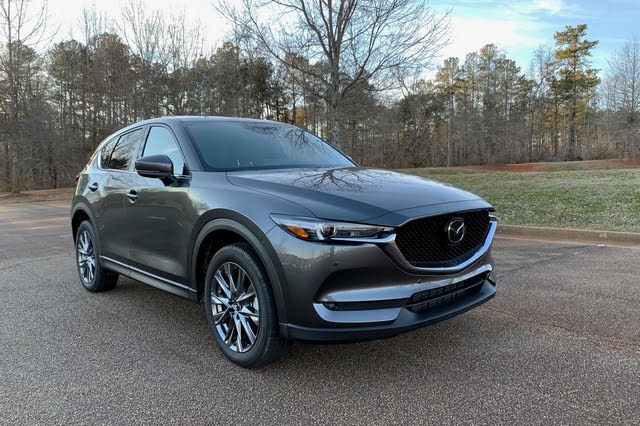
If you’ve been searching for a versatile, stylish, and reliable SUV that won’t break the bank, the Mazda CX-5 for sale might be the perfect answer to your quest. Often overlooked in a sea of cookie-cutter crossovers, the CX-5 has steadily earned its place as one of the best compact SUVs in its class. It’s not just a car—it’s a driver’s machine, blending upscale design, engaging performance, and real-world practicality.
In this blog, we’ll break down why the Mazda CX-5 continues to win awards and hearts—and why your next step should be to book a test drive at Marin Mazda.
1. Why the Mazda CX-5 Stands Out
The compact SUV segment is crowded—Toyota RAV4, Honda CR-V, Hyundai Tucson, and Subaru Forester all compete here. But Mazda CX-5 differentiates itself with a focus on premium experience, refined styling, and class-leading driving dynamics.
What makes it special?
- Sleek and elegant Kodo design
- Near-luxury interior quality
- Agile, sporty handling
- Advanced safety tech across all trims
- High resale value and owner satisfaction
For buyers looking at listings of Mazda CX-5 for sale, these aren’t just perks—they’re game changers.
2. Engine Options & Performance
One of the most unique traits of the CX-5 is that it drives like a much more expensive car.
Available Engines:
- 2.5L Skyactiv-G Inline-4 (187 hp)
- 2.5L Turbocharged Skyactiv-G (up to 256 hp with premium fuel)
Both engines are paired with a 6-speed automatic transmission, and all trims now come with standard i-ACTIV AWD—a rare benefit in this price range.
From daily commutes to spirited weekend drives on Highway 1, the CX-5 is the SUV that actually makes you enjoy driving again.
🔍 Explore current engine specs and trims at Marin Mazda.
3. Interior: Premium Without the Premium Price
Step inside a CX-5 and you’ll be forgiven for thinking you’ve entered a luxury SUV. The attention to detail is impeccable, with features you might expect from a Lexus or Acura:
- Available Nappa leather seating
- Real wood and aluminum accents
- Heated & ventilated front seats
- Power moonroof
- 10.25” infotainment with Mazda Connect
Even base trims feel elevated, offering dual-zone climate control, a leather-wrapped steering wheel, and push-button start.
🚗 Ready to experience the interior in person? Schedule a test drive.
4. Safety: A Top Choice for Families
Every Mazda CX-5 comes equipped with i-Activsense, Mazda’s advanced suite of driver assistance features:
- Radar cruise control with stop & go
- Blind spot monitoring with rear cross-traffic alert
- Lane departure warning with lane keep assist
- Smart Brake Support with pedestrian detection
These features helped the CX-5 earn a Top Safety Pick+ rating from IIHS and a 5-star safety score from NHTSA.
When looking at a Mazda CX-5 for sale, especially for family use, this safety-first engineering is a huge advantage.
5. Trims & Pricing Breakdown (2025 US Model)
| Trim | Starting MSRP (USD) | Key Features |
|---|---|---|
| 2.5 S Select | $29,300 | AWD, Blind Spot Monitor, Apple CarPlay |
| 2.5 S Preferred | $30,650 | Moonroof, Power Driver Seat, Leatherette |
| 2.5 S Carbon Edition | $32,000 | Unique styling, red leather interior |
| 2.5 Turbo Premium | $37,800 | 256-hp Turbo, Bose Audio, Heads-Up Display |
| 2.5 Turbo Signature | $40,600 | Nappa Leather, Wood Trim, 360° Camera |
🔎 Want to explore deals and inventory? See CX-5 models in stock.
6. Mazda CX-5 vs the Competition
| Feature | Mazda CX-5 | Honda CR-V | Toyota RAV4 |
|---|---|---|---|
| AWD Standard | ✅ | ❌ | ❌ |
| Horsepower (Turbo) | 256 hp | 190 hp | 203 hp |
| Interior Finish | Premium | Functional | Durable |
| Safety Tech | Standard | Partial | Partial |
| Drive Feel | Engaging | Composed | Neutral |
| Warranty | 5 yr / 60K mi | 5 yr / 60K mi | 5 yr / 60K mi |
The CX-5 not only beats rivals on performance and feel—but also delivers real value where it matters.
7. Fuel Economy & Efficiency
- Standard 2.5L Engine: 26 MPG city / 31 MPG highway
- Turbocharged Engine: 22 MPG city / 27 MPG highway
With Skyactiv Technology optimizing every element from combustion to transmission, the CX-5 strikes an excellent balance between performance and economy.
Check exact specs based on your location at Marin Mazda.
8. Used Mazda CX-5 for Sale: Is It Worth It?
Absolutely. Mazda’s long-term reliability and low maintenance costs make the CX-5 a fantastic pre-owned option as well.
Benefits of choosing a used or Certified Pre-Owned (CPO) CX-5:
- 160-point inspection (CPO)
- 12-month/12,000-mile CPO warranty
- Powertrain warranty up to 7 years / 100,000 miles
- Low depreciation vs. competitors
9. Real Owner Testimonials
Here’s what some real-world CX-5 drivers are saying:
“I traded my BMW X3 for a CX-5 and I don’t regret it. The interior quality and handling are surprisingly similar at half the price.”
— Amanda L., Marin County
“Got a turbo CX-5 and it’s a rocket. The AWD grip is great for Tahoe trips and the Bose system rocks.”
— James B., San Francisco
“Safe, reliable, and fun to drive. This is my second CX-5 and probably won’t be my last.”
— Rachel M., Concord
10. Who Should Buy a Mazda CX-5?
The CX-5 is ideal for:
- Commuters seeking comfort and MPG
- Young families needing safety and space
- Drivers who value refinement and fun
- Buyers who want luxury feel without luxury prices
Whether you’re leasing new or buying pre-owned, a Mazda CX-5 for sale is one of the smartest SUV investments you can make.
📍 Where to Find a Mazda CX-5 for Sale in Northern California
If you’re located in San Rafael, San Francisco, Concord, or anywhere in the Bay Area—your best bet is Marin Mazda.
They offer:
- Competitive pricing and lease offers
- Transparent quotes with no hidden fees
- Expert team focused on customer experience
- Service and financing all under one roof
🛻 Browse CX-5 inventory now
💰 Check current CX-5 lease offers
📞 Contact the team
✅ Final Verdict: Is the Mazda CX-5 Worth It?
If you’re searching for “Mazda CX-5 for sale” with performance, style, and long-term value in mind—the answer is a confident yes.
The CX-5 continues to offer what few others can: a true blend of head and heart. Whether you’re an enthusiast or a family-focused buyer, it checks every box and then some.
Take it from the experts—and thousands of happy drivers—your next SUV should be a Mazda CX-5.
Mazda CX-5 FAQ | Marin Mazda
1) Why is the Mazda CX-5 so popular?
Because it delivers premium quality and performance at a mainstream price. The CX-5 combines refined KODO design, upscale interiors, and sharp driving dynamics that make it stand out in the crowded compact SUV segment.
2) What engine options are available?
- 2.5L Skyactiv-G Inline-4: 187 hp, smooth and efficient.
- 2.5L Turbocharged Skyactiv-G: Up to 256 hp and 320 lb-ft of torque with premium fuel.
Both use a 6-speed automatic transmission and standard i-ACTIV AWD across all trims.
3) Does the Mazda CX-5 come with all-wheel drive?
Yes. Every 2025 CX-5 includes standard i-ACTIV AWD, providing confident traction on wet, snowy, or uneven roads — a feature often optional on competitors.
4) What is the fuel economy?
- 2.5L: ~26 mpg city / 31 mpg highway
- 2.5L Turbo: ~22 mpg city / 27 mpg highway
Efficient Skyactiv Technology optimizes combustion and transmission response for excellent real-world economy.
5) How many trims does the CX-5 offer?
Five primary U.S. trims:
| Trim | Starting MSRP | Key Features |
|---|---|---|
| 2.5 S Select | ~$29,300 | AWD, Blind Spot Monitor, Apple CarPlay |
| 2.5 S Preferred | ~$30,650 | Moonroof, Leatherette, Power Driver Seat |
| 2.5 S Carbon Edition | ~$32,000 | Red Leather, Black Accents |
| 2.5 Turbo Premium | ~$37,800 | 256-hp Turbo, Bose Audio, HUD |
| 2.5 Turbo Signature | ~$40,600 | Nappa Leather, 360° Camera, Wood Trim |
6) How does the CX-5 compare to other SUVs?
| Feature | Mazda CX-5 | Honda CR-V | Toyota RAV4 |
|---|---|---|---|
| AWD Standard | ✅ | ❌ | ❌ |
| Turbo Power | 256 hp | 190 hp | 203 hp |
| Interior Quality | Premium | Functional | Durable |
| Safety Tech | Standard | Partial | Partial |
| Drive Feel | Engaging | Composed | Neutral |
Mazda prioritizes driver connection and refinement, delivering a more emotional and engaging experience than most rivals.
7) How safe is the CX-5?
Every trim includes Mazda’s i-Activsense safety suite:
- Radar Cruise Control (Stop & Go)
- Blind Spot Monitoring
- Lane Keep Assist & Lane Departure Warning
- Smart Brake Support (with pedestrian detection)
It’s consistently rated IIHS Top Safety Pick+ and 5 stars by NHTSA.
8) What interior features make the CX-5 feel premium?
- Available Nappa leather seats and wood trim
- Dual-zone climate control
- Heated & ventilated front seats
- Power moonroof
- 10.25-inch infotainment with Mazda Connect
Even base models feel upscale with soft-touch materials and thoughtful ergonomics.
9) Is the CX-5 reliable?
Yes — Mazda’s proven Skyactiv engines and transmissions are known for durability and low maintenance costs. Owner surveys consistently rank the CX-5 among the most reliable compact SUVs.
10) Is the CX-5 good for families?
Absolutely. With advanced safety tech, comfortable seating for five, and a quiet, solid cabin, the CX-5 is a favorite among small families.
11) What is the towing capacity?
The CX-5 can tow up to 2,000 lbs, making it capable of handling small trailers or recreational equipment.
12) Are used Mazda CX-5 models worth buying?
Yes. Certified Pre-Owned CX-5s offer:
- 160-point inspection
- 12-month/12,000-mile CPO warranty
- 7-year/100,000-mile powertrain coverage
With strong resale value and reliability, they’re excellent used buys.
13) Does the CX-5 require premium fuel?
Only the turbocharged model benefits from premium fuel (to achieve full 256 hp). It still runs safely on regular unleaded, producing around 227 hp.
14) How does the CX-5 drive?
It feels connected, athletic, and composed — far closer to a European compact SUV in feel. Steering precision and chassis tuning make it one of the most engaging SUVs to drive.
15) What colors are available?
Popular colors include Soul Red Crystal, Machine Gray Metallic, Deep Crystal Blue, Jet Black, and Rhodium White. Carbon Edition adds unique dark styling and red interior options.
16) What are ownership costs like?
Mazda offers competitive maintenance pricing, moderate insurance rates, and excellent fuel efficiency — giving it one of the lowest cost-of-ownership profiles in its class.
17) How long will a CX-5 last?
With proper maintenance, many owners report 200,000+ miles of reliable service — a testament to Mazda’s engineering and build quality.
18) Is the CX-5 comfortable for long drives?
Yes. With its ergonomic seating, quiet ride, and high-quality suspension tuning, the CX-5 is ideal for daily commutes or weekend road trips.
19) Who is the CX-5 best suited for?
It’s perfect for:
- Commuters seeking comfort and MPG
- Families prioritizing safety
- Drivers who value handling and design
- Buyers wanting luxury feel without luxury pricing
20) Where can I find a Mazda CX-5 for sale in Northern California?
Visit Marin Mazda — your Bay Area destination for the latest CX-5 inventory. Browse special offers, lease deals, and Certified Pre-Owned options.
Whether you’re in San Rafael, San Francisco, or Sonoma, Marin Mazda offers transparent pricing, expert staff, and an unmatched Mazda experience.
Verdict:
The Mazda CX-5 remains one of the best compact SUVs on the road — combining style, reliability, and genuine driving enjoyment. If you’re searching for a Mazda CX-5 for sale near the Bay Area, Marin Mazda is the place to start your journey.
Mazda CX-5 FAQ | Marin Mazda
1) Why is the Mazda CX-5 so popular?
It delivers premium craftsmanship, engaging performance, and high reliability at a mainstream price — combining luxury-grade design and safety with true driver enjoyment.
2) What engine options are available?
- 2.5 L Skyactiv-G I-4: 187 hp, efficient and refined.
- 2.5 L Turbo Skyactiv-G: Up to 256 hp and 320 lb-ft torque (on premium fuel).
Both feature a 6-speed automatic and standard i-Activ AWD.
3) Does every CX-5 have AWD?
Yes — all 2025 CX-5 trims include standard AWD, enhancing traction in rain, snow, or uneven terrain.
4) What’s the fuel economy?
Approx. 26 mpg city / 31 mpg hwy (base) and 22 / 27 mpg (turbo). Skyactiv Technology ensures optimal balance of power and efficiency.
5) How many trims are offered?
| Trim | Starting MSRP | Highlights |
|---|---|---|
| 2.5 S Select | ≈ $29,300 | AWD, Blind-Spot Monitor, Apple CarPlay |
| 2.5 S Preferred | ≈ $30,650 | Moonroof, Power Driver Seat, Leatherette |
| 2.5 S Carbon Edition | ≈ $32,000 | Red Leather, Black Accents |
| 2.5 Turbo Premium | ≈ $37,800 | 256 hp Turbo, Bose Audio, HUD |
| 2.5 Turbo Signature | ≈ $40,600 | Nappa Leather, 360° Camera, Wood Trim |
6) How does it compare to rivals?
| Feature | Mazda CX-5 | Honda CR-V | Toyota RAV4 |
|---|---|---|---|
| AWD Standard | ✅ | ❌ | ❌ |
| Turbo Power | 256 hp | 190 hp | 203 hp |
| Interior Quality | Premium | Functional | Durable |
| Drive Feel | Engaging | Composed | Neutral |
7) How safe is the CX-5?
Every trim includes i-Activsense: adaptive cruise, lane-keep assist, blind-spot and cross-traffic alerts, and Smart Brake Support. Rated IIHS Top Safety Pick+ and NHTSA 5-Star.
8) What makes the interior feel premium?
Nappa leather seats, real wood accents, dual-zone climate, heated/ventilated fronts, moonroof, and 10.25″ Mazda Connect display with wireless CarPlay/Android Auto.
9) Is the CX-5 reliable?
Yes — Skyactiv powertrains are renowned for durability. Low maintenance and strong owner satisfaction rank it among the most reliable compact SUVs.
10) Is it family-friendly?
Absolutely — safe, quiet, and comfortable for five with ample cargo and excellent visibility.
11) What’s the towing capacity?
Up to 2,000 lbs, suitable for small trailers or recreational gear.
12) Are used CX-5s worth buying?
Yes — Mazda CPO models include 160-point inspection, 12-mo/12 k mi limited warranty, and 7-yr/100 k mi powertrain coverage.
13) Does it need premium fuel?
Only the Turbo benefits from premium for full power (256 hp); it runs safely on regular (~227 hp).
14) How does it drive?
Sharp steering, balanced chassis, and sporty feel — more like a European SUV than a typical commuter.
15) What colors are offered?
Soul Red Crystal, Machine Gray, Deep Crystal Blue, Jet Black, Rhodium White; Carbon Edition adds unique dark exterior and red interior trim.
16) What’s ownership cost like?
Low maintenance and fuel costs plus competitive insurance and resale value make the CX-5 a low-total-cost SUV.
17) How long can it last?
Properly maintained CX-5s regularly exceed 200,000 miles thanks to Mazda’s robust engineering.
18) Is it comfortable on long trips?
Yes — ergonomic seating, quiet cabin, and well-tuned suspension deliver excellent long-distance comfort.
19) Who is it best for?
Commuters, small families, and drivers seeking a refined, fun-to-drive SUV without luxury-brand pricing.
20) Where can I buy or lease a Mazda CX-5 in Northern California?
Visit Marin Mazda in San Rafael for new and Certified Pre-Owned CX-5 inventory, lease offers, and transparent pricing. Proudly serving San Francisco, Sonoma, and the entire Bay Area.
Are Mazdas Good Cars? Let’s Break Down the Truth
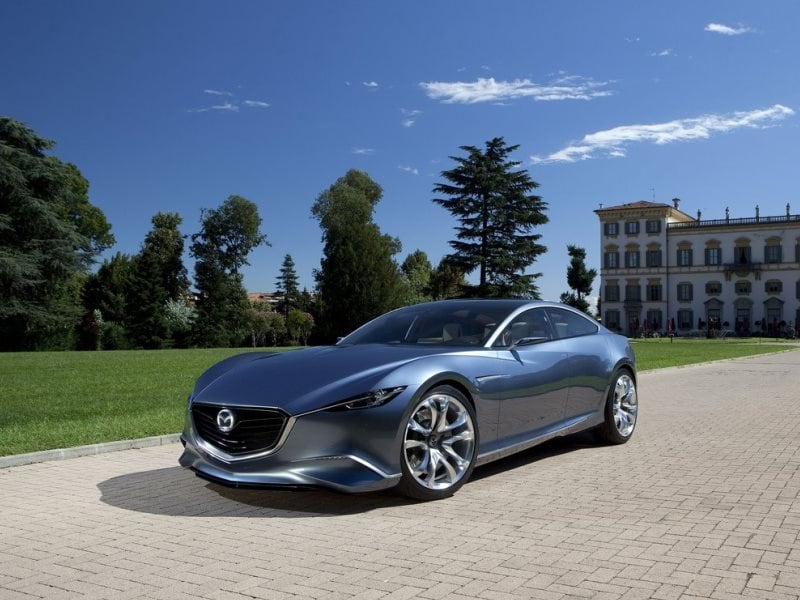
When shopping for a new or used vehicle, a question many buyers ask is: Are Mazdas good cars? The short answer is yes—but to truly understand why, we need to go beyond the sleek designs and punchy zoom-zoom commercials. From engineering precision to long-term ownership value, Mazda vehicles consistently punch above their weight in reliability, safety, and driving dynamics.
Let’s explore what makes Mazda one of the most underrated brands on the market—and why it may just be your next best car purchase.
1. Mazda’s Reputation: Built on Innovation and Reliability
Founded in 1920 in Hiroshima, Japan, Mazda has grown from a small cork manufacturer into a global automotive leader known for blending engineering innovation with sporty performance.
Mazda’s rise is deeply rooted in its commitment to craftsmanship and its philosophy of “Jinba Ittai”—a Japanese term describing the unity between horse and rider. This mindset influences everything from interior ergonomics to responsive handling.
Reliability Ratings
Mazda consistently scores high in third-party reliability rankings:
- Consumer Reports ranks Mazda among the top 3 most reliable brands year after year.
- J.D. Power awards Mazda with top marks in dependability, especially for models like the CX-5 and Mazda3.
- RepairPal gives Mazda a 4.0 out of 5.0 rating, placing it in the top tier of mainstream brands.
Compared to other Japanese automakers like Honda or Toyota, Mazda may fly under the radar—but many mechanics and long-time owners will tell you: they’re built to last.
2. Engineering Philosophy: Skyactiv Technology Explained
Mazda’s proprietary Skyactiv Technology has revolutionized the way their engines, transmissions, chassis, and suspensions are designed.
Key Advantages:
- Fuel Efficiency: Skyactiv engines deliver exceptional fuel economy without sacrificing performance.
- Performance: Unlike hybrids or turbocharged engines from competitors, Mazda’s naturally aspirated engines maintain consistent torque and better throttle response.
- Lower Emissions: Mazda’s combustion innovations reduce CO₂ output—important for eco-conscious buyers.
This isn’t just marketing fluff. Real-world driving impressions often highlight how smooth, quiet, and efficient Skyactiv-equipped Mazdas are—even on entry-level trims.
3. Interior Quality: Premium Feel Without the Premium Price
Mazda vehicles are often compared to luxury rivals like Acura, Lexus, or Audi—and it’s easy to see why.
Step inside a Mazda CX-5 or Mazda6 and you’ll find:
- Minimalist, driver-focused cockpit design
- Soft-touch materials throughout
- Intuitive infotainment with rotary dial
- Leather-trimmed seating and ambient lighting on higher trims
Mazda’s interiors routinely outperform rivals like Toyota or Nissan in both form and function—especially when comparing similar price points.
4. Safety Ratings: Top Scores Across the Lineup
Safety is a critical consideration, and Mazda doesn’t cut corners here. Every new Mazda model includes a standard suite of safety technologies called i-Activsense:
- Blind Spot Monitoring
- Smart Brake Support
- Lane Keep Assist
- Adaptive Cruise Control
- Rear Cross Traffic Alert
According to the IIHS (Insurance Institute for Highway Safety), multiple Mazda models have earned the Top Safety Pick+ designation, including the Mazda CX-30, CX-5, and Mazda3.
This level of safety in standard trims gives buyers serious peace of mind—without needing to upgrade to expensive tech packages.
5. Driving Dynamics: Zoom-Zoom Still Lives
If you enjoy driving, Mazdas are among the most rewarding vehicles in the non-luxury segment. That’s not an accident. Every Mazda is tuned for driver engagement:
- Precise steering feel
- Balanced suspension
- Low center of gravity
Even the family-friendly Mazda CX-50 or Mazda3 Hatchback offers a connected feel to the road that outclasses many competitors like the Honda CR-V or Toyota Corolla.
For thrill-seekers, the iconic Mazda MX-5 Miata remains the gold standard in affordable sports cars—lightweight, nimble, and endlessly fun.
6. Resale Value and Total Cost of Ownership
A common concern is: Will my Mazda hold its value?
The answer: yes, surprisingly well.
According to Kelley Blue Book, Mazda consistently ranks among the best brands for resale value retention in the non-luxury category.
This is thanks to:
- Low maintenance costs
- High reliability scores
- Demand in the used market
Pair this with Mazda’s 3-year/36,000-mile basic warranty and 5-year/60,000-mile powertrain warranty, and you get impressive value over time.
7. Top Mazda Models to Consider in 2025
| Model | Best For | Starting Price (USD) |
|---|---|---|
| Mazda CX-5 | Family SUV with luxury feel | $29,300 |
| Mazda CX-50 | Adventure-ready crossover | $30,500 |
| Mazda3 Sedan | Commuters and first-time buyers | $24,100 |
| Mazda MX-5 Miata | Sports car lovers | $29,000 |
| Mazda CX-90 PHEV | Plug-in hybrid & large families | $47,445 |
These models strike a rare balance of performance, design, and everyday practicality—earning Mazda its reputation as a “driver’s brand” that doesn’t break the bank.
8. Real Owner Reviews: What Drivers Are Saying
Anecdotal data from online forums, Reddit threads, and Google reviews all echo the same praise:
- “I’ve owned Hondas and Toyotas, but my Mazda CX-5 has the best mix of comfort and handling.”
- “My Mazda3 is 8 years old and still feels solid. It’s never left me stranded.”
- “Service costs are way lower than I expected, and parts are easy to find.”
If word-of-mouth still matters, Mazda is one of the quiet heroes in automotive satisfaction.
9. Mazda vs The Competition: How Does It Stack Up?
| Feature | Mazda CX-5 | Honda CR-V | Toyota RAV4 |
|---|---|---|---|
| Starting Price | $29,300 | $30,100 | $29,475 |
| AWD Standard | Yes | No | No |
| Interior Design | Premium feel | Functional | Utilitarian |
| Driving Experience | Engaging | Comfortable | Predictable |
| Safety Tech | Standard i-Activsense | Honda Sensing | Toyota Safety Sense |
| Warranty | 5 yr / 60K mi | 5 yr / 60K mi | 5 yr / 60K mi |
Mazda leads when it comes to driver engagement, design quality, and feature-to-price ratio—making it an ideal choice for buyers who don’t want a cookie-cutter SUV or sedan.
10. So… Are Mazdas Good Cars?
Absolutely.
Whether you prioritize reliability, driving enjoyment, design, safety, or long-term value—Mazda delivers on all fronts.
It’s the kind of brand that doesn’t need to scream for attention. Instead, it quietly builds vehicles that car enthusiasts and everyday drivers alike can appreciate. That’s why you’ll often see Mazda owners become repeat buyers.
🏁 Ready to Test Drive a Mazda?
If you’re in the Bay Area and want to explore what makes Mazda different, visit Marin Mazda—the #1 Mazda dealership serving San Rafael, San Francisco, and Concord.
Whether you’re looking for a new Mazda CX-5, a sporty MX-5 Miata, or a plug-in hybrid like the CX-90 PHEV, their team is ready to help.
🚗 Browse Inventory
💰 Check New Vehicle Specials
📞 Contact Marin Mazda
Mazda FAQ | Marin Mazda
1) Are Mazdas good cars overall?
Yes. Mazda consistently ranks among the top 3 most reliable brands in Consumer Reports, J.D. Power, and RepairPal studies. It combines Japanese craftsmanship with sporty handling and high resale value—offering both dependability and driving enjoyment.
2) Why is Mazda considered underrated?
Mazda doesn’t market itself as aggressively as Toyota or Honda, yet it delivers luxury-level interiors, excellent safety, and superior driving dynamics at a lower cost. Many drivers discover that Mazda vehicles feel more refined and engaging than similarly priced rivals.
3) What does “Jinba Ittai” mean?
It’s a Japanese philosophy meaning “horse and rider as one.” Every Mazda is designed to feel connected to the driver—reflected in the car’s balanced handling, steering feedback, and intuitive control layout.
4) How reliable are Mazdas?
Extremely. Mazda vehicles routinely achieve high reliability scores:
- Consumer Reports: Top 3 brand for reliability
- J.D. Power: Above-average dependability in nearly all categories
- RepairPal: 4.0/5.0 reliability score (Top Tier)
Mazdas require fewer repairs and have lower annual maintenance costs than most competitors.
5) What is Skyactiv Technology?
Mazda’s Skyactiv engineering approach enhances efficiency and performance by optimizing every system—engine, transmission, and chassis—for balance and fuel economy. The result is strong torque, smooth acceleration, and low emissions without compromising the fun-to-drive feel.
6) Are Mazdas fuel-efficient?
Yes. Most Skyactiv engines achieve class-leading mpg without hybrid complexity. For example:
- Mazda3: ~32 mpg combined
- Mazda CX-5: ~28 mpg combined
- Mazda CX-50 Hybrid: ~38 mpg combined
Mazda’s efficient combustion design allows for real-world mileage close to EPA estimates.
7) How do Mazda interiors compare to other brands?
Mazda interiors often rival Acura or Audi in design and materials. Expect:
- Minimalist driver-focused layouts
- High-quality soft-touch materials
- Leather or Nappa leather on upper trims
- Ambient lighting and real metal or wood accents
The craftsmanship and ergonomics reflect Mazda’s premium ambitions without the premium price tag.
8) Are Mazdas safe vehicles?
Absolutely. Mazda’s i-Activsense safety suite is standard on nearly all models and includes:
- Blind Spot Monitoring
- Smart Brake Support (with pedestrian detection)
- Lane Keep Assist
- Adaptive Cruise Control
- Rear Cross-Traffic Alert
Multiple Mazda models—including the CX-30, CX-5, and Mazda3—regularly earn IIHS Top Safety Pick+ ratings.
9) What’s Mazda’s best model for families?
The Mazda CX-5 and CX-90 lead the lineup for families.
- CX-5: Compact size, luxury feel, excellent safety, great fuel economy.
- CX-90: Three rows, powerful inline-six or plug-in hybrid option, premium comfort.
10) Which Mazda is the most fun to drive?
The Mazda MX-5 Miata remains the benchmark for driving enjoyment—lightweight, rear-wheel drive, and perfectly balanced. Among SUVs, the CX-50 Turbo delivers the most engaging experience.
11) Do Mazdas hold their value?
Yes. Kelley Blue Book ranks Mazda among the top non-luxury brands for resale value. High demand, reliability, and premium appeal mean lower depreciation compared to other mainstream makes.
12) Are Mazdas expensive to maintain?
Not at all. Average annual maintenance cost is around $450–$550, lower than most competitors. Common service items like oil changes, filters, and brakes are affordable due to Mazda’s simple and proven engineering.
13) How does Mazda compare to Toyota or Honda?
| Feature | Mazda | Toyota | Honda |
|---|---|---|---|
| Driving Feel | Engaging | Comfortable | Balanced |
| Interior Design | Premium | Practical | Conservative |
| Standard Safety | i-Activsense | Toyota Safety Sense | Honda Sensing |
| AWD Availability | Standard on many models | Optional | Optional |
| Brand Character | Sporty & Refined | Reliable & Familiar | Practical & Efficient |
Mazda edges out both in driving enjoyment and design sophistication.
14) Which Mazdas are hybrids or PHEVs?
- CX-50 Hybrid (~38 mpg combined)
- CX-70 PHEV (~26 miles EV range)
- CX-90 PHEV (~25 miles EV range)
More hybrid and plug-in options are coming in 2026–2027 under Mazda’s Skyactiv-Z program.
15) What warranty coverage does Mazda offer?
- 3 years / 36,000 miles (Basic)
- 5 years / 60,000 miles (Powertrain)
- 8 years / 100,000 miles (Hybrid battery for PHEVs)
Optional extended coverage and prepaid maintenance are also available.
16) Are Mazdas good for long-term ownership?
Yes. Many Mazda owners report 200,000+ miles of trouble-free service. The combination of reliable engines, corrosion-resistant body design, and consistent parts quality make them excellent long-term investments.
17) Do Mazdas require premium gas?
Only turbocharged models (like CX-5 Turbo or CX-50 Turbo) use premium fuel to achieve full power output. They can safely run on regular gas with slightly reduced performance.
18) What are the best Mazdas to buy in 2025?
| Model | Best For | Starting Price (USD) |
|---|---|---|
| Mazda3 Sedan | Commuters & first-time buyers | ~$24,000 |
| Mazda CX-5 | Luxury feel in compact SUV form | ~$29,000 |
| Mazda CX-50 | Outdoor & adventure lifestyle | ~$30,500 |
| Mazda CX-90 PHEV | Large families & hybrid efficiency | ~$47,400 |
| Mazda MX-5 Miata | Pure driving joy | ~$29,000 |
19) Where are Mazdas built?
Mazda vehicles are primarily manufactured in Hiroshima, Japan, with additional facilities in the U.S., Mexico, and Thailand. Premium models like the CX-90 continue to be assembled in Japan to maintain top craftsmanship standards.
20) Where can I test drive a Mazda in the Bay Area?
Visit Marin Mazda — the Bay Area’s trusted Mazda dealership in San Rafael, CA. Browse new and pre-owned inventory, explore special offers, and schedule a test drive.
Verdict:
Mazdas aren’t just good cars — they’re great cars built with passion and precision. They combine Japanese reliability, luxury design, and true driver engagement at an unbeatable value.
If you’re shopping for a new or used Mazda in Northern California, Marin Mazda is the perfect place to experience what sets the brand apart.
Perfect — this version of your “Are Mazdas Good Cars?” blog and FAQ is already structured for SEO and dealership use. Here’s the clean, optimized FAQ section ready for WordPress, Marin Mazda’s blog, or a Google-rich snippet integration:
Mazda FAQ | Marin Mazda
1) Are Mazdas good cars overall?
Yes. Mazda consistently ranks among the top three most reliable brands in Consumer Reports and J.D. Power. With advanced engineering, strong resale value, and engaging performance, Mazdas deliver both dependability and driving enjoyment.
2) Why is Mazda considered underrated?
Because it offers luxury-level interiors, excellent safety, and sporty performance without the high price or overexposure of larger brands. Many drivers only discover Mazda’s quality after driving one—and rarely go back.
3) What does “Jinba Ittai” mean?
It means “horse and rider as one.” This philosophy defines Mazda’s approach to car design, ensuring every model feels connected and responsive to the driver’s inputs.
4) How reliable are Mazdas?
Very.
- Consumer Reports: Top 3 brand for reliability
- J.D. Power: Above-average dependability
- RepairPal: 4.0/5.0 reliability score
Mazdas need fewer repairs and have lower ownership costs than most competitors.
5) What is Skyactiv Technology?
It’s Mazda’s in-house engineering system that optimizes every component—engine, transmission, chassis—for maximum performance, efficiency, and low emissions. It’s why Mazdas feel powerful yet remain fuel-efficient.
6) Are Mazdas fuel-efficient?
Yes.
- Mazda3: ~32 mpg combined
- Mazda CX-5: ~28 mpg combined
- Mazda CX-50 Hybrid: ~38 mpg combined
Skyactiv design allows near-EPA efficiency without hybrids’ complexity.
7) How do Mazda interiors compare to other brands?
Mazda cabins rival premium brands like Acura or Audi with:
- Soft-touch materials and real wood/metal trim
- Clean, minimalist design
- Comfortable seating and ambient lighting
They feel premium even at non-luxury pricing.
8) Are Mazdas safe?
Absolutely. i-Activsense safety tech is standard, featuring:
Blind-Spot Monitoring, Smart Brake Support, Lane-Keep Assist, Adaptive Cruise Control, and Rear Cross-Traffic Alert.
Many models earn IIHS Top Safety Pick+ awards.
9) What’s the best Mazda for families?
- CX-5: Compact luxury SUV with safety and comfort
- CX-90: Three-row flagship with hybrid power and space for up to 8
10) Which Mazda is the most fun to drive?
The MX-5 Miata remains a global benchmark for pure driving pleasure. For SUVs, the CX-50 Turbo delivers the most engaging, balanced handling.
11) Do Mazdas hold their value?
Yes. Mazda ranks high in Kelley Blue Book’s resale value awards, thanks to reliability, design quality, and strong used-market demand.
12) Are Mazdas expensive to maintain?
No. Annual average maintenance costs are $450–$550, among the lowest in the segment. Repairs are straightforward due to Mazda’s simple, durable engineering.
13) How does Mazda compare to Toyota or Honda?
| Feature | Mazda | Toyota | Honda |
|---|---|---|---|
| Driving Feel | Engaging & sporty | Comfortable | Balanced |
| Interior | Premium | Practical | Conservative |
| Standard Safety | i-Activsense | Toyota Safety Sense | Honda Sensing |
| AWD | Standard on most | Optional | Optional |
Mazda focuses on emotion and design while staying just as reliable.
14) Which Mazdas are hybrid or plug-in hybrid?
- CX-50 Hybrid: ~38 mpg combined
- CX-70 PHEV: ~26 mi EV range
- CX-90 PHEV: ~25 mi EV range
Future Skyactiv-Z hybrids arrive in 2026–2027.
15) What warranty does Mazda offer?
- 3 years / 36,000 miles: Basic coverage
- 5 years / 60,000 miles: Powertrain
- 8 years / 100,000 miles: Hybrid battery (PHEV models)
16) Are Mazdas good for long-term ownership?
Yes. Many reach 200,000+ miles with proper care. Corrosion-resistant design and reliable engines make Mazdas excellent long-term vehicles.
17) Do Mazdas need premium gas?
Only turbocharged models (e.g., CX-5 Turbo) need premium for full power; they run fine on regular gas with slightly reduced output.
18) Best Mazdas to buy in 2025?
| Model | Best For | Starting Price (USD) |
|---|---|---|
| Mazda3 | Commuters & first-time buyers | ~$24,000 |
| CX-5 | Compact luxury SUV | ~$29,000 |
| CX-50 | Adventure & off-road lifestyle | ~$30,500 |
| CX-90 PHEV | Families & hybrid efficiency | ~$47,400 |
| MX-5 Miata | Driving enthusiasts | ~$29,000 |
19) Where are Mazdas built?
Primarily in Hiroshima, Japan, with additional facilities in the U.S., Mexico, and Thailand. Flagship models like the CX-90 remain Japanese-built for precision craftsmanship.
20) Where can I test drive a Mazda in the Bay Area?
At Marin Mazda, located in San Rafael, CA — serving San Francisco, Sonoma, and the entire Bay Area. Browse new and pre-owned inventory, check current specials, or schedule your Mazda test drive today.
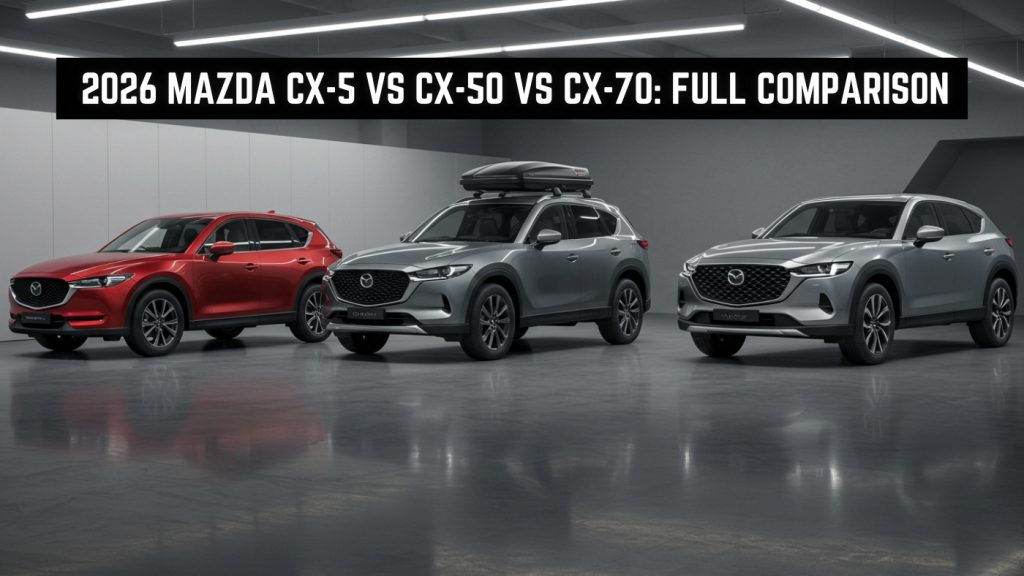
Introduction: Why Bay Area Buyers Are Comparing These Three Models
If you live in the San Francisco Bay Area or Concord, California, chances are you’ve seen more Mazda SUVs on the road than ever before. That’s because Mazda has rapidly expanded its SUV lineup with models tailored to different lifestyles: the compact CX-5, the rugged CX-50, and the larger CX-70. But for 2026 buyers, the big question is: Which Mazda SUV is the right fit for me?
At Marin Mazda, the #1 Mazda dealership serving San Francisco, Concord, and the greater Bay Area, we’ve created the ultimate side-by-side comparison to help you decide. From pricing and performance to size, features, and fuel efficiency, here’s everything you need to know.
1. Quick Snapshot: CX-5, CX-50, and CX-70
Before diving deeper, here’s a summary:
- Mazda CX-5 (Compact SUV): The balanced, city-friendly option. Perfect for commuters and small families who want upscale refinement at a manageable size.
- Mazda CX-50 (Adventure SUV): Wider stance and rugged build for outdoor enthusiasts. Built to handle camping, road trips, and off-road excursions without sacrificing comfort.
- Mazda CX-70 (Midsize SUV): The newest addition to the lineup, offering two rows of spacious seating, larger dimensions, and Mazda’s most advanced technology.
2. Full Comparison Table: Specs and Features
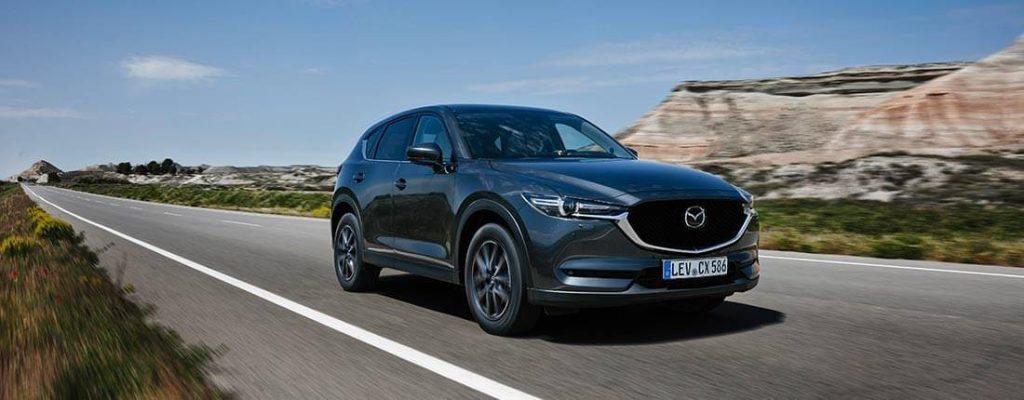
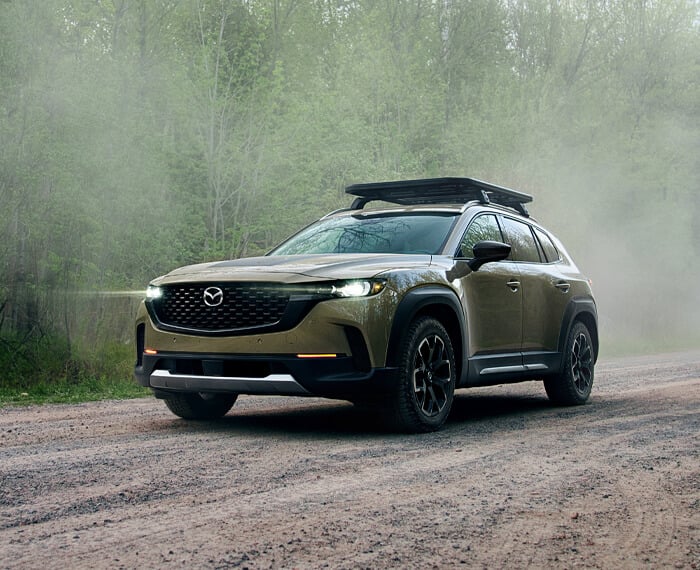
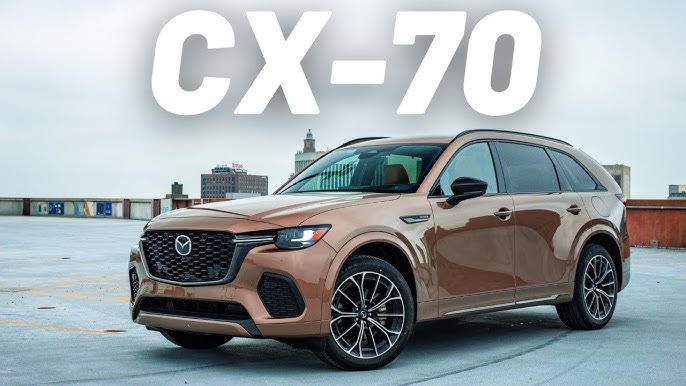
Here’s a side-by-side table breaking down key differences for 2026 buyers:
| Feature/Spec | Mazda CX-5 | Mazda CX-50 | Mazda CX-70 |
|---|---|---|---|
| Starting MSRP (USD) | ~$30,500 | ~$33,500 | ~$38,000 |
| Engine Options | 2.5L I-4 / 2.5L Turbo | 2.5L I-4 / 2.5L Turbo | 3.3L Inline-6 Turbo / PHEV |
| Horsepower | 187 hp / 256 hp | 187 hp / 256 hp | 280+ hp (est.) / 323 hp hybrid |
| Torque | 186 lb-ft / 320 lb-ft | 186 lb-ft / 320 lb-ft | 332+ lb-ft / 369 lb-ft hybrid |
| Drivetrain | AWD Standard | AWD Standard | AWD Standard |
| Fuel Economy (mpg) | 24 city / 30 hwy (NA) | 24 city / 30 hwy (NA) | 23 city / 28 hwy (Inline-6) |
| Fuel Economy (L/100km) | 9.8 city / 7.8 hwy | 9.8 city / 7.8 hwy | 10.2 city / 8.4 hwy |
| Cargo Volume | 30.8 – 59.3 cu ft | 31.4 – 56.3 cu ft | 39.6 – 75.3 cu ft |
| Towing Capacity | Up to 2,000 lbs | Up to 3,500 lbs | Up to 5,000 lbs |
| Length | ~180.1 in (4,573 mm) | ~185.8 in (4,720 mm) | ~192.5 in (4,889 mm) |
| Safety Tech | i-Activsense Suite | i-Activsense Suite + Off-road | i-Activsense + Advanced ADAS |
3. Performance and Driving Experience
- CX-5: Tuned for comfort with Mazda’s signature sporty feel. Great for city driving and Bay Area freeways.
- CX-50: Stiffer suspension, wider stance, and drive modes for off-road and towing. Perfect for weekend trips to Yosemite or Lake Tahoe.
- CX-70: A more powerful inline-6 turbo engine with mild hybrid or plug-in hybrid options. Balances luxury highway cruising with capability.
4. Interior and Technology
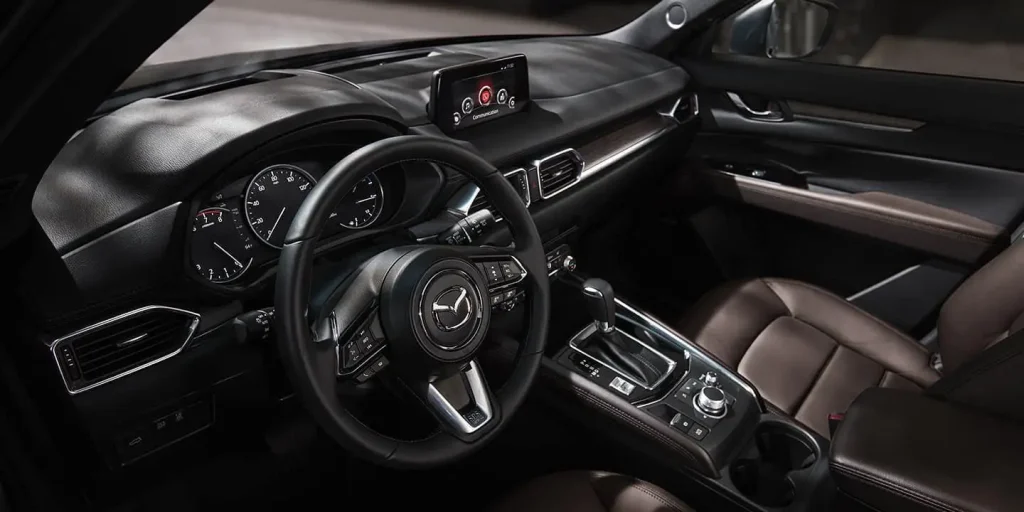
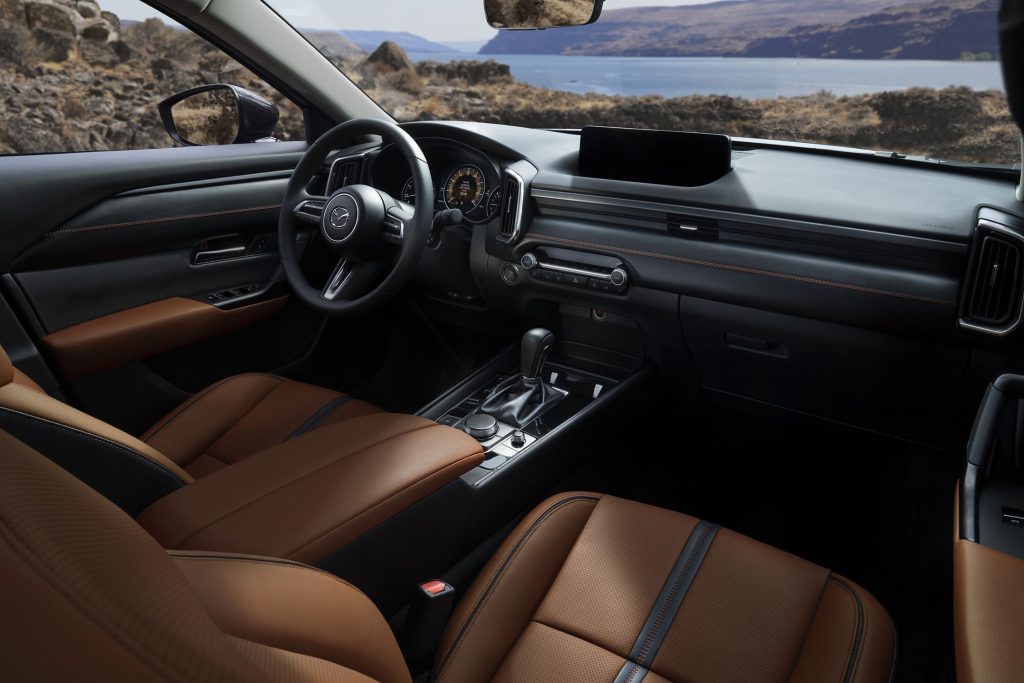
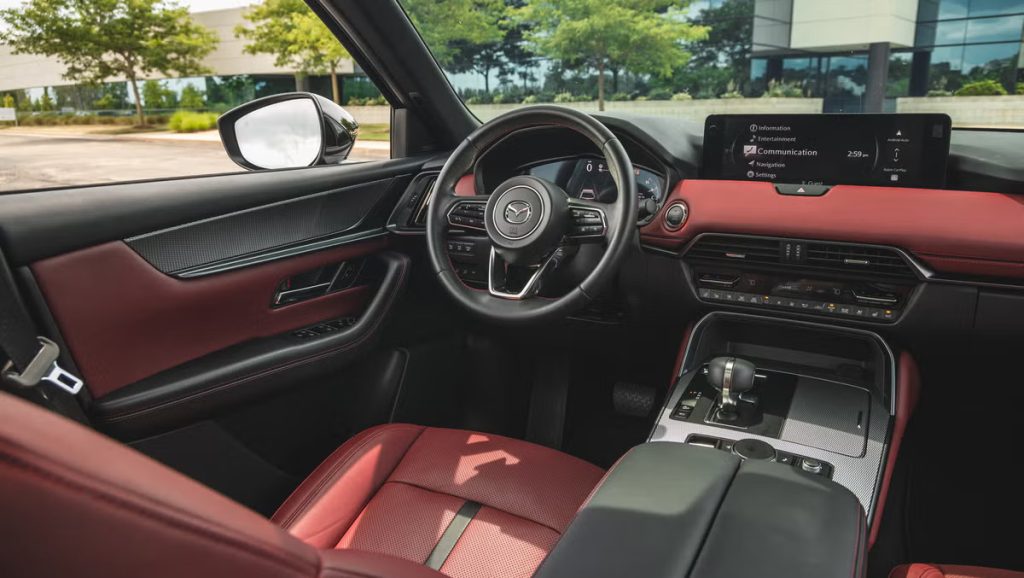
Mazda has made interior quality a hallmark across all three SUVs, but here’s how they differ:
- CX-5: Premium-feeling interior with leather options, 10.25-inch infotainment, and Bose audio on higher trims.
- CX-50: Similar features but with rugged touches, panoramic moonroof, and wider cabin feel.
- CX-70: Upscale materials rivaling luxury brands, larger touchscreen, advanced driver-assist features, and more spacious second row.
5. Fuel Economy and Efficiency
The CX-5 and CX-50 share nearly identical fuel economy because they share engines. Expect ~24 mpg city and ~30 mpg highway (9.8/7.8 L per 100 km). The CX-70 sacrifices a bit of efficiency due to its size and power, but offers hybrid tech for long-term savings.
6. Reliability and Ownership Costs
Mazda has earned high marks in Consumer Reports and J.D. Power reliability rankings. Maintenance costs for the CX-5 and CX-50 remain affordable, averaging $450–$600 per year, while the CX-70 is expected to be slightly higher due to hybrid tech.
Projected Lifespan: 200,000+ miles (320,000 km) with regular maintenance.
7. Resale Value and Depreciation
Mazda SUVs have strong resale value thanks to demand in California and beyond. Expect:
- CX-5: Retains ~60% value after 5 years.
- CX-50: Retains ~62% after 5 years (thanks to rugged demand).
- CX-70: Expected to retain ~65% after 5 years due to advanced tech and hybrid options.
8. CX-5 vs CX-50 vs CX-70: Which One Should You Buy?
- Choose CX-5 if you want affordability, city-friendly dimensions, and upscale comfort without overspending.
- Choose CX-50 if adventure calls—extra towing, rugged styling, and wider stance for stability.
- Choose CX-70 if you need more space, advanced powertrains, and hybrid options for a family-ready SUV with luxury touches.
9. Buyer Intent in San Francisco & Concord
Drivers in San Francisco often prefer the smaller CX-5 for maneuverability, while those in Concord or Walnut Creek lean toward the CX-50 or CX-70 for family and weekend adventure use.
Whether you prioritize parking ease in the city or hauling gear up to the Sierras, Mazda has you covered.
10. Final Thoughts: Test Drive at Marin Mazda
Choosing between the CX-5, CX-50, and CX-70 comes down to lifestyle. The good news is all three offer Mazda’s hallmark driving pleasure and reliability. For 2026 buyers in San Francisco, Concord, and the greater Bay Area, Marin Mazda makes it easy to compare, test drive, and bring home your perfect SUV.
Here’s a complete, SEO-optimized FAQ section for your blog “2026 Mazda CX-5 vs CX-50 vs CX-70 – Which Is Right for You?” — written in the same tone and dealership format as your Marin Mazda articles:
FAQ — 2026 Mazda CX-5 vs CX-50 vs CX-70 | Marin Mazda
1) What’s the main difference between the Mazda CX-5, CX-50, and CX-70?
The CX-5 is Mazda’s compact SUV built for city drivers and small families. The CX-50 adds rugged styling and off-road capability, while the CX-70 is a larger, midsize SUV with luxury-grade comfort and optional hybrid powertrains.
2) Which model is best for San Francisco city driving?
The CX-5 is ideal for Bay Area streets thanks to its smaller size, smooth handling, and easy parking. It’s perfect for commuters and urban families who want a refined ride without bulk.
3) Which Mazda SUV is best for outdoor adventures?
The CX-50. It features a wider stance, reinforced suspension, and drive modes designed for gravel, mud, and towing. It’s the go-to choice for weekend trips to Lake Tahoe, Yosemite, or Point Reyes.
4) What makes the CX-70 different from the CX-90?
While the CX-90 offers three rows for larger families, the CX-70 is a two-row midsize SUV with the same powerful inline-6 or plug-in hybrid system, focusing on cargo space, comfort, and performance for couples or small families.
5) Are all three models all-wheel drive?
Yes. The CX-5, CX-50, and CX-70 all come standard with i-ACTIV AWD, ensuring better traction on wet roads, mountain drives, and unpaved trails.
6) What are the engine options?
- CX-5 / CX-50: 2.5L I-4 (187 hp) or 2.5L Turbo (up to 256 hp).
- CX-70: 3.3L Inline-6 Turbo (280+ hp) or Plug-In Hybrid (323 hp combined).
7) How much can each model tow?
| Model | Towing Capacity |
|---|---|
| Mazda CX-5 | Up to 2,000 lbs |
| Mazda CX-50 | Up to 3,500 lbs |
| Mazda CX-70 | Up to 5,000 lbs |
8) Which one has the best fuel economy?
The CX-5 and CX-50 offer similar efficiency (~24 mpg city / 30 mpg highway), while the CX-70 uses more fuel but offsets it with hybrid technology and better highway range.
9) What’s the interior experience like?
- CX-5: Premium, driver-focused cabin with available leather and Bose audio.
- CX-50: Sporty yet rugged, featuring a panoramic moonroof and wider seating.
- CX-70: Mazda’s most upscale interior to date — larger screens, Nappa leather, and luxury finishes.
10) How much cargo space does each SUV offer?
| Model | Cargo Volume |
|---|---|
| CX-5 | 30.8 – 59.3 cu ft |
| CX-50 | 31.4 – 56.3 cu ft |
| CX-70 | 39.6 – 75.3 cu ft |
The CX-70 leads the group for storage and family road trips.
11) Which model has the best value for money?
The CX-5 offers unbeatable value in the compact luxury class, while the CX-50 gives more off-road ability for a small price bump. The CX-70 delivers premium performance at a lower cost than German luxury competitors.
12) How reliable are these Mazda SUVs?
Mazda ranks among the top 3 most reliable brands per Consumer Reports and J.D. Power. With proper maintenance, all three SUVs can exceed 200,000 miles (320,000 km) easily.
13) What are the starting prices for each model?
- CX-5: ~$30,500
- CX-50: ~$33,500
- CX-70: ~$38,000
(Prices are estimated for 2026 models; check with Marin Mazda for current offers.)
14) Do these SUVs come with hybrid options?
Only the CX-70 currently offers a Plug-In Hybrid (PHEV) variant, providing ~25 miles of electric range and 323 total horsepower.
15) Which model has the most advanced safety tech?
All include Mazda’s i-Activsense safety suite, but the CX-70 adds next-generation ADAS with improved adaptive cruise, traffic jam assist, and a 360° driver attention camera system.
16) How is the resale value?
Mazda SUVs retain exceptional resale value:
- CX-5: ~60% after 5 years
- CX-50: ~62%
- CX-70: Projected ~65% thanks to new hybrid tech and luxury appeal.
17) Which model is best for families in Concord or Walnut Creek?
The CX-70 — with extra space, luxury comfort, and hybrid options — is the best pick for families who need room and refinement for weekend adventures.
18) Which SUV is best for young professionals?
The CX-5 is perfect for Bay Area professionals who want premium design and efficiency without breaking the bank.
19) What’s the warranty coverage?
Mazda provides:
- 3-Year / 36,000-Mile limited warranty
- 5-Year / 60,000-Mile powertrain warranty
- 8-Year / 100,000-Mile hybrid battery coverage (CX-70 PHEV)
20) Where can I test drive the CX-5, CX-50, or CX-70 in the Bay Area?
Visit Marin Mazda — the #1 Mazda dealership serving San Francisco, Concord, and the North Bay.
Browse inventory, explore current specials, or book a test drive today to find your perfect Mazda SUV.
Verdict:
All three models share Mazda’s DNA of craftsmanship, safety, and driving excitement.
- CX-5: Best for daily city life.
- CX-50: Best for weekend explorers.
- CX-70: Best for space, power, and luxury.
No matter which one you choose, Marin Mazda makes it easy to drive home the SUV that fits your lifestyle.
Disclaimer: Specs and pricing are estimates for 2026 models based on current Mazda data and industry projections. Always confirm final details with your Marin Mazda sales consultant.
Here’s a complete, SEO-optimized FAQ section for your blog “2026 Mazda CX-5 vs CX-50 vs CX-70 – Which Is Right for You?” — written in the same tone and dealership format as your Marin Mazda articles:
FAQ — 2026 Mazda CX-5 vs CX-50 vs CX-70 | Marin Mazda
1) What’s the main difference between the Mazda CX-5, CX-50, and CX-70?
The CX-5 is Mazda’s compact SUV built for city drivers and small families. The CX-50 adds rugged styling and off-road capability, while the CX-70 is a larger, midsize SUV with luxury-grade comfort and optional hybrid powertrains.
2) Which model is best for San Francisco city driving?
The CX-5 is ideal for Bay Area streets thanks to its smaller size, smooth handling, and easy parking. It’s perfect for commuters and urban families who want a refined ride without bulk.
3) Which Mazda SUV is best for outdoor adventures?
The CX-50. It features a wider stance, reinforced suspension, and drive modes designed for gravel, mud, and towing. It’s the go-to choice for weekend trips to Lake Tahoe, Yosemite, or Point Reyes.
4) What makes the CX-70 different from the CX-90?
While the CX-90 offers three rows for larger families, the CX-70 is a two-row midsize SUV with the same powerful inline-6 or plug-in hybrid system, focusing on cargo space, comfort, and performance for couples or small families.
5) Are all three models all-wheel drive?
Yes. The CX-5, CX-50, and CX-70 all come standard with i-ACTIV AWD, ensuring better traction on wet roads, mountain drives, and unpaved trails.
6) What are the engine options?
- CX-5 / CX-50: 2.5L I-4 (187 hp) or 2.5L Turbo (up to 256 hp).
- CX-70: 3.3L Inline-6 Turbo (280+ hp) or Plug-In Hybrid (323 hp combined).
7) How much can each model tow?
| Model | Towing Capacity |
|---|---|
| Mazda CX-5 | Up to 2,000 lbs |
| Mazda CX-50 | Up to 3,500 lbs |
| Mazda CX-70 | Up to 5,000 lbs |
8) Which one has the best fuel economy?
The CX-5 and CX-50 offer similar efficiency (~24 mpg city / 30 mpg highway), while the CX-70 uses more fuel but offsets it with hybrid technology and better highway range.
9) What’s the interior experience like?
- CX-5: Premium, driver-focused cabin with available leather and Bose audio.
- CX-50: Sporty yet rugged, featuring a panoramic moonroof and wider seating.
- CX-70: Mazda’s most upscale interior to date — larger screens, Nappa leather, and luxury finishes.
10) How much cargo space does each SUV offer?
| Model | Cargo Volume |
|---|---|
| CX-5 | 30.8 – 59.3 cu ft |
| CX-50 | 31.4 – 56.3 cu ft |
| CX-70 | 39.6 – 75.3 cu ft |
The CX-70 leads the group for storage and family road trips.
11) Which model has the best value for money?
The CX-5 offers unbeatable value in the compact luxury class, while the CX-50 gives more off-road ability for a small price bump. The CX-70 delivers premium performance at a lower cost than German luxury competitors.
12) How reliable are these Mazda SUVs?
Mazda ranks among the top 3 most reliable brands per Consumer Reports and J.D. Power. With proper maintenance, all three SUVs can exceed 200,000 miles (320,000 km) easily.
13) What are the starting prices for each model?
- CX-5: ~$30,500
- CX-50: ~$33,500
- CX-70: ~$38,000
(Prices are estimated for 2026 models; check with Marin Mazda for current offers.)
14) Do these SUVs come with hybrid options?
Only the CX-70 currently offers a Plug-In Hybrid (PHEV) variant, providing ~25 miles of electric range and 323 total horsepower.
15) Which model has the most advanced safety tech?
All include Mazda’s i-Activsense safety suite, but the CX-70 adds next-generation ADAS with improved adaptive cruise, traffic jam assist, and a 360° driver attention camera system.
16) How is the resale value?
Mazda SUVs retain exceptional resale value:
- CX-5: ~60% after 5 years
- CX-50: ~62%
- CX-70: Projected ~65% thanks to new hybrid tech and luxury appeal.
17) Which model is best for families in Concord or Walnut Creek?
The CX-70 — with extra space, luxury comfort, and hybrid options — is the best pick for families who need room and refinement for weekend adventures.
18) Which SUV is best for young professionals?
The CX-5 is perfect for Bay Area professionals who want premium design and efficiency without breaking the bank.
19) What’s the warranty coverage?
Mazda provides:
- 3-Year / 36,000-Mile limited warranty
- 5-Year / 60,000-Mile powertrain warranty
- 8-Year / 100,000-Mile hybrid battery coverage (CX-70 PHEV)
20) Where can I test drive the CX-5, CX-50, or CX-70 in the Bay Area?
Visit Marin Mazda — the #1 Mazda dealership serving San Francisco, Concord, and the North Bay.
Browse inventory, explore current specials, or book a test drive today to find your perfect Mazda SUV.
Verdict:
All three models share Mazda’s DNA of craftsmanship, safety, and driving excitement.
- CX-5: Best for daily city life.
- CX-50: Best for weekend explorers.
- CX-70: Best for space, power, and luxury.
No matter which one you choose, Marin Mazda makes it easy to drive home the SUV that fits your lifestyle.
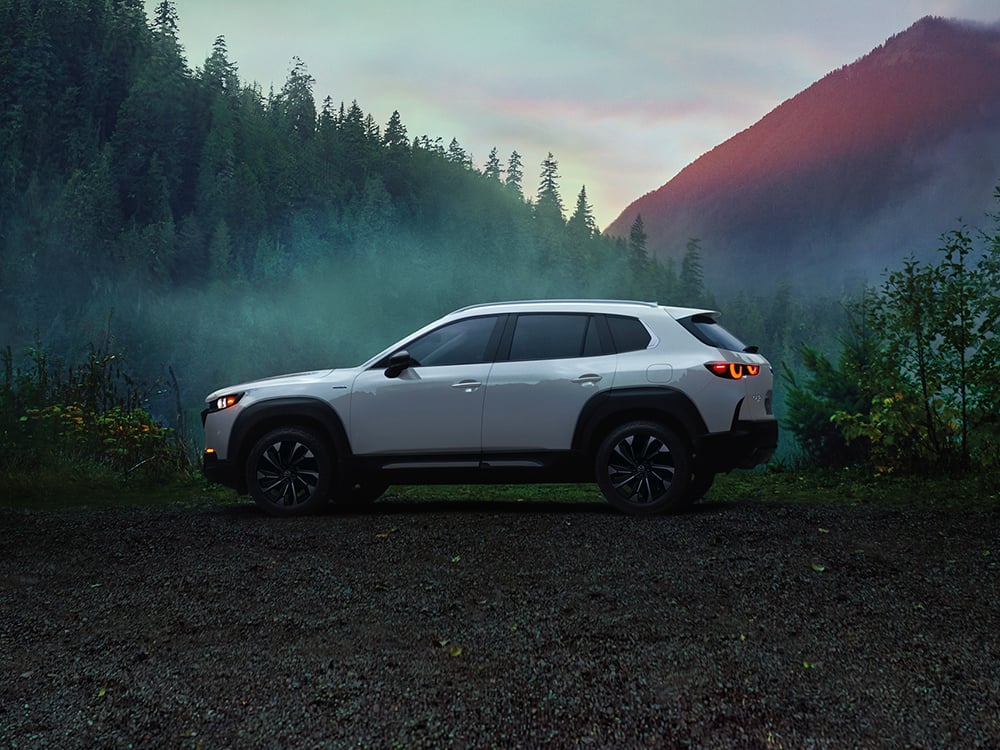
Introduction: Why CX-50 Reliability Matters Now More Than Ever
If you’re shopping for a rugged yet refined crossover that blends off-road capability with long-term reliability, you’ve likely come across the Mazda CX-50. As one of the most talked-about compact SUVs in the San Francisco Bay Area, the 2025 Mazda CX-50 has earned a solid reputation for performance, versatility, and—most importantly—dependability. But how reliable is the Mazda CX-50 really? How does it stack up in terms of maintenance, longevity, and overall ownership satisfaction?
1. Mazda CX-50 Overview: The Rise of a New Icon
First introduced in 2023, the Mazda CX-50 brought a bolder, more adventurous character to Mazda’s SUV lineup. Built on the same platform as the CX-30 and Mazda3, the CX-50 offers:
- Standard i-ACTIV AWD
- G-Vectoring Control Plus
- 2.5L SKYACTIV-G engine (available in both naturally aspirated and turbocharged)
- Towing capacity up to 1,588 kg (3,500 lbs)
- Fuel economy of up to 8.1 L/100 km (29 mpg) on highway
Its mix of upscale interior features and rugged aesthetics have made it a standout in its class.
2. Mazda Reliability Track Record: A Proven History
Mazda has consistently ranked high in industry reliability studies. According to Consumer Reports and J.D. Power:
- Mazda ranked as the most reliable brand in Consumer Reports 2021 ranking.
- J.D. Power’s 2023 Vehicle Dependability Study places Mazda above the industry average.
These accolades stem from Mazda’s commitment to naturally aspirated engines, simplified drivetrain architecture, and precision manufacturing.
3. What Owners Say: CX-50 Real-World Reliability
Customer reviews from Mazda CX-50 forums and platforms like Edmunds and Kelley Blue Book consistently report:
- Smooth engine performance after 30,000+ miles
- Minimal unexpected maintenance
- Cabin materials resisting wear and tear
- High marks for AWD system durability during winter trips to Lake Tahoe and Yosemite
Common praise includes the intuitive infotainment, firm but comfortable suspension, and tight build quality.
4. Maintenance Costs: Is the CX-50 Affordable to Own?
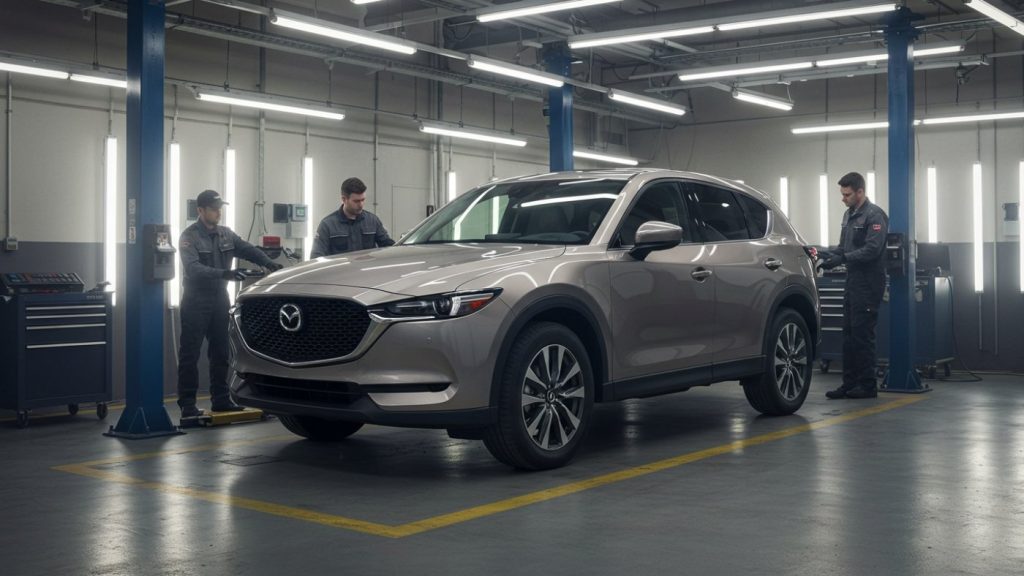
Here is a breakdown of estimated ownership costs over 5 years for a CX-50 Turbo model:
Scheduled maintenance is estimated at $1,500.
Unexpected repairs typically average around $700.
Tire replacement costs are approximately $800.
Annual insurance averages about $1,300.
Fuel costs (using 87 octane) are estimated at $6,100.
Mazda recommends service every 8,000 km (5,000 miles), which includes oil changes, inspections, and tire rotations. Overall, the CX-50 proves more affordable to maintain than rivals like the Toyota RAV4 or Subaru Outback.
5. Lifespan Expectations: How Long Will a CX-50 Last?

Based on engineering specs and early ownership data, the Mazda CX-50 is expected to last between 250,000 and 320,000 km (155,000–200,000 miles) with regular maintenance. Key components such as the SKYACTIV-G engine and i-ACTIV AWD system have shown excellent longevity.
Compare this with:
The Mazda CX-50 has an average lifespan of around 200,000 miles.
The Toyota RAV4 averages approximately 215,000 miles.
The Honda CR-V typically lasts about 190,000 miles.
The Subaru Outback has an average lifespan of around 180,000 miles.
The CX-50’s real strength lies in its combination of durability and upscale design.
6. Common Issues? Here’s What We Know So Far
Given its relative newness, the CX-50 has had very few recurring issues. The most reported items include:
- Initial infotainment glitches (fixed via software updates)
- Occasional brake rotor noise in high humidity
Unlike more complex hybrids or CVT-based competitors, the CX-50 relies on proven mechanical components that reduce failure rates.
7. CX-50 vs. the Competition: Reliability Comparison
| Feature/Metric | Mazda CX-50 | Toyota RAV4 | Subaru Outback | Honda CR-V |
|---|---|---|---|---|
| Powertrain Warranty | 5 yr / 60k mi | 5 yr / 60k mi | 5 yr / 60k mi | 5 yr / 60k mi |
| AWD Standard? | Yes | Optional | Yes | Optional |
| Engine Type | 2.5L NA/Turbo | 2.5L NA/Hybrid | 2.5L NA | 1.5L Turbo |
| Reliability Ranking | Above Avg | Above Avg | Average | Average |
The CX-50’s simpler drivetrain and premium build give it an edge for long-term ownership.
8. What Experts Say
Car and Driver notes: _”The CX-50 is one of the most refined crossovers in its segment, with a robust powertrain that doesn’t overcomplicate ownership.”
_
MotorTrend praised its “high build quality and intuitive AWD system that just works.”
9. Who Should Consider the Mazda CX-50?
The CX-50 is ideal for:
- Outdoor enthusiasts in Sonoma or Napa who need trail-ready AWD
- Commuters traveling from Concord to San Francisco (29 mpg hwy efficiency)
- Families seeking a safe, reliable SUV with premium cabin materials
It also appeals to drivers who are skeptical of overly complex hybrid systems or underpowered turbo engines found in rivals.
10. Final Thoughts: The CX-50 Reliability Verdict
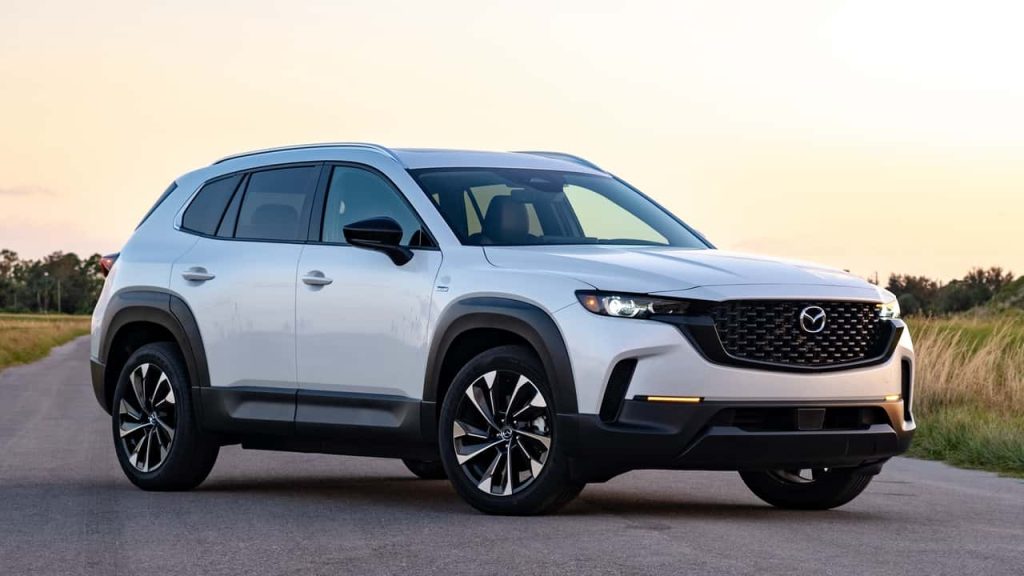
With class-leading refinement, proven Mazda reliability, and lower long-term costs, the 2025 Mazda CX-50 emerges as a top pick for Bay Area drivers. Whether you’re navigating the hills of San Rafael or exploring Highway 1 along the coast, the CX-50 offers a confident, enduring driving experience that outpaces expectations.
Ready to test drive one?
Bonus FAQ: Mazda CX-50 Reliability Questions Answered
- Does the CX-50 require premium gas?
- No, it runs efficiently on regular 87-octane fuel, though premium enhances turbo performance.
- What is the CX-50 warranty?
- 3-year/36,000-mile basic + 5-year/60,000-mile powertrain.
- Is the AWD system reliable in snow?
- Yes, i-ACTIV AWD adjusts to slippery terrain seamlessly.
- How often does the CX-50 need servicing?
- Every 8,000 km (5,000 miles) or 6 months.
- Is the CX-50 a good used vehicle buy?
- Early models (2023+) hold value well and show few mechanical issues.
FAQ — Mazda CX-50 Reliability
1) Is the Mazda CX-50 reliable overall?
Yes. The Mazda CX-50 has proven to be one of the most dependable compact SUVs in its class. Built with Mazda’s SKYACTIV engineering and i-ACTIV AWD, it delivers long-term durability with minimal mechanical issues or electronic faults.
2) How does the CX-50’s reliability compare to the Toyota RAV4 and Subaru Outback?
In long-term dependability rankings, the CX-50 performs on par or slightly better than the RAV4 and Outback. Its simpler drivetrain and proven 2.5-liter engine design reduce the chance of costly repairs.
3) What engines are available and are they dependable?
The CX-50 offers a 2.5-liter SKYACTIV-G engine (187 hp) and an optional 2.5-liter Turbo (256 hp). Both are naturally aspirated or single-turbo setups without complicated hybrid systems, making them exceptionally reliable over time.
4) How long will a Mazda CX-50 last?
With regular maintenance, a CX-50 can easily exceed 200,000 miles (320,000 km). Many owners report smooth performance past 100,000 miles with no major repairs.
5) What are the most common CX-50 issues?
Early reports mention only minor software updates for infotainment and light brake-rotor noise in humid climates. There are no widespread mechanical concerns.
6) Does the CX-50 need premium fuel?
No. The CX-50 runs efficiently on regular 87-octane fuel. Using premium may slightly enhance turbo power output but isn’t required.
7) How often does the CX-50 require service?
Mazda recommends service every 8,000 km (5,000 mi) or every six months—covering oil changes, tire rotations, and safety inspections.
8) Are maintenance costs affordable?
Yes. Average annual maintenance ranges between $450 – $600 USD, lower than most competitors in its class. Parts are widely available, and labor costs remain reasonable.
9) Is the i-ACTIV AWD system reliable?
Absolutely. The AWD system uses predictive sensors to adjust torque distribution instantly. Owners report excellent traction in snow, rain, and uneven terrain—ideal for Bay Area or Tahoe trips.
10) What kind of warranty does Mazda provide?
- 3 years / 36,000 miles – New Vehicle Limited Warranty
- 5 years / 60,000 miles – Powertrain Warranty
This coverage ensures long-term peace of mind for CX-50 owners.
11) How fuel-efficient is the CX-50?
The standard 2.5-liter engine delivers up to 29 mpg highway (8.1 L/100 km), while the turbo model averages around 27 mpg highway—excellent for a standard-AWD crossover.
12) Is the CX-50 a good used SUV choice?
Yes. 2023-plus models retain strong resale value and show few mechanical issues, making them one of the smartest certified pre-owned buys in the segment.
13) How does the CX-50 perform in the Bay Area climate?
The AWD system and balanced chassis make it perfect for San Francisco’s wet roads, steep hills, and weekend mountain drives to Sonoma or Tahoe.
14) Does the CX-50 have good resale value?
Yes. The CX-50 retains roughly 62 % of its value after five years, outperforming many compact crossovers thanks to its premium appeal and reliability.
15) What are owner reviews saying?
CX-50 drivers praise its quiet cabin, build quality, and smooth AWD operation. Many highlight its durability and low maintenance compared with rivals.
16) How does Mazda ensure CX-50 quality?
Every CX-50 is built with precision assembly standards in Mazda’s North American plant, using SKYACTIV materials engineered for strength and corrosion resistance.
17) Are there recalls on the CX-50?
As of 2025, no major recalls have affected the CX-50’s powertrain or safety systems. Mazda continues to issue software updates proactively to maintain peak performance.
18) Is the CX-50 good for families?
Yes. Its spacious interior, top-tier safety scores, and durable components make it an excellent daily driver for Bay Area families seeking style and reliability.
19) What is the towing reliability like?
The CX-50 can tow up to 3,500 lbs (1,588 kg) when properly equipped, with no common drivetrain strain issues reported during long-term testing.
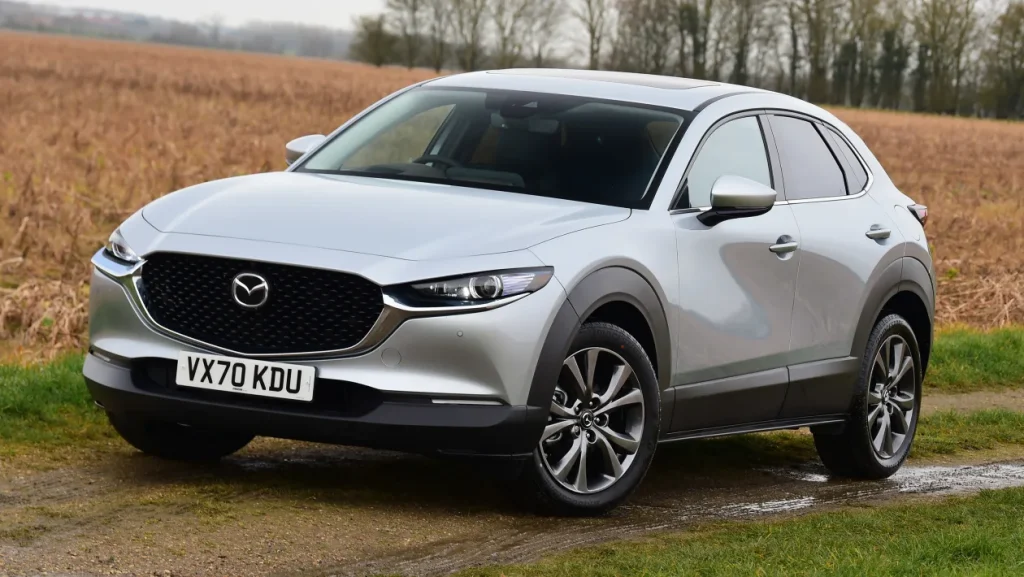
If you’re considering a Mazda CX‑30—or already own one—you may be asking: How long will this vehicle last? What problems should I watch out for? Is it more reliable than its competitors? For folks in San Francisco, Concord, or anywhere in the Bay Area, where roads, weather, and driving styles vary, knowing the reliability of the CX‑30 is crucial.
At Marin Mazda, #1 Mazda dealership in the Bay Area, we believe in transparency. So let’s dig into the evidence, the rumors, and what owners are reporting. We’ll compare with competitive models, discuss maintenance practices, and give you a realistic view of how dependable a Mazda CX‑30 can be—assuming you take care of it.
Table of Contents
- What We Know: Manufacturer Warranty & Reputation
- Owner Feedback: Lifespan & Mileage Stories
- Common Problems: What to Watch Out For
- Maintenance Cost Estimates & Best Practices
- How the CX‑30 Holds Its Value vs. Rivals
- Comparisons: CX‑30 vs Other Similar Compact SUVs
- Verdict: What to Expect If You Own One for 5, 7, or 10 Years
- Marin Mazda’s Role: Buying Smart & Maintaining Smart
1. What We Know: Warranty & Manufacturer Reputation
Mazda has a fairly strong reputation for building reliable, solid small SUVs. While the CX‑30 is newer to the Mazda lineup (introduced around 2019 globally, 2020 in many markets), its core engineering derives from Mazda’s Skyactiv platform, shared with Mazda3 and related models. This gives it some pedigree.
Warranty coverage (U.S.):
- Basic / bumper‑to‑bumper warranty: ~3 years or 36,000 miles
- Powertrain warranty: ~5 years or 60,000 miles. (Car and Driver confirms these numbers in their 2025 CX‑30 specs / warranty data) Car and Driver
That means Mazda is confident enough to cover major engine and drivetrain components for at least 5 years or 60,000 miles. This is fairly typical in the industry—but reliability beyond that depends heavily on maintenance, driving habits, and avoiding known weak points.
2. Owner Feedback: Lifespan & Mileage Stories
What do actual CX‑30 owners say?
- According to CopilotSearch, many owners report that with regular maintenance, a Mazda CX‑30 can reach 150,000 miles and often approach 200,000 miles with fewer major repairs. CoPilot
- Some owners on forums (such as Reddit) report reaching 200,000+ miles, especially with older non‑turbo CX‑30s or those without problematic features like cylinder deactivation. Reddit
So the anecdotal evidence suggests the CX‑30 is capable of long life—especially when treated well mechanically.
3. Common Problems: What To Watch Out For
No vehicle is perfect. Here are some of the issues reported by owners and via recalls / TSBs (Technical Service Bulletins) that may affect reliability:
| Issue | Affected Model Years / Trims | Nature of Problem | Severity / Impact |
|---|---|---|---|
| Valve Stem Seal / Excessive Oil Consumption | 2021 Turbo CX‑30 reported by owners | Engine uses more oil than expected; may require more frequent top‑offs or service | Moderate; depends on how early it’s addressed. Reddit |
| Electrical System / Charging / Battery Drain | Various 2020‑2023 CX‑30s | Dashboard flicker, battery discharge complaints | Mild to moderate; some require service visits. Lemon Firm |
| Infotainment Glitches & Connectivity Issues | Many model years | Bluetooth, navigation, screen freezing or rebooting | Low‑impact in daily use, but annoying and may require software updates or repairs. Lemon Firm |
| Brakes / Calipers / Fuel System Recalls | 2020 CX‑30 recalls (e.g. front brake caliper mounting, fuel system vent hoses) | Safety‑related; must be addressed via recall work | High in terms of safety; subject to recall remedy. Lemberg Law |
Also, some years are considered more risky used purchases. For example, the 2021 CX‑30 Turbo (depending on VIN) is noted in forums and reviews as having more issues with oil consumption and valve stem sealing. Reddit+1
4. Maintenance Cost Estimates & Best Practices
Part of reliability is how well you maintain your vehicle. Based on owner reports and industry data, here’s what you should budget and do to see the CX‑30 last long with fewer headaches:
| Maintenance Item | Interval | Estimated Cost (USD, Bay Area) |
|---|---|---|
| Oil & filter changes (synthetic, dealer service) | Every 5,000‑7,500 miles | $80‑$120 |
| Tire rotations and balance | Every 5,000‑10,000 miles | $50‑$100 |
| Brake pad replacement (front/rear) | 30,000‑50,000 miles depending on driving | $250‑$400 per axle |
| Transmission fluid / Drivetrain inspection | Every ~60,000 miles or as needed | $300‑$500 |
| Major service at 100,000‑150,000 miles (spark plugs, belts/hoses, cooling) | 100,000 miles | $800‑$1,200 depending on engine & trim |
Best practices that many long‑life owners cite:
- Stick to Mazda’s recommended service intervals
- Use high quality oil & filters
- Address electrical / infotainment glitches early
- Keep fluids topped off & monitor for leaks
- Drive gently; hard acceleration and towing stress turbo and drivetrain components
If these are followed, many owners assert the CX‑30 can reach or exceed 150,000‑200,000 miles (≈ 240,000‑320,000 km) with minimal major repairs. CoPilot
5. How the CX‑30 Holds Its Value vs. Rivals
Resale and depreciation are key parts of reliability in the broader sense: how well does it retain value?
- According to data published by Marin Mazda itself on resale & depreciation facts, the CX‑30 has a 5‑year depreciation around 39.5%, meaning it retains about 60‑61% of its value. marinmazda.net
- When compared with rivals like the Honda HR‑V, Hyundai Kona, Subaru Crosstrek, the CX‑30’s resale value is competitive—often outperforming many non‑premium compact SUVs. marinmazda.net
That means reliability isn’t just mechanical; it’s value retention, which matters if you plan to sell or trade in after a few years.
6. Comparisons: CX‑30 vs Other Compact SUVs in Reliability
To get a clearer picture, here’s how CX‑30 stacks up against some close competitors on lifespan and reported issues.
| Model | Typical Lifespan (Miles) | Common Reliability Issues | Value Retention (5 yrs) |
|---|---|---|---|
| Mazda CX‑30 | ~150,000‑200,000 miles | Oil consumption (turbo), electrical glitches, minor recalls | ~60‑61% marinmazda.net |
| Subaru Crosstrek | ~200,000+ miles (esp. non‑turbo) | CVT issues, heater core, rust in some regions | ~62‑65% |
| Honda CR‑V (gas) | ~200,000+ miles | Transmission issues (older models), AC problems | ~58‑60% |
| Toyota RAV4 (gas/hybrid) | 200,000+ miles | Fewer issues; strong reputation | ~60‑63% |
Note: Lifespan numbers assume regular maintenance and no major abuse.
7. Years & Trims to Prefer / Years to Avoid
If you’re shopping for a CX‑30, especially used, knowing which model years and trims have fewer issues can help:
- Prefer 2022‑2024 non‑turbo models for lower chances of oil consumption or mechanical issues. Earlier turbo trims, especially around 2021, have more reported problems. Reddit+1
- Avoid models with known early recalls or defective parts unless fixed under recall service.
- Check for clean maintenance records; confirm items like oil change intervals, any software updates, battery health, etc.
8. What Drivers in the Bay Area Should Expect Over 5, 7 & 10 Years
Here’s a projection of what owning a CX‑30 likely looks like if you live in Concord, San Francisco, or Napa—that is, moderate climate, occasional harsh conditions (fog, salt air), varied driving (stop‑and‑go + highway + hills).
| Ownership Duration | Expected Mileage* | Likely Repairs / Interventions | Depreciation & Value Considerations |
|---|---|---|---|
| 5 years / ~60,000 miles | 50,000‑70,000 mi | Routine maintenance (oil, tires, brakes), maybe minor infotainment updates or battery servicing | Retains 70‑80% value; trade‑in or resale favorable |
| 7 years / ~90,000 miles | 80,000‑100,000 mi | Potential turbo/seal work (on turbo trims), more frequent electrical checks, perhaps brake rotor replacement, suspension wear | Value drop more pronounced; maintenance costs increase |
| 10 years / 150,000‑200,000 miles | 140,000‑200,000 mi | Major component wear: transmission, engine seals, timing (if applicable), HVAC, drivetrain; costlier repairs; body wear (paint/fades) | Value much lower; good candidates for CPO resale earlier; maintenance history crucial |
*Mileage based on average Bay Area driver (~15,000 miles/year)
9. Marin Mazda’s Role: How to Make Your CX‑30 Last Longer

If you’re thinking of buying a CX‑30—or already own one—Marin Mazda offers resources and advice to maximize longevity:
- Recommended servicing schedule (OEM Mazda schedule)
- Using genuine Mazda parts and certified technicians
- Access to current specials for maintenance or parts at Marin Mazda’s Specials
- Touring and test‑driving new CX‑30s via the New Inventory page to see which trim and features suit your long‑term needs
- Contacting service department ahead for known software updates or recall work
10. Verdict: Is the CX‑30 Truly Dependable?
Putting it all together, here’s the bottom line:
- The Mazda CX‑30 has proven itself in multiple markets to be reliable, especially in non‑turbo trims, when well maintained.
- Lifespan can reach 150,000‑200,000 miles with regular care; some owners report even more if driving gently and keeping up with maintenance.
- Known issues are relatively limited and often addressed under warranty or recall, especially with newer model years.
- Resale value is strong compared to many crossover SUVs, especially when the vehicle is kept in good condition.
If you’re buying new or used in the Bay Area, a CX‑30 with good maintenance history, preferably non‑turbo or with turbo trimmed carefully, is likely to serve very well for 5 to 10 years.
Ready to Own Your CX‑30 with Confidence?
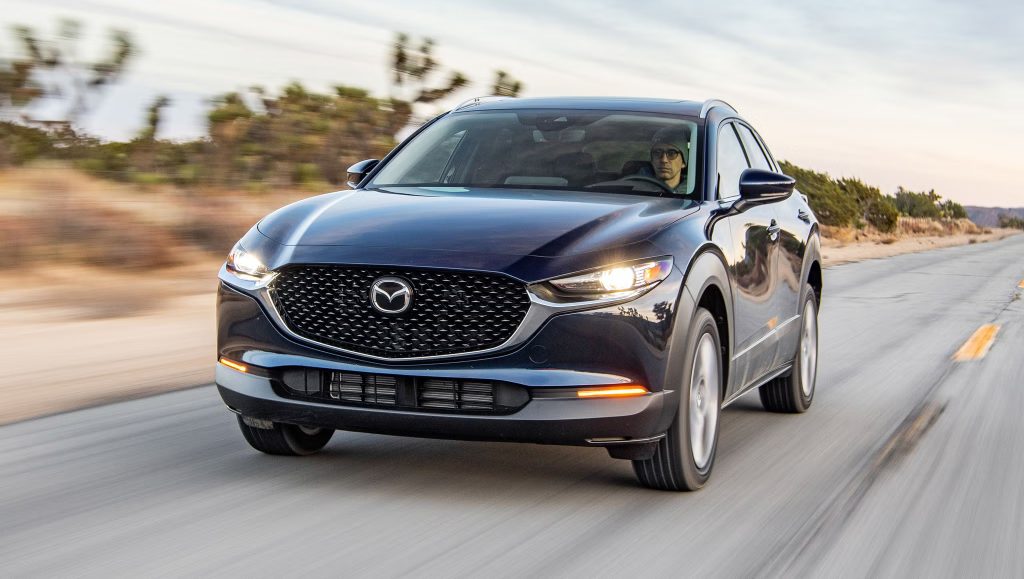
If you’re now leaning toward getting a Mazda CX‑30, Marin Mazda is your best partner:
- Browse current CX‑30s via Marin Mazda New Inventory to see what’s in stock
- Check for maintenance or ownership specials at Marin Mazda Specials to help with long‑term cost of ownership
- Reach out via the Contact page with questions about specific trims, reliability history, or service plans
Final Thought
A car’s reliability isn’t just about stats—it’s about how well you care for it. The Mazda CX‑30 offers a compelling mix of solid design, strong engineering, and owner satisfaction that supports legendary dependability. If you intend to drive it for years, keep up the maintenance, choose your model wisely, and maintain records—the CX‑30 can be a partner on many journeys ahead.
Got it — here’s your final clean version of the Mazda CX-50 Reliability FAQ, ready for direct use on your Marin Mazda blog (no extra lines or editor notes):
FAQ — Mazda CX-50 Reliability | Marin Mazda
1) Is the Mazda CX-50 reliable overall?
Yes. The Mazda CX-50 has proven to be one of the most dependable compact SUVs in its class. Built with Mazda’s SKYACTIV engineering and i-ACTIV AWD, it delivers long-term durability with minimal mechanical issues or electronic faults.
2) How does the CX-50’s reliability compare to the Toyota RAV4 and Subaru Outback?
In long-term dependability rankings, the CX-50 performs on par or slightly better than the RAV4 and Outback. Its simpler drivetrain and proven 2.5-liter engine design reduce the chance of costly repairs.
3) What engines are available and are they dependable?
The CX-50 offers a 2.5-liter SKYACTIV-G engine (187 hp) and an optional 2.5-liter Turbo (256 hp). Both are naturally aspirated or single-turbo setups without complicated hybrid systems, making them exceptionally reliable over time.
4) How long will a Mazda CX-50 last?
With regular maintenance, a CX-50 can easily exceed 200,000 miles (320,000 km). Many owners report smooth performance past 100,000 miles with no major repairs.
5) What are the most common CX-50 issues?
Early reports mention only minor software updates for infotainment and light brake-rotor noise in humid climates. There are no widespread mechanical concerns.
6) Does the CX-50 need premium fuel?
No. The CX-50 runs efficiently on regular 87-octane fuel. Using premium may slightly enhance turbo power output but isn’t required.
7) How often does the CX-50 require service?
Mazda recommends service every 8,000 km (5,000 mi) or every six months—covering oil changes, tire rotations, and safety inspections.
8) Are maintenance costs affordable?
Yes. Average annual maintenance ranges between $450 – $600 USD, lower than most competitors in its class. Parts are widely available, and labor costs remain reasonable.
9) Is the i-ACTIV AWD system reliable?
Absolutely. The AWD system uses predictive sensors to adjust torque distribution instantly. Owners report excellent traction in snow, rain, and uneven terrain—ideal for Bay Area or Tahoe trips.
10) What kind of warranty does Mazda provide?
- 3 years / 36,000 miles – New Vehicle Limited Warranty
- 5 years / 60,000 miles – Powertrain Warranty
This coverage ensures long-term peace of mind for CX-50 owners.
11) How fuel-efficient is the CX-50?
The standard 2.5-liter engine delivers up to 29 mpg highway (8.1 L/100 km), while the turbo model averages around 27 mpg highway—excellent for a standard-AWD crossover.
12) Is the CX-50 a good used SUV choice?
Yes. 2023-plus models retain strong resale value and show few mechanical issues, making them one of the smartest certified pre-owned buys in the segment.
13) How does the CX-50 perform in the Bay Area climate?
The AWD system and balanced chassis make it perfect for San Francisco’s wet roads, steep hills, and weekend mountain drives to Sonoma or Tahoe.
14) Does the CX-50 have good resale value?
Yes. The CX-50 retains roughly 62 % of its value after five years, outperforming many compact crossovers thanks to its premium appeal and reliability.
15) What are owner reviews saying?
CX-50 drivers praise its quiet cabin, build quality, and smooth AWD operation. Many highlight its durability and low maintenance compared with rivals.
16) How does Mazda ensure CX-50 quality?
Every CX-50 is built with precision assembly standards in Mazda’s North American plant, using SKYACTIV materials engineered for strength and corrosion resistance.
17) Are there recalls on the CX-50?
As of 2025, no major recalls have affected the CX-50’s powertrain or safety systems. Mazda continues to issue software updates proactively to maintain peak performance.
18) Is the CX-50 good for families?
Yes. Its spacious interior, top-tier safety scores, and durable components make it an excellent daily driver for Bay Area families seeking style and reliability.
19) What is the towing reliability like?
The CX-50 can tow up to 3,500 lbs (1,588 kg) when properly equipped, with no common drivetrain strain issues reported during long-term testing.
20) Where can I test-drive a Mazda CX-50 in the Bay Area?
Visit Marin Mazda — the #1 Mazda dealership serving San Francisco, Concord, and the North Bay.
Explore the latest CX-50 inventory, view limited-time specials, or schedule a test drive today.
Verdict:
The 2025 Mazda CX-50 blends toughness, premium comfort, and long-term dependability into one package. For Bay Area drivers seeking a confident, reliable SUV that’s as capable as it is refined, the CX-50 remains a standout choice — backed by Marin Mazda’s trusted service and expertise.
Connect with us


Leave a Reply