

How to Check Transmission Fluid – Expert Guide
One Simple Check That Can Save You Thousands in Repairs
Most drivers know how to check engine oil. Almost no one knows how to check transmission fluid properly. And that’s a problem — because transmission failure is one of the most expensive repairs a car can need.
A bad transmission doesn’t fail suddenly. It fails slowly. Heat, low fluid, dirty fluid, and poor lubrication quietly destroy internal components over time. By the time symptoms show up, the damage is often already done.
Checking your transmission fluid is one of the simplest preventative steps you can take — but only if you do it correctly. And most people don’t.
Why Transmission Fluid Matters So Much
Transmission fluid is not just “oil.” It does four critical jobs at once:
- Lubrication of internal components
- Cooling of transmission internals
- Hydraulic pressure for gear changes
- Cleaning of contaminants and debris
If the fluid is low, dirty, burnt, or degraded:
- Shifting becomes rough
- Internal wear accelerates
- Heat builds up
- Seals harden
- Clutches slip
- Valves stick
- Gear engagement weakens
This is how small problems turn into $3,000 to $7,000 rebuilds.
First Important Truth: Not All Cars Are the Same
Before checking anything, you need to know this:
Some cars have a transmission dipstick
Many modern cars do not
Newer vehicles often use:
- Sealed transmissions
- Check plugs instead of dipsticks
- Electronic level monitoring
- Dealer-only service procedures
So the process depends on your vehicle type.
If Your Car Has a Transmission Dipstick
This is the traditional method, and it’s still common in older vehicles and many trucks.
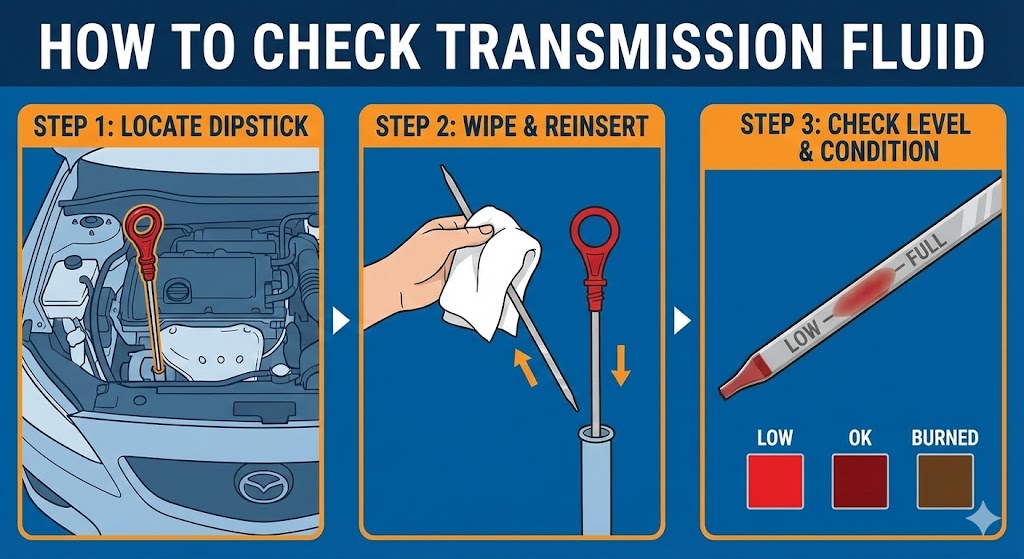
Step-by-Step Proper Method
- Warm the vehicle
Drive for 10 to 15 minutes so the transmission reaches operating temperature. - Park on level ground
This matters. A slope gives false readings. - Leave the engine running
Transmission fluid expands when warm. Checking it cold gives false low readings. - Cycle through gears
With foot on brake:
Park → Reverse → Neutral → Drive → Low → back to Park
This circulates fluid through the system. - Locate the transmission dipstick
Usually:
- Red handle
- Near firewall
- Different from engine oil dipstick
- Pull dipstick and wipe clean
- Reinsert fully
- Pull again and read level
Fluid should be in the HOT range (not cold range).
Reading the Dipstick Correctly
You are checking two things, not one.
Fluid level
- Too low = poor lubrication and pressure
- Too high = foaming and overheating
Fluid condition
Color and smell matter more than people realize:
Healthy fluid:
- Bright red or pink
- Clean
- Slight oil smell
Bad fluid:
- Dark brown or black
- Burnt smell
- Cloudy appearance
- Metal particles
- Milky color (water contamination)
If it smells burnt, the transmission has already been overheating.
If Your Car Does NOT Have a Dipstick
Many modern cars use sealed systems.
These require:
- Lift or jack stands
- Level check plugs
- Temperature-based checking
- Scan tools for fluid temperature
- Specific fill procedures
General method (simplified):
- Vehicle must be level
- Transmission at specific temperature range
- Engine running
- Check plug removed
- Fluid should lightly trickle out
No trickle = low
Heavy flow = overfilled
This is why many sealed transmissions are not DIY-friendly.
Common Mistakes People Make
Checking when cold
Gives false low reading
Checking with engine off
Gives false reading
Confusing oil dipstick with transmission dipstick
Happens more than people admit
Overfilling
Overfill causes:
- Foaming
- Pressure issues
- Seal damage
- Shifting problems
Using wrong fluid type
Wrong ATF can destroy a transmission
When You Should Check Transmission Fluid
Best timing:
- Before long trips
- When noticing rough shifts
- When feeling hesitation
- After fluid service
- When smelling burning odor
- During regular maintenance
- When buying a used car
Warning Signs of Low or Bad Transmission Fluid
- Hard shifting
- Slipping gears
- Delayed engagement
- Jerking between gears
- Whining noise
- Burning smell
- Shuddering
- Overheating warnings
- Poor acceleration
- RPM spikes without speed increase
These are not “normal aging” symptoms. They are fluid-related signs.
Why Low Fluid Is So Dangerous
Low fluid causes:
- Loss of hydraulic pressure
- Internal clutch slippage
- Overheating
- Metal-on-metal wear
- Seal breakdown
- Valve body damage
Heat is the #1 killer of transmissions.
The Cost Reality
Checking transmission fluid:
Free
Transmission fluid top-up:
$10 to $40
Transmission service:
$150 to $400
Transmission rebuild:
$3,000 to $7,000+
Transmission replacement:
$4,000 to $10,000+
This is why fluid checks matter.
Manual Transmissions
Manual transmissions are different:
- No dipstick usually
- Use check/fill plugs
- Thicker gear oil
- Different service intervals
They still need fluid checks — but procedures differ.
CVT Transmissions
CVTs are even more sensitive:
- Precise fluid levels required
- Special fluid types
- Temperature-based checking
- Overfilling is dangerous
- Underfilling causes belt damage
CVTs fail fast when fluid maintenance is poor.
Bottom Line Truth
Checking your transmission fluid is one of the simplest things you can do to protect your car — but it must be done correctly.
Not checking it doesn’t save money.
It only delays the bill until it’s much larger.
If your car allows manual checking, do it every few months.
If it’s sealed, have it checked during service intervals.
Transmission problems don’t start loud.
They start quietly.
FAQ Section
How often should I check my transmission fluid?
Every 2 to 3 months, or at every oil change interval.
Should the engine be running when I check it?
Yes, for dipstick-equipped vehicles. Always check warm and running unless the manual says otherwise.
Can low transmission fluid cause slipping?
Yes. Low fluid directly causes clutch slippage and gear engagement issues.
Can I drive with low transmission fluid?
You can, but it causes rapid internal damage. Every mile increases wear.
What color should transmission fluid be?
Healthy fluid is red or pink and clean. Dark brown or black means it is degraded.
What does burnt transmission fluid smell like?
Strong burnt odor, similar to burned plastic or overheated oil.
Can I add transmission fluid myself?
Yes, if your vehicle has a dipstick and you use the correct fluid type.
What happens if I overfill transmission fluid?
Foaming, pressure issues, seal damage, poor shifting, and overheating.
Do sealed transmissions really not need checking?
They still need checking, just with special procedures and tools.
Is transmission fluid lifetime fluid?
No. “Lifetime fluid” is a marketing term, not a mechanical reality.
How Often to Replace a Cabin Air Filter
The Overlooked Maintenance Item That Quietly Affects Your Health, Comfort, and Car
Most drivers obsess over oil changes, tire rotations, and brake pads. But there’s one small, cheap component in your car that impacts your health more than almost anything else you maintain — the cabin air filter.
And most people ignore it completely.
The cabin air filter controls the quality of the air you breathe inside your vehicle. Every time you turn on your AC, heater, or defroster, the air passes through this filter before it reaches your lungs. Dust, pollen, exhaust particles, mold spores, bacteria, and road pollution all get trapped here.
If that filter is clogged, dirty, or overdue, you’re not just hurting your HVAC system — you’re breathing contaminated air.
So how often should you actually replace it?
The real answer is: more often than most people do.
The Simple Rule Most Mechanics Agree On
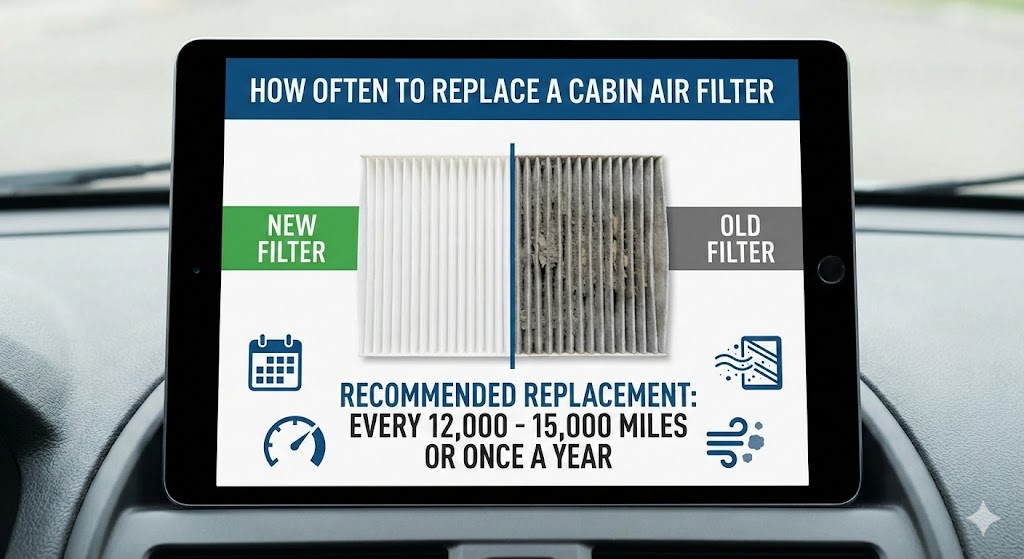
Every 12,000 to 15,000 miles (19,000 to 24,000 km)
or
Once every 12 months
That’s the standard baseline recommendation.
But that’s only the starting point, not the full story.
Why That Interval Exists
Cabin air filters are passive filters. They don’t regenerate, self-clean, or shake debris loose. Once they trap contaminants, those particles stay there. Over time, three things happen:
- Airflow decreases
- HVAC efficiency drops
- Air quality inside the cabin degrades
A clogged filter forces your blower motor to work harder, reduces cooling and heating performance, and increases moisture retention — which leads to odor, mold growth, and bacteria buildup.
It’s not just about airflow. It’s about air quality and system health.
Real-World Replacement Timing (Not the Generic Answer)
Here’s the realistic replacement schedule based on actual driving conditions:
Normal city/highway driving
Every 12 months or 15,000 miles
Urban environments with heavy traffic and pollution
Every 6 to 9 months
Allergy sufferers or asthma-sensitive drivers
Every 6 months
Rural roads, construction zones, dirt roads
Every 6 to 9 months
Cold climates with heavy heater usage
Every 9 months
Hot climates with constant AC use
Every 6 to 9 months
Ride-share drivers, delivery drivers, fleet vehicles
Every 4 to 6 months
If you live in a city, drive daily, or use climate control regularly, once a year is usually too long.
Signs Your Cabin Air Filter Is Overdue
This is where most people miss the warning signs because they assume something else is wrong.
1. Weak airflow from vents
Even on high fan settings, airflow feels restricted
2. Musty or sour smell when AC turns on
Often caused by moisture trapped in a dirty filter
3. Foggy windows that take longer to clear
Poor airflow reduces defogging efficiency
4. Increased dust inside the cabin
Dashboard dust builds faster than normal
5. Allergy symptoms while driving
Sneezing, watery eyes, irritated throat
6. AC or heater feels less effective
System works harder, performs worse
These are not HVAC failures — they’re airflow restriction symptoms.
What Happens If You Never Replace It
People assume ignoring the cabin filter just means “dirty air.” The reality is worse:
- Mold growth inside the HVAC box
- Bacteria accumulation
- Blower motor strain
- Evaporator core contamination
- Persistent interior odors
- Reduced AC efficiency
- Higher repair costs later
A $15 to $40 filter can prevent hundreds in HVAC repairs.
Standard vs Carbon Cabin Filters
Not all cabin air filters are the same.
Standard paper filter
- Traps dust, pollen, debris
- Basic air filtration
- Cheapest option
Activated carbon filter
- Traps odors and gases
- Filters exhaust fumes
- Better for cities and pollution
- Better for allergies
- Better air quality overall
If you drive in traffic-heavy areas, carbon filters are worth it.
Why Most People Replace It Too Late
Three reasons:
- It’s out of sight
- No warning lights
- No dashboard reminders
Unlike oil or brakes, the car doesn’t tell you it’s dirty. So people forget it exists.
Most cabin filters that get removed at shops are black, clogged, and falling apart.
Cost vs Value
Cabin air filter cost:
- DIY: $10 to $35
- Shop replacement: $30 to $70
That’s one of the cheapest maintenance items on any car — yet one of the most ignored.
DIY vs Shop Replacement
DIY
Most cabin air filters take 2 to 5 minutes to change.
Usually located:
- Behind glove box
- Under dashboard
- Under hood (some models)
No tools needed in most cars.
Shop
Convenient, but often overpriced for labor time.
If you can open a glove box, you can change a cabin filter.
The Truth Most Owners Manuals Don’t Tell You
Manufacturers often list long replacement intervals because they assume:
- Ideal driving conditions
- Low pollution
- Clean environments
- Light HVAC use
Real-world driving is not ideal conditions.
Traffic, construction dust, pollution, pollen, wildfire smoke, and urban air quality shorten filter life drastically.
Health Aspect Most People Ignore
You’re not just filtering air for comfort — you’re filtering air for your lungs.
Dirty cabin filters:
- Circulate allergens
- Recirculate mold spores
- Trap bacteria
- Increase respiratory irritation
- Worsen asthma symptoms
- Increase sinus issues
For people with allergies, this filter matters more than your engine air filter.
Bottom Line Recommendation
Replace your cabin air filter every 6 to 12 months.
Not because the manual says so — but because real-world driving conditions demand it.
If you:
- Live in a city
- Drive daily
- Use AC or heat often
- Have allergies
- Sit in traffic
- Drive in polluted areas
Then every 6 to 9 months is the smart interval.
It’s cheap, easy, and directly affects your health and comfort.
FAQ Section
How often should I replace my cabin air filter exactly?
For most drivers, every 12 months or 15,000 miles. For city drivers, allergy sufferers, and high AC use, every 6 to 9 months is more realistic.
Can a dirty cabin filter damage my AC system?
Yes. Restricted airflow strains the blower motor and increases moisture buildup, which can lead to mold and HVAC contamination.
Is it dangerous to drive with a dirty cabin air filter?
Not immediately dangerous, but it degrades air quality, increases allergen exposure, and can cause respiratory irritation over time.
Does a cabin air filter affect fuel economy?
Indirectly. A restricted filter forces the HVAC system to work harder, increasing electrical load, which slightly increases fuel consumption.
How do I know if my cabin air filter needs replacing?
Weak airflow, musty smells, foggy windows, dust buildup, and allergy symptoms are common signs.
Can I clean a cabin air filter instead of replacing it?
Not properly. Most are paper or carbon filters and are not designed to be cleaned. Cleaning only removes surface dust, not trapped particles or bacteria.
Is a carbon cabin filter worth it?
Yes, especially in cities. Carbon filters remove odors, pollution, and exhaust gases better than standard filters.
Does winter or summer affect replacement timing?
Yes. Heavy heater or AC usage increases filter contamination. Seasonal use shortens lifespan.
Is cabin air filter replacement a scam upsell?
No. It’s one of the most legitimate maintenance items shops recommend. It’s just often overpriced for labor.
Can a dirty cabin filter cause bad smells in the car?
Yes. Mold, bacteria, and moisture buildup in dirty filters are a primary cause of musty AC odors.
Ask any car owner how long their vehicle will last and you’ll usually get a vague answer: “It depends.”
But if you’re specifically wondering how long a Mazda CX-5 lasts, the answer is more concrete and more interesting than you might expect.

The Mazda CX-5 has quietly earned a reputation for longevity, not because it’s flashy, but because it’s engineered to age well. This article breaks down what owners actually experience over time, what typically fails (and what doesn’t), and how long you can realistically expect a CX-5 to stay on the road.
The Short Answer (Then We’ll Go Deeper)
A well-maintained Mazda CX-5 typically lasts 200,000 to 250,000 miles (320,000 to 400,000 km).
Many owners report going well beyond that with routine maintenance.
But mileage alone doesn’t tell the full story.
Why the Mazda CX-5 Ages Better Than Most Compact SUVs
Longevity isn’t accidental. The CX-5 benefits from several engineering decisions that favor durability over short-term trends.
1. No CVT Transmission
One of the biggest reasons many SUVs don’t age well is the CVT. Mazda avoided that trap.
The CX-5 uses a traditional 6-speed automatic transmission, which:
- Handles heat better over time
- Is easier to service
- Has a proven long-term reliability record
This alone adds years to a vehicle’s usable life.
2. Naturally Aspirated Engines That Aren’t Overstressed
Most CX-5 models use Mazda’s 2.5-liter four-cylinder engine, which is known for:
- Conservative tuning
- Strong internal components
- Lower long-term stress
Even turbocharged CX-5 models tend to hold up well when maintained properly, because Mazda didn’t chase extreme output numbers.
3. Mazda’s “Understated” Reliability Philosophy
Mazda doesn’t chase the newest tech for headlines. Instead, it focuses on refining systems over time. That means:
- Fewer first-generation failures
- Better real-world reliability
- Less electronic complexity compared to some competitors
This pays dividends after 8–10 years of ownership.
What Mazda CX-5 Owners Actually Experience Over Time
Let’s break longevity into realistic stages.
0–100,000 Miles: Almost Boring (In a Good Way)
Most CX-5s experience very few issues in this phase. Typical maintenance includes:
- Oil changes
- Brake pads and rotors
- Tires
- Battery replacement
Major mechanical failures are uncommon.
100,000–200,000 Miles: The True Test
This is where weaker vehicles start to fall apart — and where the CX-5 usually keeps going.
Common maintenance items may include:
- Suspension components (shocks, bushings)
- Wheel bearings
- Cooling system service
- Spark plugs and coils
Engines and transmissions typically remain solid if fluids were serviced on time.
200,000+ Miles: Still Alive With Care
Reaching this milestone isn’t rare for the CX-5. Vehicles that make it here usually:
- Had consistent oil changes
- Avoided overheating
- Received transmission and brake service
At this point, age-related wear becomes more about economics than capability. Many CX-5s are still mechanically sound but retired due to cosmetic wear or owner upgrades.
What Usually Doesn’t Fail on a CX-5
This matters just as much as what does fail.
Owners consistently report:
- Few engine failures
- Minimal transmission issues
- Strong AWD system reliability
- Fewer electrical gremlins than competitors
These are the big-ticket items that determine whether a car lasts 10 years or 20.
How Maintenance Affects CX-5 Lifespan (A Lot)
Two identical Mazda CX-5s can have wildly different lifespans depending on maintenance habits.
CX-5s That Die Early Usually Have:
- Skipped oil changes
- Overheated engines
- Ignored warning lights
- Never-serviced transmissions
CX-5s That Last Forever Usually Have:
- Oil changes every 6,000–8,000 miles
- Transmission fluid service (even if “lifetime”)
- Brake and suspension maintenance
- Quality tires and alignments
Maintenance doesn’t just prevent failure — it extends life dramatically.
How the Mazda CX-5 Compares to Other SUVs for Longevity
In the compact SUV segment, the CX-5 regularly outlasts:
- Many CVT-equipped competitors
- SUVs with smaller, highly boosted engines
- Vehicles overloaded with fragile electronics
It competes closely with brands known for long life, but often at a lower long-term ownership cost.
Is the Mazda CX-5 a Good Long-Term Buy?
If your goal is to buy a vehicle and keep it for 10–15 years, the CX-5 is one of the safest bets in its class.
It’s especially appealing for:
- Families planning long ownership
- Buyers who value reliability over trends
- Drivers who want fewer surprises after 100,000 miles
The Real Question Isn’t “How Long Will It Last?”
The better question is:
How long do you want it to last?
Because with basic care, a Mazda CX-5 will often outlast:
- Your loan
- Your warranty
- Your expectations
That’s why so many owners replace their CX-5 not because it failed — but because they simply wanted something new.
Final Verdict
So, how long do Mazda CX-5s last?
With proper maintenance:
- 200,000 miles is normal
- 250,000 miles is common
- 300,000+ miles is achievable
In a market full of short-lived complexity, the Mazda CX-5 stands out by quietly doing what matters most: lasting.
Can a Mazda CX-5 really last over 200,000 miles?
Yes, and many do. A properly maintained Mazda CX-5 commonly reaches 200,000 to 250,000 miles, and some owners report exceeding that. The key factors are regular oil changes, cooling system care, and not ignoring warning signs.
What usually ends the life of a Mazda CX-5?
Surprisingly, it’s rarely the engine or transmission. Most CX-5s are retired due to neglected maintenance, accident damage, or repair costs outweighing vehicle value, not because the drivetrain fails.
Do turbocharged Mazda CX-5s last as long as non-turbo models?
They can, but maintenance matters more. Turbo CX-5s require more frequent oil changes and careful warm-up habits. Owners who follow service intervals closely often see similar longevity to non-turbo models.
At what mileage do Mazda CX-5s start needing “real” repairs?
For most owners, notable wear begins around 120,000 to 150,000 miles. This usually involves suspension components, wheel bearings, or cooling parts — not catastrophic failures.
Is the Mazda CX-5 more durable than other compact SUVs?
In many cases, yes. The CX-5 avoids CVT transmissions and overly complex electronics, which helps it age more gracefully than many competitors in the compact SUV class.
Can poor maintenance cut a CX-5’s lifespan in half?
Absolutely. Skipping oil changes, ignoring transmission service, or allowing the engine to overheat can reduce a CX-5’s life dramatically. Maintenance habits matter more than model year.
Why do so many owners replace their CX-5 even though it still runs fine?
Most replacements happen for lifestyle reasons, not reliability. Owners upgrade for new tech, safety features, or personal preference — not because the CX-5 has reached the end of its usable life.
Best Tire Gauge: How to Choose One That’s Actually Accurate (And Why Most People Buy the Wrong One)
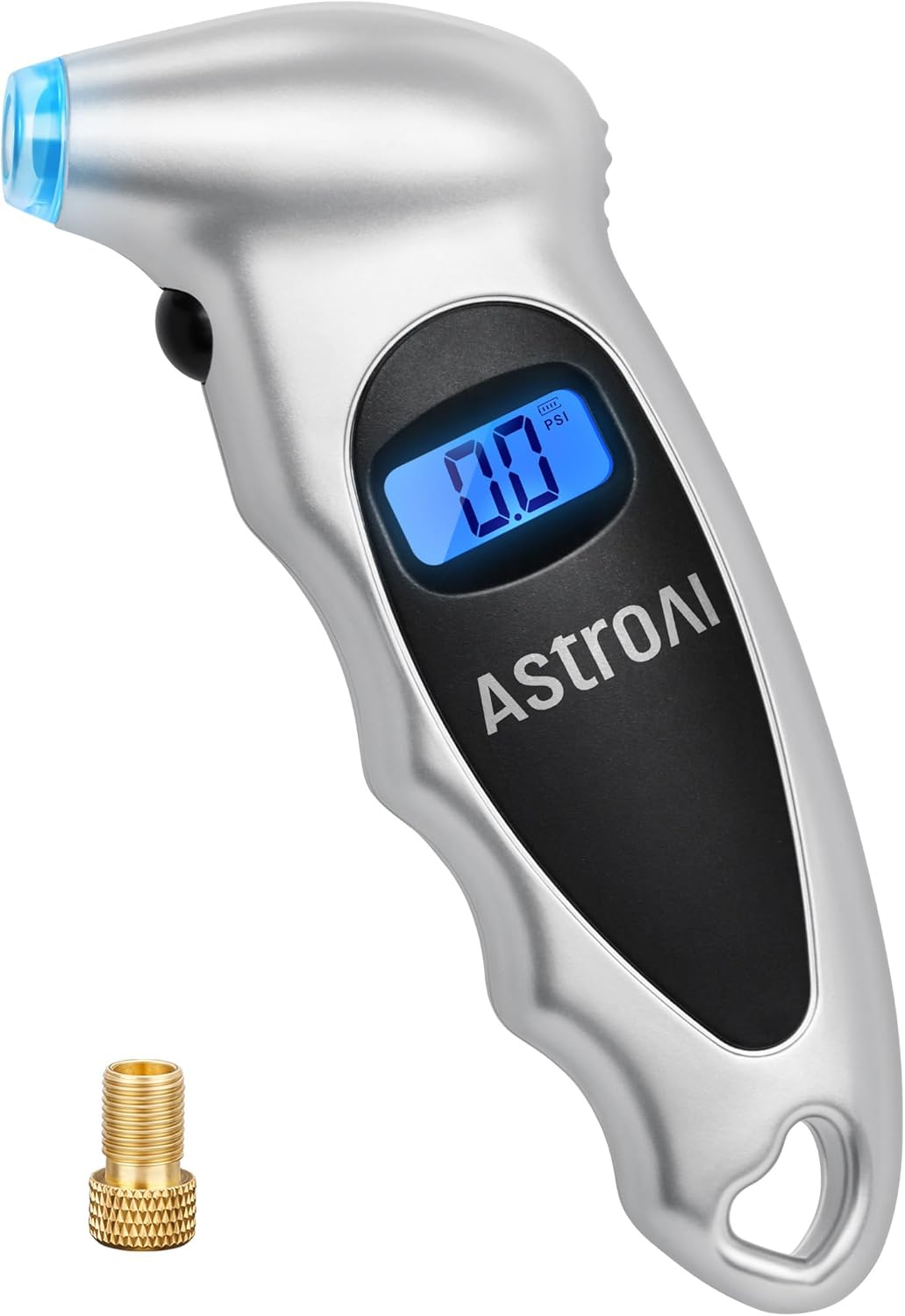
A tire gauge is one of the cheapest tools you can own, yet it directly affects safety, fuel economy, tire life, and how your car feels on the road. Despite that, most drivers either do not own one or use the first cheap gauge they find at a gas station without understanding what makes a gauge accurate or reliable.
This guide explains what the best tire gauge really is, how different types work, which ones professionals trust, and how to avoid the most common mistakes people make when buying or using one.
If you want a tire gauge that actually gives you correct readings instead of false confidence, this article is for you.
Why a Tire Gauge Matters More Than Most People Think
Tire pressure affects more than just ride comfort.
Incorrect pressure can cause:
- Uneven tire wear
- Reduced braking performance
- Poor fuel economy
- Sluggish steering
- Increased risk of blowouts
- Compromised traction in wet conditions
Even modern vehicles with tire pressure monitoring systems are not a replacement for a manual gauge. TPMS systems often:
- Trigger only when pressure is dangerously low
- Measure relative pressure, not exact PSI
- Drift over time
- Lag behind actual pressure changes
A tire gauge gives you exact numbers, not warnings after the damage has already started.
What Makes a Tire Gauge “Good” vs “Bad”
Not all tire gauges are equal. Accuracy, durability, and consistency matter far more than brand names or fancy designs.
A good tire gauge should:
- Give repeatable readings
- Read within 1 PSI accuracy
- Work in cold and hot conditions
- Seal properly on the valve stem
- Be easy to read without guesswork
A bad tire gauge:
- Gives inconsistent readings
- Loses calibration quickly
- Leaks air during measurement
- Is hard to read or ambiguous
- Breaks after minor drops
Price alone does not determine quality, but extremely cheap gauges often sacrifice accuracy and durability.
The Main Types of Tire Gauges (And What They’re Good At)
Pencil-Style Tire Gauges
These are the classic stick gauges many people grew up with.
How they work:
- Air pressure pushes a calibrated rod outward
- PSI markings are printed on the rod
Pros:
- Simple
- No batteries
- Compact
- Inexpensive
Cons:
- Can stick or jam over time
- Hard to read in low light
- Less precise at higher PSI ranges
Best for:
- Emergency use
- Glove box backup
- Basic checks on standard passenger cars
A quality pencil gauge is still better than guessing, but it should not be your only gauge.
Dial Tire Gauges
Dial gauges use a mechanical needle and internal spring mechanism.
How they work:
- Air pressure moves a needle across a numbered dial
- Pressure is held until manually released
Pros:
- Easier to read than pencil gauges
- More accurate when well-made
- Durable metal construction available
- Often used in professional settings
Cons:
- Can lose calibration if dropped
- Larger than pencil gauges
- Cheaper versions may drift over time
Best for:
- Enthusiasts
- Home garages
- Drivers who want reliable readings without batteries
A high-quality dial gauge is one of the best all-around options.
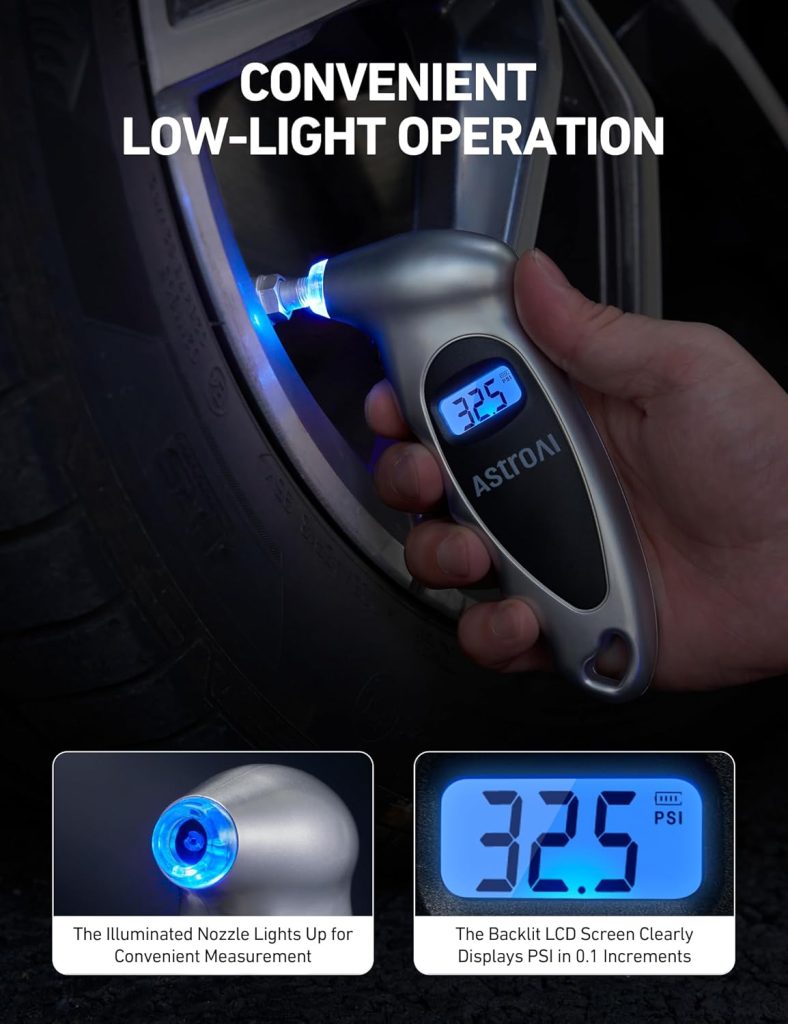
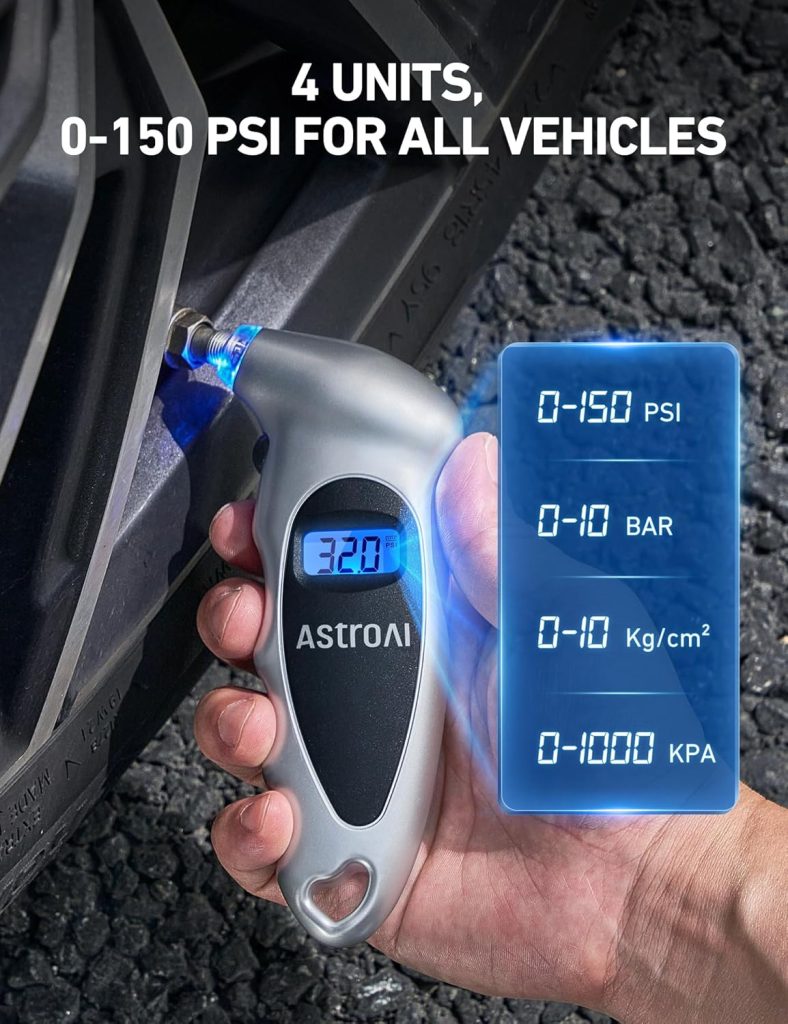
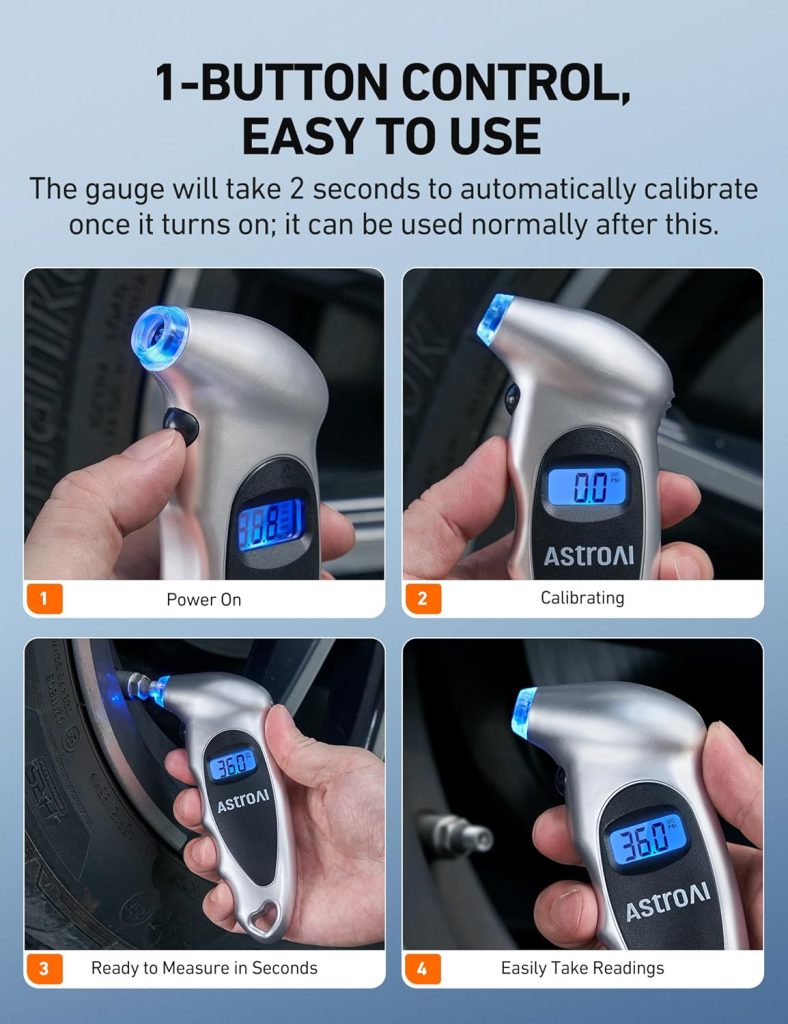
Digital Tire Gauges
Digital gauges display pressure on an electronic screen.
How they work:
- Electronic pressure sensors convert air pressure into digital readings
Pros:
- Very easy to read
- Often precise to 0.1 PSI
- Useful in low light
- Can switch between PSI, BAR, and kPa
Cons:
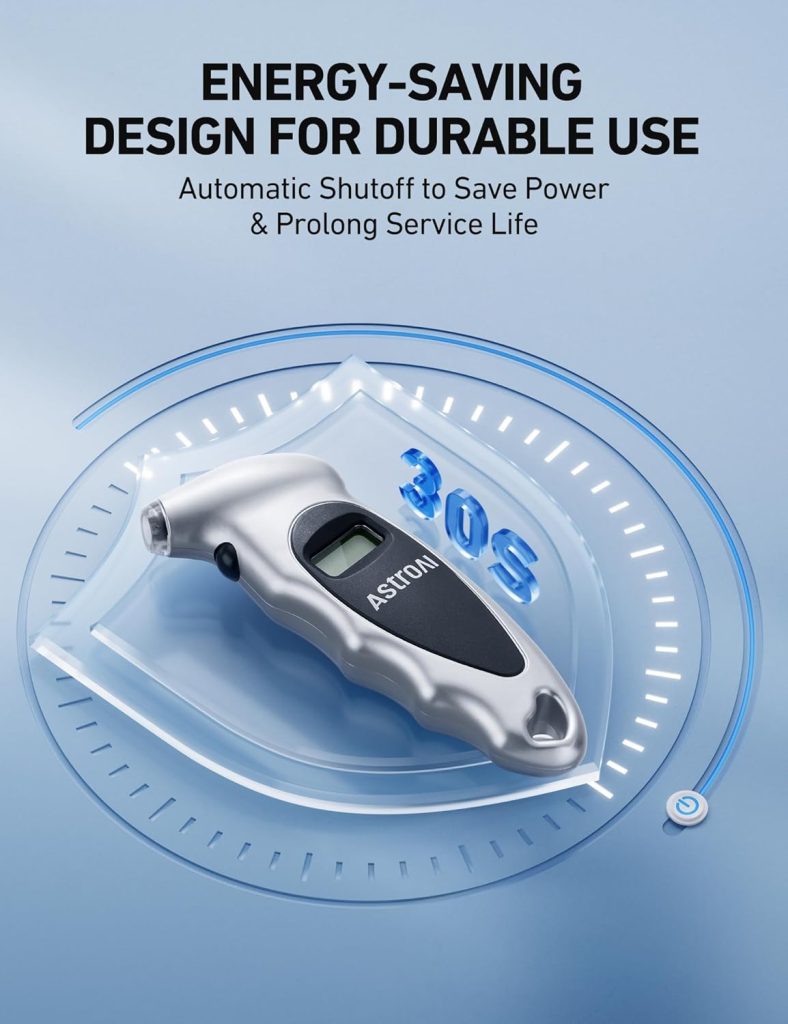
- Requires batteries
- Electronics can fail
- Cheap models can be inaccurate
- Slower response in extreme cold
Best for:
- Drivers who want clarity
- Modern vehicles with specific PSI requirements
- People who prefer digital readouts
A well-made digital gauge can be excellent, but quality matters more here than with mechanical gauges.
Combination Inflator Gauges
These are gauges built into air hoses or inflators.
Pros:
- Convenient
- One-tool solution
- Common in garages and shops

Cons:
- Accuracy varies widely
- Can be affected by hose pressure loss
- Often less precise than standalone gauges
Best for:
- Quick adjustments
- Shop environments
- Not ideal as a primary measuring tool
Many professionals use a standalone gauge to verify readings from inflator gauges.
Accuracy: The One Thing Most Buyers Ignore
The biggest mistake people make when buying a tire gauge is assuming all gauges are accurate.
They are not.
Even brand-new gauges can be off by 2 to 5 PSI. That may not sound like much, but it is enough to:
- Accelerate tire wear
- Reduce fuel economy
- Alter handling
- Trigger or suppress TPMS warnings incorrectly
Professional-grade gauges are often tested and calibrated. Cheap gauges usually are not.
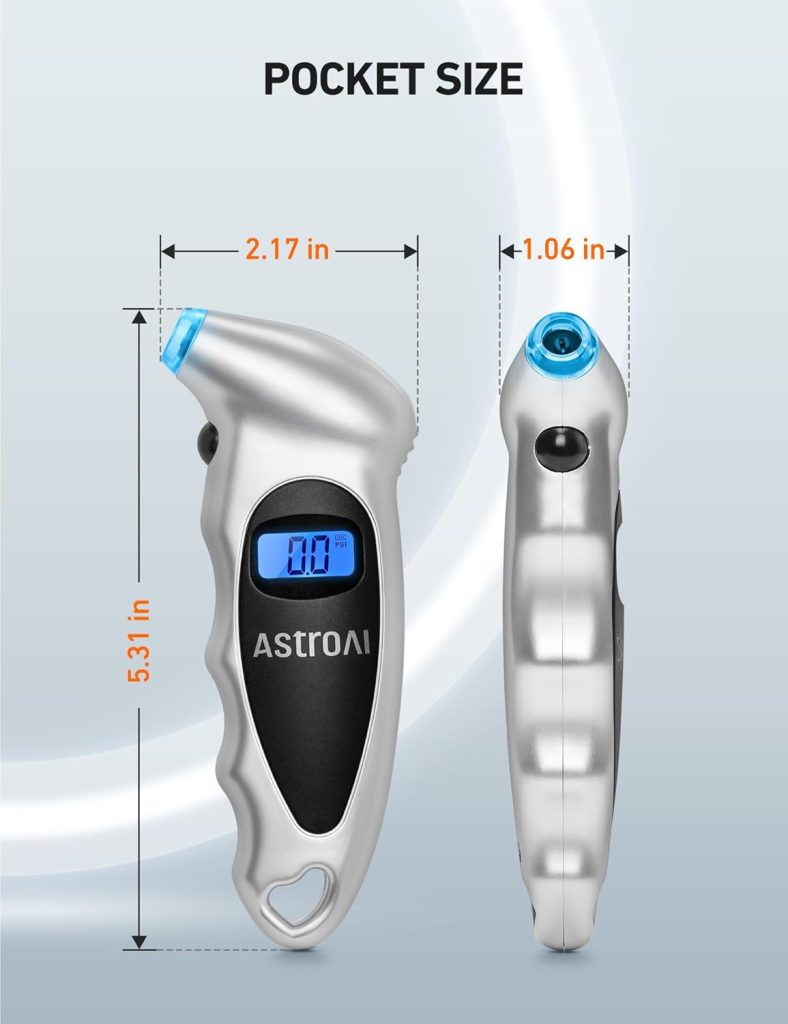
If accuracy matters, buy a gauge designed for automotive use, not a novelty keychain tool.
PSI Range Matters More Than You Think
Many cheap gauges are designed for wide PSI ranges, such as 0 to 100 PSI. That reduces precision where you actually need it.
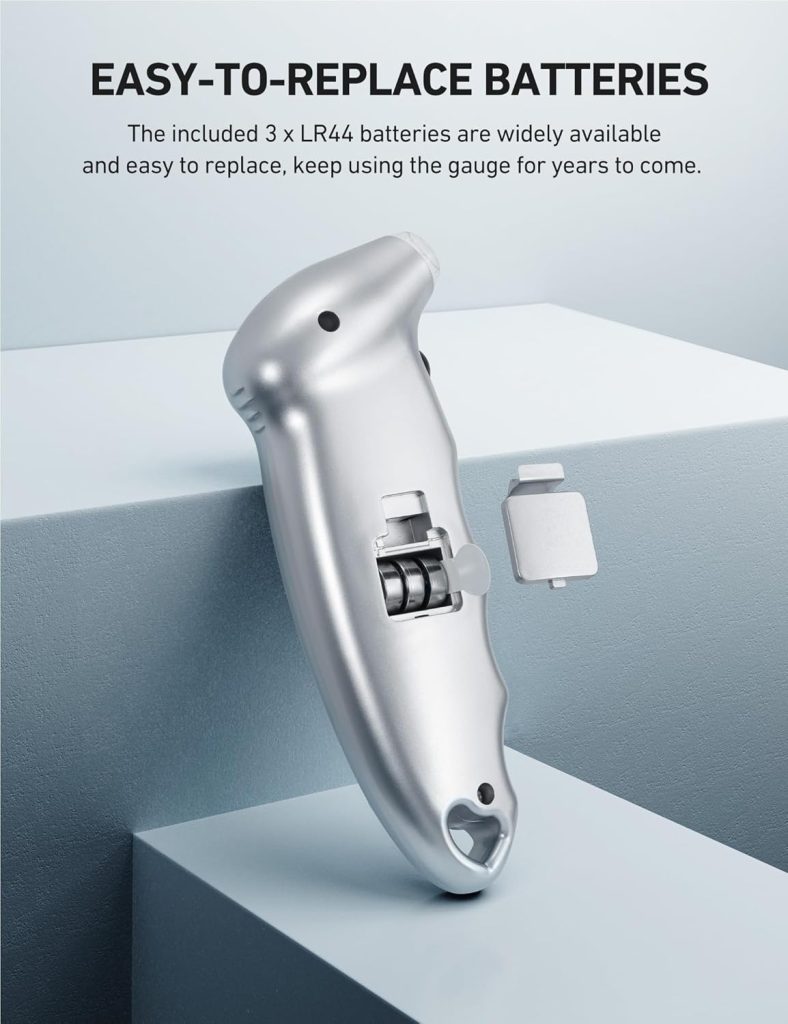
Passenger vehicles typically require:
- 30 to 40 PSI
A gauge optimized for:
- 0 to 60 PSI
will be more accurate in that range than one stretching to 100 PSI.
This is why professional gauges are often range-specific.
How to Use a Tire Gauge Correctly (Most People Don’t)
Even the best gauge will give bad readings if used incorrectly.
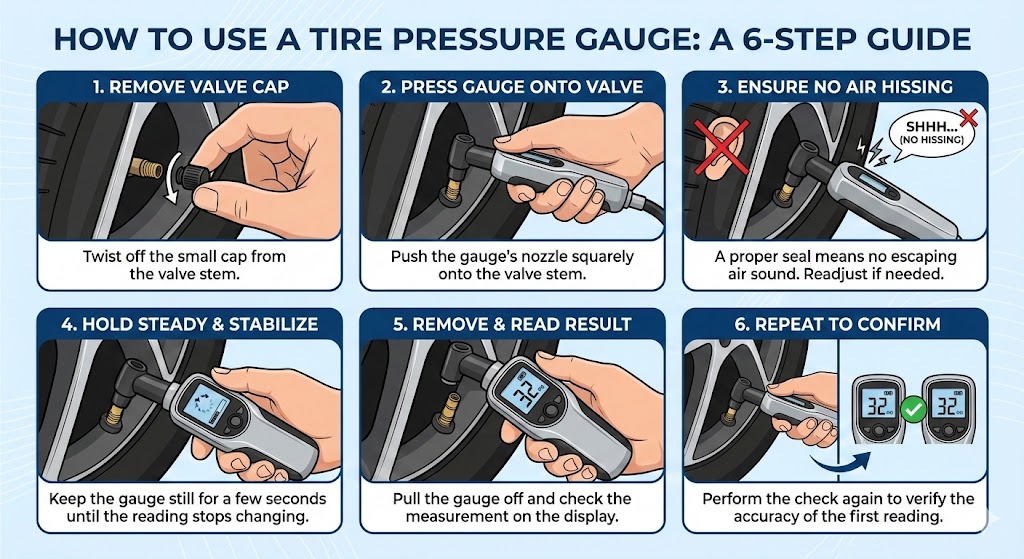
Always measure tire pressure:
- When tires are cold
- Before driving or after sitting for several hours
- On level ground
Steps:
- Remove the valve cap
- Press the gauge straight onto the valve stem
- Ensure no air hissing occurs
- Hold steady until the reading stabilizes
- Remove and read the result
- Repeat once to confirm
If readings differ, use the second reading.
Never trust a single rushed measurement.
Common Tire Gauge Myths
“Gas station gauges are accurate”
Most are abused, dropped, and never calibrated. Treat them as rough estimates only.
“Digital is always better”
Only if the sensor is high quality. Cheap digital gauges can be worse than good mechanical ones.
“One gauge is enough forever”
Gauges can drift. Periodic comparison with another gauge is smart.
“TPMS replaces a gauge”
TPMS is a warning system, not a measuring tool.
How Often Should You Check Tire Pressure?
Best practice:
- Once a month
- Before long trips
- With seasonal temperature changes
- After hitting potholes or curbs
Temperature changes alone can alter pressure by several PSI.
Signs Your Tire Gauge Is No Longer Reliable
Replace or verify your gauge if:
- Readings vary wildly
- The needle sticks
- Digital display flickers
- Air leaks during measurement
- Results differ drastically from known-good gauges
A faulty gauge is worse than no gauge because it creates false confidence.
Professional Advice on Choosing the Best Tire Gauge
If you want a simple rule:
- For everyday drivers: high-quality dial gauge
- For clarity and convenience: reputable digital gauge
- For backup use: pencil gauge only
Avoid ultra-cheap novelty gauges. Accuracy is more important than design.
Final Verdict: What Is the Best Tire Gauge?
The best tire gauge is not the most expensive or flashy. It is the one that:
- Gives consistent readings
- Matches your vehicle’s PSI range
- Is easy to use correctly
- Holds accuracy over time
A good tire gauge costs less than a tank of gas but protects thousands of dollars in tires and improves safety every time you drive.
That makes it one of the smartest tools you can own.
Old gasoline is a problem most car owners eventually run into. A Mazda that sat too long, a spare fuel can from last summer, or a vehicle parked during travel or repairs. When fuel goes bad, it is not just an inconvenience. It can cause real damage to modern Mazda fuel systems if handled incorrectly.

This guide explains how to get rid of old gasoline the right way, following U.S. safety and environmental rules, with specific considerations for Mazda vehicles. If you drive a Mazda and are dealing with stale fuel, this is what you need to know before doing anything else.
For Mazda service guidance or professional help, owners can always start at
https://www.marinmazda.net/
Why Old Gasoline Is Especially Risky for Mazda Vehicles

Gasoline does not stay fresh forever. In most real-world conditions:
- Gasoline begins degrading after 3 to 6 months
- Ethanol-blended fuel breaks down faster
- Moisture contamination increases over time
Modern Mazda engines, especially Skyactiv-G and turbocharged models, use high-pressure fuel systems and precision injectors. These components are far less tolerant of stale or contaminated fuel than older engines.
When old gasoline is left in a Mazda, it can:
- Cause hard starts or no-start conditions
- Trigger check-engine lights
- Lead to injector clogging
- Damage fuel pumps
- Create rough idle or hesitation
Mazda service departments regularly advise removing old fuel rather than attempting to drive through it.
If your Mazda has been sitting and you suspect bad fuel, the safest next step is to contact a certified Mazda service department such as
https://www.marinmazda.net/service
How to Tell If Gasoline Is Too Old to Use
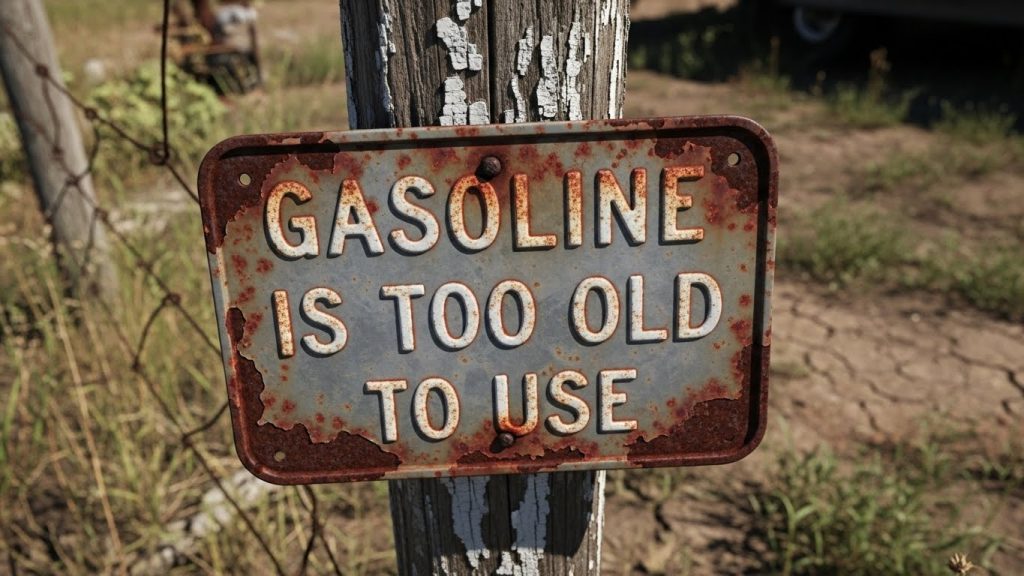
Old gasoline usually shows clear warning signs. If you notice any of the following, disposal is the correct move:
- Sour, varnish-like smell instead of a sharp gasoline odor
- Dark yellow or brown color
- Cloudy appearance or sediment
- Engine misfires or stalls after sitting
- Vehicle struggles to start even with a healthy battery
If a Mazda has been parked for more than six months without fuel stabilizer, assume the fuel quality has degraded.
What You Should Never Do With Old Gasoline
In the United States, improper gasoline disposal is both dangerous and illegal in many areas.

Never:
- Dump gasoline onto the ground
- Pour it into storm drains or sewers
- Burn it in open containers
- Throw it in household trash
- Mix it with oil or other automotive fluids
Gasoline is classified as household hazardous waste. Disposal must be handled responsibly to avoid environmental damage and fire risk.
The Correct Ways to Dispose of Old Gasoline in the U.S.
1. Household Hazardous Waste Facilities (Best Option)
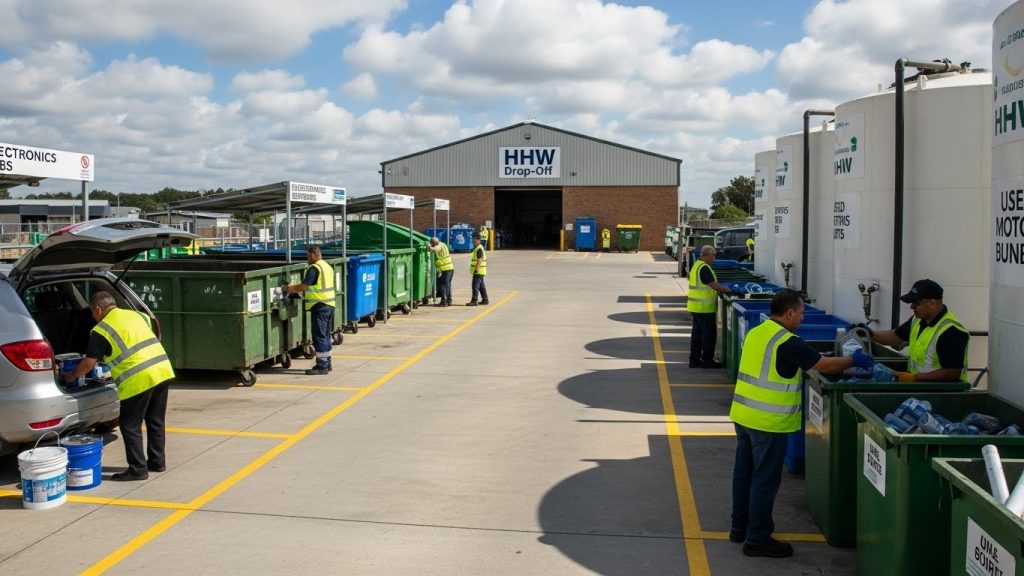
Most cities and counties in the U.S. operate Household Hazardous Waste facilities or scheduled collection events. These locations are specifically designed to handle gasoline safely.
Steps:
- Store old gasoline in an approved fuel container
- Keep it sealed and upright
- Transport it securely
- Drop it off during operating hours
This method is usually free for residents and is the option most recommended by Mazda service professionals.
If you are unsure how to remove fuel from your Mazda safely, scheduling professional service is strongly advised:
https://www.marinmazda.net/schedule-service
2. Professional Fuel Removal by a Mazda Service Department

If old gasoline is already inside your Mazda’s fuel tank, the safest solution is professional removal.
Mazda technicians can:
- Drain the fuel properly
- Inspect the fuel system
- Prevent injector or pump damage
- Dispose of the fuel through approved channels
This option is especially important for:
- Turbocharged Mazda models
- Vehicles that sat longer than one year
- Cars that already show drivability issues
Service appointments can be scheduled directly through
https://www.marinmazda.net/service
3. Dilution for Mildly Stale Fuel (Limited Situations Only)
If gasoline is only slightly old and shows no signs of contamination, some U.S. guidelines allow controlled dilution.
This involves:
- Mixing one part old fuel with five to ten parts fresh gasoline
- Using it only in non-turbocharged vehicles
- Driving gently until the diluted fuel is consumed
Important Mazda note:
This is not recommended for turbocharged Mazda engines or vehicles with direct injection sensitivity. When in doubt, disposal is safer than dilution.
How to Remove Old Gasoline From a Mazda Safely
Professional Removal (Recommended)
Mazda service departments have proper equipment to drain fuel safely without damaging components. This is the preferred method for modern Mazdas.
Schedule assistance here:
https://www.marinmazda.net/schedule-service
DIY Siphoning (Use Caution)

If removing fuel yourself:
- Use a hand-pump siphon only
- Never mouth-siphon
- Work outdoors away from sparks or heat
- Use an approved fuel container
Once removed, the gasoline must still be disposed of legally.
Proper Containers for Old Gasoline
Always use:
- DOT-approved gasoline containers
- Clearly labeled fuel cans
- Tight-sealing caps
Never store gasoline in:
- Plastic drink containers
- Glass bottles
- Open buckets
- Unmarked containers
Improper storage greatly increases fire and vapor risks.
Environmental and Legal Considerations in the U.S.
Gasoline contains hazardous compounds that contaminate soil and groundwater. Improper disposal can result in fines and environmental damage.
This is why Mazda dealerships and service centers follow strict disposal procedures and why owners are strongly encouraged to do the same.
For guidance or assistance, contacting a certified Mazda dealer such as
https://www.marinmazda.net/
is always a safe starting point.
How Mazda Owners Can Prevent Old Gas Problems
To avoid dealing with stale fuel in the future:
- Use fuel stabilizer if storing longer than three months
- Keep the fuel tank at least half full during storage
- Start and drive the vehicle monthly when possible
- Avoid long-term storage with ethanol-heavy fuel
- Follow Mazda’s recommended maintenance schedule
Mazda service teams can also advise on long-term storage preparation and fuel system care.
Final Advice for Mazda Owners
If you are dealing with old gasoline:
- Do not dump it
- Do not ignore it
- Do not guess
Use approved disposal methods or professional service. Old fuel is inexpensive to dispose of properly. Fuel system repairs are not.
For Mazda-specific service support, inspections, or fuel system concerns, visit
https://www.marinmazda.net/
Frequently Asked Questions About Old Gasoline (Mazda Owners)
1. How long can gasoline safely sit in a Mazda before it goes bad?
In most cases, gasoline begins to degrade after 3 to 6 months, especially ethanol-blended fuel. If your Mazda has been sitting longer than that without a fuel stabilizer, the fuel quality may already be compromised and should be inspected or removed by a professional service department.
For help, Mazda owners can contact
https://www.marinmazda.net/service
2. Can old gasoline damage my Mazda’s engine or fuel system?
Yes. Old gasoline can clog fuel injectors, damage the fuel pump, and cause rough idle, misfires, or hard starts. Modern Mazda engines use tight-tolerance fuel systems that are more sensitive to contaminated or stale fuel than older vehicles.
If symptoms appear, professional inspection is strongly recommended:
https://www.marinmazda.net/schedule-service
3. Should I try to drive out old gas instead of removing it?
This depends on how old the fuel is. Mildly stale fuel may sometimes be diluted with fresh gas, but if the gasoline smells sour, looks dark, or the vehicle runs poorly, driving it can cause further damage. Mazda service technicians generally recommend removing bad fuel rather than forcing it through the system.
4. Can a Mazda dealership dispose of old gasoline?
Many Mazda service departments can safely drain old fuel and dispose of it through approved hazardous waste channels. Availability and fees may vary, so it is best to call ahead or schedule service directly with a certified Mazda dealer such as
https://www.marinmazda.net/service
5. Is it illegal to dump old gasoline in the U.S.?
Yes. Gasoline is classified as household hazardous waste in the United States. Dumping it on the ground, into drains, or into trash containers can result in environmental damage and fines. Proper disposal through approved facilities or professional service is required.
6. How can I prevent gasoline from going bad in my Mazda during storage?
To prevent fuel degradation:
- Use a fuel stabilizer if storing longer than three months
- Keep the tank at least half full
- Start and drive the vehicle periodically
- Follow Mazda maintenance recommendations
If you plan long-term storage, a Mazda service team can help you prepare properly:
https://www.marinmazda.net/
Which Cylinders Does AFM Deactivate in the GM 6.2L V8? The Real Answer Explained Clearly

If you’re asking which cylinders AFM deactivates in the GM 6.2L V8, you’re already ahead of most buyers. This is not trivia. This detail explains why certain lifters fail, why ticking noises show up where they do, and why AFM and DFM engines develop uneven wear over time.
This article breaks it down plainly. No marketing language. No myths. Just how the system actually works on GM’s 6.2-liter V8.
Quick Answer (Then We’ll Go Deep)
On GM 6.2L V8 engines equipped with AFM (Active Fuel Management), the system deactivates:
Cylinders 1, 4, 6, and 7
The engine continues running on:
Cylinders 2, 3, 5, and 8
This pattern is fixed on AFM engines.
GM 6.2L V8 Cylinder Layout (Important to Understand)
Before AFM makes sense, you need to understand GM’s cylinder numbering. GM does not number cylinders left to right like some brands.
Facing the engine from the front of the truck:
Driver side (left bank):
- Cylinder 1
- Cylinder 3
- Cylinder 5
- Cylinder 7
Passenger side (right bank):
- Cylinder 2
- Cylinder 4
- Cylinder 6
- Cylinder 8
This layout applies to:
- Silverado 1500
- Sierra 1500
- Tahoe
- Suburban
- Yukon
- Escalade
with the 6.2L V8
Which Cylinders Shut Down Under AFM?
When AFM activates, the engine disables:
- Cylinder 1 (driver front)
- Cylinder 4 (passenger second)
- Cylinder 6 (passenger third)
- Cylinder 7 (driver rear)
These cylinders stop:
- Opening valves
- Injecting fuel
- Firing spark
The engine becomes a V4 under light load, typically during steady highway cruising.
Why GM Chose These Specific Cylinders
This was not random.
GM selected these cylinders to:
- Maintain crankshaft balance
- Reduce vibration
- Keep exhaust pulses evenly spaced
- Avoid shutting down adjacent cylinders on the same bank
From an engineering standpoint, the choice makes sense.
From a long-term wear standpoint, this decision created a problem.
The AFM Lifter Problem Explained Simply
AFM cylinders use special collapsible lifters. These lifters physically change shape when oil pressure is applied, allowing the valves to stay closed.
Here’s the issue:
- The same four cylinders are always deactivated
- Their lifters experience different heat, oil flow, and wear
- The remaining four cylinders work constantly
Over time, this creates uneven lifter wear across the engine.
Reddit mechanics explain it bluntly:
The AFM lifters live a harder life than the rest.
Why AFM Failures Often Hit the Same Cylinders
If you read enough GM truck teardown threads, a pattern shows up.
Failures often involve:
- Cylinder 1
- Cylinder 6
- Cylinder 7
Those are all AFM cylinders.
When one AFM lifter collapses or sticks:
- The valve may stop opening
- The cam lobe gets damaged
- Metal circulates through the engine
That’s why AFM failures escalate quickly if ignored.
Does This Apply to the 6.2L Specifically?
Yes.
The GM 6.2L V8 uses the same AFM logic as the 5.3L, just scaled up.
The 6.2L AFM system:
- Deactivates the same cylinder pattern
- Uses similar lifter architecture
- Suffers from the same uneven wear concept
The difference is cost. When a 6.2L fails, repairs are usually more expensive.
What About DFM on Newer 6.2L Engines?
Starting around 2019, GM replaced AFM with DFM (Dynamic Fuel Management) on many 6.2L engines.
This changes things slightly.
AFM:
- Always deactivates cylinders 1, 4, 6, 7
DFM:
- Can deactivate different combinations of cylinders
- Not limited to a fixed group
- Adjusts in real time based on load
However, Reddit consensus is clear:
DFM did not eliminate lifter problems. It just made the pattern less predictable.
Early DFM 6.2L engines still experience lifter failures, just without the consistent cylinder pattern seen in AFM engines.
Why AFM Disablers Don’t “Fix” the Cylinder Issue
Many owners install AFM disablers or tuning devices.
Important reality:
- Disablers stop cylinder deactivation electronically
- They do not remove AFM lifters
- They do not change which cylinders were designed for AFM
If wear has already begun on cylinders 1, 4, 6, or 7, disabling AFM will not undo it.
This is why Reddit is full of posts that say:
“I disabled AFM early and still lost a lifter.”
How This Affects Buyers and Owners
Knowing which cylinders AFM deactivates helps you:
- Diagnose ticking noises more accurately
- Understand why certain misfire codes repeat
- Make informed decisions when buying used
- Decide whether AFM delete work is worth it
It also explains why oil consumption often precedes failure. AFM lifters rely heavily on oil pressure. Once oil control degrades, the AFM cylinders suffer first.
Common Symptoms Tied to AFM Cylinders
Owners frequently report:
- Ticking from the driver side rear (cylinder 7 area)
- Random misfire on cylinder 1 or 6
- Rough idle after highway driving
- Noise that disappears under throttle
These symptoms align directly with AFM cylinder locations.
Final Takeaway
On GM 6.2L V8 engines with AFM:
- Cylinders 1, 4, 6, and 7 are deactivated
- The pattern is fixed
- These cylinders experience unique wear
- Most AFM-related failures trace back to this design
AFM was built to save fuel. It succeeded at that.
But it also introduced uneven mechanical stress, and over time, that stress shows up exactly where the system operates.
Once you understand which cylinders AFM deactivates, a lot of GM V8 “mysteries” suddenly make sense.

If you are researching 5.3 AFM years to avoid for the Silverado 1500, you are already past the brochure stage. You are not asking whether the 5.3 V8 is powerful or smooth. You are trying to figure out one thing: which years are most likely to cost you serious money once the warranty is gone.
The most honest answers do not come from reliability charts or dealer talking points. They come from owners. And for GM trucks, owners talk the most openly on Reddit.
Across r/Silverado, r/ChevyTrucks, and r/gmcsierra, there are thousands of threads documenting real failures, long-term ownership experiences, and patterns that repeat year after year. This article pulls from those patterns, not isolated horror stories, to explain which 5.3 AFM years deserve caution and why.
What AFM Actually Does to the 5.3 Engine
AFM stands for Active Fuel Management. It was GM’s solution to fuel economy regulations. Under light throttle, the engine shuts down four cylinders and runs as a V4. When power is needed, it switches back to V8 operation.
To make this work, GM added special collapsible lifters, oil pressure solenoids, and control logic that constantly cycles cylinders on and off. That added complexity is where the problems begin.
According to Reddit mechanics and long-term owners, AFM does not usually fail all at once. It fails gradually. Oil consumption increases. Lifters wear unevenly. One lifter eventually collapses or sticks. If caught early, the repair can be limited. If ignored, the camshaft often follows.
This is why AFM failures are so expensive. The problem is not just a lifter. It is what happens after.
Why Reddit Is the Best Source for AFM Reality
Reddit is not perfect data, but it is brutally honest. People post there after something breaks, not when everything is fine. Over time, patterns emerge.
When the same model years appear repeatedly in lifter failure threads, oil consumption complaints, and engine rebuild stories, that matters. Reddit does not exaggerate consistency. It exposes it.
And when you read hundreds of threads instead of one, the signal becomes clear.
2007–2010 Silverado 1500: The AFM Years Most Owners Regret
If there is one group of years Reddit consistently warns people about, it is the 2007 to 2010 Silverado 1500 with the 5.3 AFM engine.
These trucks introduced AFM in its earliest and least refined form. Reddit threads from owners of these trucks are filled with the same phrases:
Ticking at startup
Burning oil between changes
Lifter noise turning into misfires
Camshaft damage after lifter failure
Many owners report failures between 50,000 and 90,000 miles. Others made it further, but the anxiety is always present. Even owners who never experienced failure often say they would not buy the same truck again.
The biggest issue with this era is oil control. Early AFM engines are known to burn oil. Once oil consumption increases, lifter lubrication suffers. That is when failures accelerate.
On Reddit, these years dominate “what should I avoid” threads for a reason.
If reliability is your priority, this is the highest-risk 5.3 AFM range ever produced.
2011–2013 Silverado 1500: Improved, But Still AFM
GM made changes starting around 2011. Updated valve covers, revised oil control, and incremental improvements helped reduce failure frequency.
Reddit agrees that 2011 to 2013 trucks are better than earlier AFM years, but still not immune.
Some owners report 180,000 to 220,000 miles with no major issues. Others experienced lifter failure well before 100,000 miles. The difference often comes down to oil change habits, driving style, and luck.
What Reddit makes clear is that these engines still rely on the same AFM concept. The lifters are still there. The uneven wear pattern is still there.
These years are often described as “the best of the AFM era,” not “problem-free.”
2014–2018 Silverado 1500: EcoTec3 Did Not End AFM Problems
This is where many buyers get misled.
The 2014 redesign introduced the EcoTec3 branding, and many people assume that AFM issues were solved. Reddit strongly disagrees.
Across countless threads, owners of 2014 to 2018 Silverado 1500 trucks report:
Collapsed lifters
AFM failures despite perfect maintenance
Oil consumption that starts slowly and worsens
AFM disablers failing to prevent mechanical damage
One common Reddit theme is frustration. Owners disabled AFM early using tuners or plug-in devices, only to experience lifter failure later anyway. The reason is simple. Disabling AFM electronically does not remove the AFM lifters. It only changes how often they engage.
Once wear begins, a disabler cannot reverse it.
Reddit sentiment around these years is clear. They are better than early AFM trucks, but still risky long-term.
2019–2021 Silverado 1500: DFM Changed the Name, Not the Outcome
GM replaced AFM with DFM, or Dynamic Fuel Management, starting in the 2019 generation. DFM allows more flexible cylinder deactivation instead of fixed four-cylinder shutdown.
On Reddit, the reaction was cautious optimism at first. That optimism did not last.
Early DFM trucks quickly began appearing in lifter failure threads. Some owners reported failures at shockingly low mileage. Others reported repeat failures even after dealer repairs.
The complexity increased. The lifter design philosophy remained.
Reddit’s conclusion is blunt. DFM did not eliminate the risk. It redistributed it.
These years are frequently mentioned in “years to avoid” discussions, especially by owners who expected the problem to be solved and were disappointed.
The 5.3 Years Reddit Actually Recommends
Reddit is not all negativity. Certain years consistently earn respect.
Pre-AFM 5.3 engines from 1999 to 2006 are widely praised. No cylinder deactivation. Simpler valvetrain. Proven longevity.
Among AFM trucks, 2012 and 2013 are often considered the safest compromise if you must stay in that era.
Some 2022 and newer trucks removed AFM on specific configurations. Reddit recommends verifying engine codes carefully, because DFM still exists on others.
Warning Signs Reddit Says Never to Ignore
If you are inspecting a used Silverado 1500, Reddit owners say walk away immediately if you notice:
Cold start ticking that disappears when warm
Random misfire codes without ignition issues
Rough idle after highway driving
Burning oil with no visible leaks
Sellers minimizing lifter noise as “normal”
These signs appear repeatedly in threads that end with engine teardown photos.
Are All 5.3 AFM Engines Bad?
No. Reddit is very clear on this.
Many AFM engines last a long time. Maintenance matters. Oil quality matters. Driving style matters. Some people simply get lucky.
But Reddit is equally clear about this. AFM added a failure point that did not need to exist. And when it fails, it fails expensively.
Final Verdict Based on Reddit Reality
If you want the lowest risk of major engine repairs, avoid:
2007–2010 Silverado 1500 5.3
2014–2018 Silverado 1500 5.3
2019–2021 Silverado 1500 5.3 with early DFM
If you want balance and are willing to inspect carefully:
2011–2013 Silverado 1500
If you want maximum peace of mind:
Pre-2007 non-AFM 5.3
Or newer trucks verified without AFM or DFM
Bottom Line
The 5.3 V8 itself is not the problem.
AFM is.
And Reddit, for all its noise and chaos, has been documenting that truth for more than a decade.
Frequently Asked Questions About 5.3 AFM Engines
1. What does AFM mean on the 5.3 Silverado engine?
AFM stands for Active Fuel Management. It is GM’s cylinder deactivation system that shuts down four cylinders during light driving to improve fuel economy. On the 5.3 V8, this means the engine regularly switches between V8 and V4 operation.
2. Why do so many people say the 5.3 AFM engine is unreliable?
The reliability concern comes from the AFM lifters. These special lifters are prone to collapsing or sticking over time, which can lead to misfires, ticking noises, oil consumption, and in worst cases camshaft damage. Reddit discussions show the issue is not rare enough to ignore.
3. What are the worst 5.3 AFM years to avoid?
Based on Reddit owner reports, the most commonly avoided years are 2007–2010, 2014–2018, and 2019–2021 Silverado 1500 models with AFM or early DFM. These years show the highest concentration of lifter failure threads.
4. Are all 5.3 engines with AFM guaranteed to fail?
No. Many owners report running AFM-equipped 5.3 engines well past 150,000 or even 200,000 miles without major issues. However, failure rates are high enough that AFM is widely considered a risk factor rather than a guarantee.
5. How do I know if a Silverado 1500 has AFM?
Most Silverado 1500 trucks with the 5.3 V8 from 2007 onward have AFM unless specifically configured otherwise. You can confirm by checking the engine code, build sheet, or VIN information, or by asking a GM dealer to decode it.
6. Does disabling AFM with a tuner or plug-in device prevent lifter failure?
Reddit consensus says no. AFM disablers stop cylinder deactivation electronically, but they do not remove the AFM lifters. If wear has already started, disabling AFM will not reverse it. Many owners report lifter failures even after using disablers.
7. What are the first warning signs of AFM lifter failure?
Common early signs include ticking noises at cold start, rough idle, random misfire codes, increased oil consumption, and vibration when the engine switches modes. Reddit users often say the noise starts subtle and gets worse quickly.
8. How expensive is it to fix a failed AFM lifter?
Costs vary, but Reddit mechanics commonly quote $3,500 to $8,000 depending on whether the camshaft is damaged. If the lifter failure is caught late, a full engine rebuild or replacement may be required.
9. Are the 2011–2013 Silverado 5.3 AFM engines safer?
They are generally considered better than earlier AFM years. GM made incremental improvements to oil control and hardware. However, they still use AFM lifters, so the risk is reduced, not eliminated.
10. Did GM fix AFM problems with DFM in newer Silverados?
Dynamic Fuel Management replaced AFM in newer trucks, but Reddit reports show lifter failures still occur. DFM is more complex and flexible, but it still relies on similar lifter designs, and early DFM years are frequently criticized.
11. Which 5.3 Silverado years are considered the most reliable?
Reddit owners most often recommend pre-2007 non-AFM 5.3 engines and carefully maintained 2012–2013 models. Some newer trucks without AFM or with revised configurations are also viewed more favorably, but verification is critical.
12. Does oil choice and maintenance actually matter with AFM engines?
Yes. Regular oil changes with high-quality oil are one of the few things that can reduce risk. Many Reddit users believe neglected oil changes accelerate lifter failure, especially on AFM-equipped engines that already struggle with oil control.
13. Is oil consumption normal on 5.3 AFM engines?
Mild oil consumption is common, but excessive oil loss is a red flag. Reddit threads frequently show oil consumption as the first step toward lifter and camshaft problems, not just a harmless quirk.
14. Should I avoid buying a used Silverado 1500 with AFM entirely?
It depends on your risk tolerance. If you want maximum peace of mind, many Reddit users say yes. If you are comfortable inspecting thoroughly, budgeting for potential repairs, and maintaining aggressively, some AFM trucks can still be worthwhile.
15. What is the single biggest mistake buyers make with 5.3 AFM trucks?
Ignoring early symptoms. Reddit stories repeatedly show that owners who dismissed ticking noises or oil consumption often ended up with far more expensive repairs. Catching AFM issues early can be the difference between a manageable repair and a totaled engine.
If you’ve ever searched “Mazda CX-5 oil change interval” online, you already know the problem. One Reddit thread says 3,000 miles or your engine explodes. Another claims 15,000 miles is totally fine because “modern oil is magic.” Both confidently upvote each other. Both are wrong in different ways.
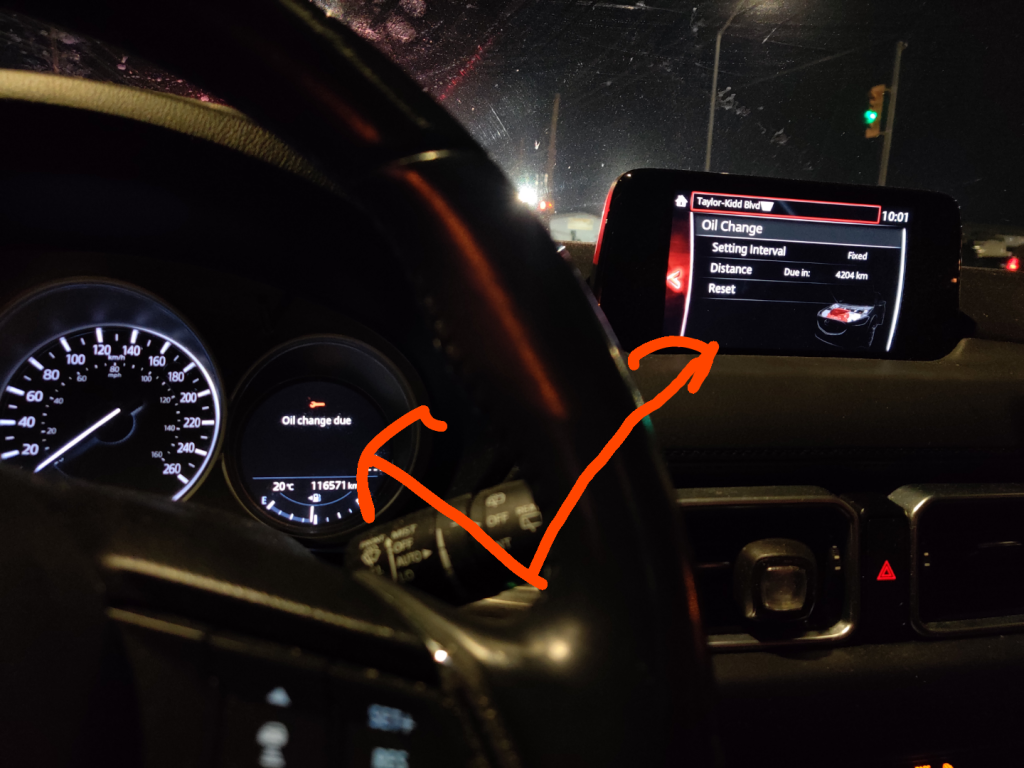
The truth sits in the boring middle, backed by engineering, not anecdotes.
This guide explains the real Mazda CX-5 oil change interval, why Reddit advice is unreliable, how Mazda actually determines service schedules, and how to choose the correct interval based on how you drive, not how loud someone is online.
Why Reddit Is the Worst Place for Oil Advice
Reddit is useful for experiences, not engineering standards. Oil change advice on forums fails for three big reasons:
- No two drivers use their CX-5 the same way
A highway commuter in Arizona and a short-trip city driver in Canada are not comparable. - People confuse “survived” with “optimal”
An engine lasting 120,000 miles on neglected oil doesn’t mean it wasn’t damaged internally. - Most advice ignores time-based oil degradation
Oil degrades by age, not just mileage. Reddit almost never accounts for this.
Mazda does. That’s the difference.
Mazda’s Official Oil Change Interval (The Real Baseline)
For most gasoline Mazda CX-5 models using full synthetic oil, Mazda specifies:
Every 7,500 to 10,000 miles OR 12 months, whichever comes first
That is not a suggestion. It’s a boundary set by Mazda’s engineering team based on:
- Oil chemistry breakdown
- Contaminant loading
- Engine operating temperatures
- Emissions system protection
This interval assumes normal driving conditions and correct oil viscosity, usually full synthetic 0W-20 for most model years.
What Mazda Means by “Normal” vs “Severe” Driving
This is where Reddit advice completely falls apart.
Normal Driving (Longer Interval Applies)
- Regular highway trips
- Steady speeds
- Engine reaches full operating temperature
- Minimal idling
- Mild climate
If this describes your driving, the 7,500–10,000 mile interval is valid.
Severe Driving (Shorter Interval Required)
Mazda explicitly classifies the following as severe service:
- Frequent trips under 10 miles
- Stop-and-go city driving
- Long idling periods
- Very hot or very cold climates
- Towing or heavy loading
- Driving that rarely warms the engine fully
If this describes your use, Mazda expects oil changes closer to:
Every 5,000–7,500 miles OR every 6 months
This is not optional. Severe driving accelerates oil contamination and breakdown.
Why Time Matters as Much as Mileage
This is the part Reddit ignores almost entirely.
Oil degrades even if the vehicle barely moves. Moisture, fuel dilution, and acid buildup occur simply from:
- Cold starts
- Short trips
- Sitting unused
That’s why Mazda includes 12 months as a hard limit, even if mileage is low.
If you drive:
- 3,000 miles per year
- Mostly short trips
You still need at least one oil change per year.
Low mileage does not mean low wear.
Turbo CX-5 Models: Be More Conservative
The Mazda CX-5 turbo engine operates under:
- Higher oil temperatures
- Higher pressure loads
- Greater shear stress
While Mazda still allows extended intervals, many experienced technicians recommend staying toward the lower end of the range for turbo models.
Smart interval for turbo CX-5 owners:
- 5,000–7,500 miles
- Or once per year, whichever comes first
This is not fear-mongering. Turbochargers rely entirely on clean, stable oil.
Why “3,000 Miles” Is Outdated (But Not Totally Wrong)
The 3,000-mile rule came from:
- Conventional oil
- Carbureted engines
- Loose tolerances
- Poor filtration
Modern CX-5 engines use:
- Full synthetic oil
- Tight tolerances
- Advanced engine management
- High-efficiency filters
Changing oil every 3,000 miles won’t hurt your CX-5, but it does not provide proportional benefit unless you operate in extreme conditions.
It’s safe, not necessary.
Why “15,000 Miles Is Fine” Is Dangerous
This advice usually comes from:
- European interval confusion
- Lease return logic
- Oil brand marketing
- Survivorship bias
Yes, some engines survive long intervals. That doesn’t mean:
- Bearings aren’t wearing faster
- Rings aren’t accumulating deposits
- Oil control isn’t compromised over time
Mazda did not design the CX-5 for 15,000-mile oil intervals in North American conditions.
The Mazda Maintenance Monitor Is Smarter Than Reddit
Many CX-5 models use a calculated oil life monitoring system. It does not just count miles.
It tracks:
- Engine temperature cycles
- RPM behavior
- Load patterns
- Cold starts
- Driving duration
When it tells you to change oil early, it’s because your usage pattern demands it.
Ignoring it because Reddit says “you’re fine” is how engines quietly wear out.
Real-World Oil Change Interval Scenarios
City Driver, Short Trips, Cold Climate
- Oil change every 5,000–6,000 miles
- Or every 6 months
Highway Commuter, Moderate Climate
- Oil change every 7,500–10,000 miles
- Or once per year
Low Mileage Retiree or Second Vehicle
- Oil change once per year minimum
- Even if mileage is low
Turbo CX-5 with Mixed Driving
- Oil change every 5,000–7,500 miles
- Conservative, engine-friendly approach
What Happens If You Stretch the Interval Too Far
Damage from long oil intervals is slow and silent:
- Sludge and varnish buildup
- Ring sticking
- Timing chain wear
- Turbo bearing stress
- Reduced fuel economy
- Oil consumption increase
You won’t notice it at 30,000 miles. You will at 120,000.
Reddit won’t be paying for that repair.
The Oil Filter Is Part of the Interval Equation
Every oil change must include a new oil filter.
Why:
- Filters load with contaminants
- Bypass valves open more often as filters clog
- Old filters undo the benefit of fresh oil
Changing oil without changing the filter shortens the effective interval immediately.
Warranty, Resale, and Documentation
Following Mazda’s recommended interval protects:
- Warranty claims
- Service records
- Resale value
If engine issues arise, documented maintenance at Mazda-approved intervals matters. Reddit comments do not.
The Bottom Line: The Interval You Should Actually Use
Forget Reddit. Use this instead:
- Normal driving: 7,500–10,000 miles or 12 months
- Severe driving: 5,000–7,500 miles or 6 months
- Turbo models: Lean conservative
- Low mileage: Time still matters
Oil changes are cheap insurance. Engines are not.
Final Thought
Reddit advice is loud, emotional, and inconsistent. Mazda’s oil change interval is quiet, boring, and engineered.
Trust the people who built the engine, not the people who happened to still be driving one.
1) What is the correct oil change interval for a Mazda CX-5?
For most gasoline CX-5 models using full synthetic oil, Mazda recommends every 7,500–10,000 miles or 12 months, whichever comes first. This assumes normal driving conditions and the correct oil viscosity.
2) Why does Mazda list both mileage and time for oil changes?
Because oil degrades with age as well as mileage. Moisture, fuel dilution, and acids build up even if you drive very little. That’s why Mazda sets a 12-month maximum, even for low-mileage vehicles.
3) What counts as “severe driving” for the Mazda CX-5?
Mazda classifies driving as severe if you:
- Take frequent short trips (under 10 miles)
- Drive mostly in stop-and-go traffic
- Idle for long periods
- Drive in very hot or very cold climates
- Tow or carry heavy loads
Under these conditions, oil should be changed every 5,000–7,500 miles or 6 months.
4) Is the Mazda CX-5 oil life monitor reliable?
Yes. The oil life monitoring system does not simply count miles. It factors in engine temperature, RPM, load, driving patterns, and cold starts. If it calls for an early oil change, it’s responding to your actual usage, not guessing.
5) Should turbo Mazda CX-5 models follow a shorter oil change interval?
Yes, it’s wise to be more conservative. Turbo engines run hotter and stress oil more. Many technicians recommend 5,000–7,500 miles for turbo CX-5 models, even though Mazda allows longer intervals under normal conditions.
6) Is changing oil every 3,000 miles better for my CX-5?
Not usually. That interval comes from older engines and conventional oil. With modern synthetic oil and Skyactiv engines, 3,000 miles is safe but unnecessary unless you operate under extreme conditions.
7) Is it safe to go 12,000–15,000 miles between oil changes?
No. While some engines may survive it, Mazda does not recommend intervals that long for the CX-5. Extended intervals increase the risk of sludge, timing wear, and oil breakdown, especially in North American driving conditions.
8) What happens if I delay oil changes beyond Mazda’s recommendations?
Delaying oil changes can lead to:
- Increased engine wear
- Sludge and varnish buildup
- Reduced fuel economy
- Higher oil consumption
- Potential warranty issues
Damage develops gradually and may not be obvious until it’s expensive.
9) What is the safest oil change strategy for long engine life?
Use Mazda-recommended synthetic oil, replace the oil filter at every change, follow the oil life monitor, and shorten intervals if your driving is mostly city, short-trip, or in extreme climates. Consistency matters more than chasing the longest possible interval.
Best Mazda CX-5 Oil Filter: What to Buy, Why It Matters, and How to Choose the Right One
If you are searching for the best Mazda CX-5 oil filter, you are already ahead of most owners. Oil filters are not all the same, and on modern Skyactiv engines, the “close enough” approach can show up as noisy cold starts, faster oil contamination, or inconsistent oil pressure control during severe use.
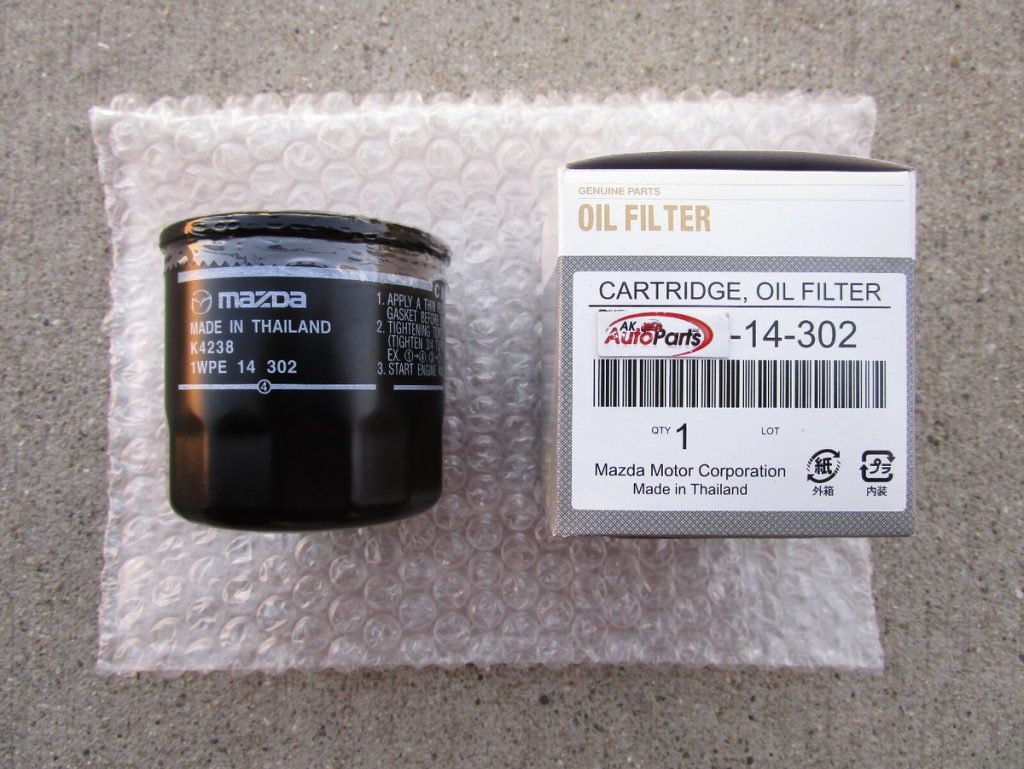
This in-depth guide explains what actually makes an oil filter “best” for the CX-5, identifies the correct OEM Mazda oil filters by engine, and then ranks the best aftermarket options for owners who want premium filtration or longer service intervals, without compromising the engineering Mazda designed into the lubrication system.
Why the Oil Filter Matters More Than People Think
Engine oil does two jobs at once: lubricate and clean. The filter is the gatekeeper. A high-quality filter:
- Captures wear metals, soot, and carbon deposits before they circulate
- Maintains stable oil flow in cold starts and high RPM operation
- Prevents oil drain-back (dry starts) when the engine sits
- Uses a bypass valve calibrated to protect the engine if the filter media becomes restrictive
On a CX-5, especially in stop and go driving or short-trip winter use, a strong filter can be the difference between clean internals and accelerated deposit formation.
The “Best” Oil Filter Starts With Correct Fitment
Before brand preferences, the “best” filter must match the engine configuration. On the Mazda CX-5, non-turbo and turbo applications use different OEM filters in many model years.
OEM Mazda CX-5 Oil Filter Part Numbers (Correct Baseline)
| CX-5 Engine | Correct OEM Mazda Oil Filter | Notes |
|---|---|---|
| SKYACTIV-G 2.0L (where equipped) | 1WPE-14-302 | Common non-turbo filter |
| SKYACTIV-G 2.5L non-turbo | 1WPE-14-302 | Replaces older PE01-series numbers |
| SKYACTIV-G 2.5L Turbo | 1WPY-14-302 | Turbo-specific OEM filter |
| SKYACTIV-D 2.2L diesel (markets where sold) | SH01-14-302A | Diesel application |
A key detail: Mazda’s parts catalog shows PE01-14-302A as a genuine Mazda oil filter cartridge number, and it cross-references to 1WPE-14-302 among replacements.
What Makes an Oil Filter “Best” for a CX-5?
1) Strong Filtration Media (Efficiency Without Restricting Flow)
Filters use cellulose, synthetic, or blended media. Higher efficiency is good, but only if oil flow remains strong at cold start and high load.
Practical takeaway: “Best” filters balance filtration efficiency with flow. This is particularly relevant for turbo engines that see higher heat and may demand more stable oil delivery.
2) Silicone Anti-Drainback Valve (ADBV)
The anti-drainback valve keeps oil from draining out of the filter and oil passages when the engine is off. A weak ADBV can contribute to:
- Brief lifter noise or timing chain rattle at start-up
- Extra wear during repeated cold starts
Premium filters often use silicone ADBVs because silicone resists heat better than nitrile.
3) Correct Bypass Valve Calibration
Every spin-on filter has a bypass valve. If oil is too thick (cold) or the filter is clogged, the bypass opens so the engine still receives oil. The “best” filter uses a bypass calibration consistent with the application.
This is one of the reasons many owners stay with OEM for turbos: turbo lubrication systems are less forgiving about oil delivery consistency during cold operation or hard driving.
4) Build Quality: End Caps, Seams, Base Plate, and Gasket
Oil filters are pressure vessels. Better build quality reduces the risk of:
- Media separation
- Internal leaks around end caps
- Gasket deformation leading to seepage
5) Avoiding Counterfeit and “Too Cheap” Filters
If the price looks unrealistically low online, treat it as a risk. Counterfeit filters exist and can look convincing. The best practice is to buy from a known retailer, a dealership parts counter, or a reputable parts distributor.
Best Mazda CX-5 Oil Filter: The Top Recommendation
Best Overall (Factory Correct, Lowest Risk): Genuine Mazda OEM Filter
For most CX-5 owners, the best answer is simple:
- Non-turbo CX-5: Mazda OEM 1WPE-14-302
- Turbo CX-5: Mazda OEM 1WPY-14-302
Why OEM is the safest “best” choice:
- Correct fitment and engineering baseline for Mazda’s lubrication system
- Correct application split between turbo and non-turbo
- Minimizes guesswork around bypass and flow characteristics
If you do not want to overthink it, OEM is the most consistently correct option.
Best Aftermarket Mazda CX-5 Oil Filters (When OEM Is Not Available)
Aftermarket filters can be excellent, but you should choose ones that are clearly engineered for modern synthetic oil intervals and that have credible published specs.
Premium Aftermarket Pick: FRAM Ultra Synthetic
FRAM’s Ultra Synthetic line is positioned for longer intervals and synthetic oil usage, and it highlights key features owners care about, including a silicone anti-drainback valve and high filtration efficiency claims.
This category generally makes sense if you:
- Run full synthetic oil
- Want a premium filter media design
- Prefer easy removal features and robust construction
Well-Known Equivalent Option: WIX (Example Fitment: WIX 57002)
WIX lists a CX-5 fitment with published specs including bypass range and thread size. For example, one listing for a CX-5 2.5L shows 20 x 1.5 mm threads and a bypass valve setting in the 11–14 range.
This is useful because it signals the product is not purely generic. It also illustrates why you must match the filter to the vehicle and not assume “any small Mazda filter” is correct.
Important note: listings and fitment charts are helpful, but for turbo applications many owners prefer sticking with the turbo-specific OEM filter to avoid spec ambiguity.
Turbo CX-5 Owners: Why Filter Choice Is More Sensitive
The 2.5L turbo CX-5 runs higher oil temperatures and can see different pressure and flow demands than the naturally aspirated engine. Mazda’s decision to specify a different OEM filter for turbo engines is a strong signal that they want a specific design baseline for that application.
If you own a turbo CX-5 and want the lowest-risk choice:
- Use the Mazda OEM 1WPY-14-302
- Pair it with the correct oil viscosity and change intervals
- Avoid “one part fits all” logic unless you have verified the bypass and ADBV details for your exact engine
Oil Capacity and Why It Relates to Filter Choice
Why talk about oil capacity in a filter article? Because the filter is part of the system volume, and accurate fill matters to both lubrication and oil life.
Mazda’s owner manual capacity guidance (approximate quantities) shows:
- SKYACTIV-G 2.5 with oil filter replacement: 4.5 L (4.8 US qt)
- SKYACTIV-G 2.0 with oil filter replacement: 4.2 L (4.4 US qt)
This reinforces the practical point: if you change the filter, your final fill is different than a drain-only top-up.
How Often Should You Replace the Oil Filter on a CX-5?
General best practice:
- Replace the oil filter every oil change, not every other oil change
Why:
- Filters are designed for a finite contaminant-holding capacity
- Modern engines generate fine particulates that can load media faster than you expect
- Filters are inexpensive insurance compared to engine repairs
If you stretch oil intervals, a premium filter becomes more relevant. If you follow conservative intervals, OEM is more than sufficient.
Installation Quality Matters as Much as Brand
Even the best filter can leak or cause issues if installed poorly.
Best practices:
- Lightly oil the rubber gasket before installation
- Spin on until gasket contact, then tighten per the filter instructions
- Do not over-tighten (over-tightening can deform the gasket)
- Always check for leaks after the first start
- Confirm the old gasket did not stick to the engine block (double-gasket mistakes cause major leaks)
Practical Recommendations by Owner Type
If You Want the Safest Choice
Buy OEM:
- 1WPE-14-302 (non-turbo)
- 1WPY-14-302 (turbo)
If You Want a Premium Aftermarket Filter
Choose a premium synthetic-rated filter line with clear features like a silicone ADBV and published efficiency claims, such as FRAM Ultra Synthetic.
If You Want a Recognized Equivalent With Published Specs
Use a reputable line with published bypass specs and correct thread fitment for the CX-5 application, verifying fitment by year and engine.
Final Verdict: Best Mazda CX-5 Oil Filter
For most drivers, the best Mazda CX-5 oil filter is the genuine Mazda OEM filter matched to your engine:
- Non-turbo CX-5: 1WPE-14-302
- Turbo CX-5: 1WPY-14-302
It is the most consistent way to preserve factory oil flow behavior, bypass characteristics, and start-up protection, especially on the turbo engine where the margin for error is smaller.
If you tell me your CX-5 model year and whether it is 2.5 non-turbo or 2.5 turbo, I will tailor the recommendation into a tight “buy this exact filter” answer and include a short shortlist of the best equivalent aftermarket options for your exact configuration.
FAQ: Best Mazda CX-5 Oil Filter
1) What is the best oil filter for a Mazda CX-5?
For most owners, the best oil filter is the genuine Mazda OEM filter matched to your engine. Mazda engineers the filter’s flow rate, bypass valve, and anti-drainback design specifically for Skyactiv engines, making it the safest and most consistent choice.
2) Does the Mazda CX-5 use a different oil filter for turbo models?
Yes. Turbo CX-5 models use a different OEM oil filter than non-turbo models. The turbo engine runs higher oil temperatures and pressures, so Mazda specifies a filter designed for those conditions. Always confirm turbo vs non-turbo before buying.
3) Are aftermarket oil filters safe for the Mazda CX-5?
High-quality aftermarket filters can be safe if they match OEM specifications for flow, bypass pressure, and anti-drainback performance. Cheap or generic filters may cause cold-start noise, reduced oil flow, or inconsistent pressure, especially in turbo engines.
4) Should I replace the oil filter at every oil change?
Yes. Mazda CX-5 oil filters are designed to be replaced at every oil change. Reusing a filter can reduce oil cleanliness and increase internal wear, even if the oil itself is fresh.
5) Can the wrong oil filter damage a Mazda CX-5 engine?
Over time, yes. An incorrect filter can:
- Restrict oil flow
- Open the bypass valve too early or too late
- Allow oil to drain back, causing dry starts
- Increase wear on timing components and turbo bearings
The damage is usually gradual but costly.
6) What matters more: oil brand or oil filter quality?
Both matter, but filter quality directly affects oil flow and cleanliness. A premium oil with a poor filter still circulates contaminants. For best results, pair Mazda-recommended synthetic oil with a high-quality OEM or OEM-equivalent filter.
Mazda CX-5 Recommended Oil: What to Use, Why It Matters, and How to Get the Best Performance
When it comes to maintaining a Mazda CX-5, nothing affects engine performance and longevity more than your choice of motor oil. With varying climates, driving habits, and engine options across model years, understanding the recommended oil for a Mazda CX-5 isn’t just a matter of picking from the shelf—it’s a science that can save money, increase reliability, and protect your engine for the long run.
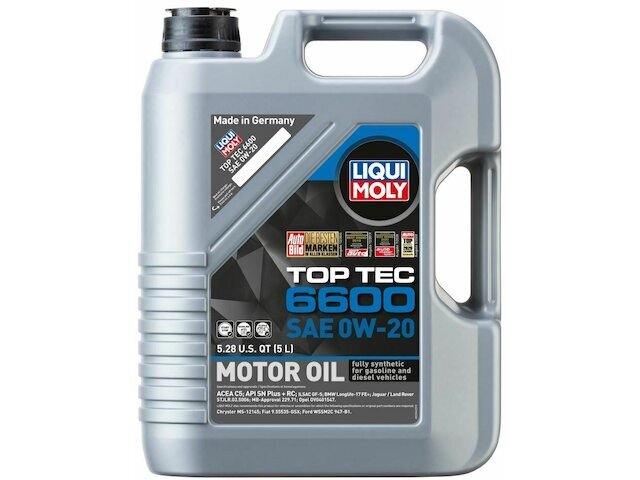
This in-depth guide will walk you through all the essentials: Mazda’s factory oil specifications, oil viscosity choices, synthetic vs conventional oil, service intervals, oil capacity, recommendations for high-mileage vehicles, and real-world driving scenarios. Whether you’re doing your own maintenance or preparing to talk to your service advisor, you’ll walk away informed and confident.
Why the Right Oil Matters in Your Mazda CX-5
Engine oil does far more than lubricate moving parts: it reduces friction, controls operating temperature, prevents wear, protects against corrosion, and keeps the engine clean by suspending contaminants. Choosing the wrong oil—or failing to change it on schedule—can lead to:
- Increased engine wear
- Reduced fuel economy
- Higher oil consumption
- Internal sludge formation
- Potential long-term engine damage
For modern engines like the Mazda CX-5’s Skyactiv-G and Skyactiv-D powerplants, oil technology must match the engine’s precision tolerances and combustion characteristics.
Mazda’s Factory Recommended Oil Specification
Across most Mazda CX-5 model years and engine options, Mazda specifies full synthetic motor oil meeting API (American Petroleum Institute) standards and the following viscosity grades:
- 0W-20 — This is the most common Mazda recommended oil viscosity for gasoline Skyactiv-G engines (2.0L and 2.5L naturally aspirated).
- 5W-30 — Used in some older models or specific markets; check your owner’s manual.
- Diesel engines (Skyactiv-D) — Typically require a diesel-rated synthetic oil meeting CJ-4 or equivalent spec.
Why Mazda favors 0W-20
Mazda specifies 0W-20 for its light viscosity profile:
- Improves cold-start flow to protect the engine on startup
- Reduces internal friction for better fuel economy
- Meets Skyactiv engine requirements for modern emissions and performance
Always refer first to the specific model year owner’s manual for the exact recommended viscosity.
Synthetic vs Conventional Oil: What’s Best for Your CX-5
Synthetic oil is engineered through a controlled process that results in:
- Higher stability at extreme temperatures
- Better shear resistance
- Superior protection against deposits and sludge
- Longer service life
Modern Mazda CX-5 engines benefit from synthetic oil because they operate with tight clearances and high efficiency, which conventional oil struggles to protect over time.
Bottom line: For virtually all Mazda CX-5 applications, full synthetic oil is the best choice unless the owner’s manual explicitly allows conventional for that model year.
Recommended Oil Viscosity by Common Mazda CX-5 Engines
| Engine | Recommended Oil Viscosity | Notes |
|---|---|---|
| 2.0L Skyactiv-G Gasoline | 0W-20 | Most common, excellent for all climates |
| 2.5L Skyactiv-G Gasoline | 0W-20 | Best balance of protection and economy |
| Skyactiv-D Diesel (if equipped) | Diesel-rated 5W-30 | Requires diesel spec CJ-4 or better |
Important: Mazda does not recommend higher viscosity (e.g., 10W-30) for stock CX-5 engines unless aftermarket conditions or severe use justify it. Using a non-recommended viscosity may impact warranty coverage.
Oil Change Interval: When to Service
Mazda generally recommends:
- Every 7,500 to 10,000 miles or 12 months, whichever comes first, for normal driving.
- More frequent service under severe conditions (towing, heavy city driving, extreme temperatures).
Always follow the oil life monitored by the Mazda maintenance system if your CX-5 is equipped with it; it adapts based on real driving conditions.
How Much Oil Does a Mazda CX-5 Take?
Oil capacity varies by engine and year:
- 2.0L Skyactiv-G: ~4.0 to 4.3 quarts (3.8–4.1 L)
- 2.5L Skyactiv-G: ~4.8 to 5.1 quarts (4.5–4.8 L)
- Skyactiv-D Diesel: ~6.0 to 6.5 quarts (5.7–6.2 L)
Always check the dipstick and top up if necessary after the initial fill, as environmental conditions and oil filter displacement can affect final volume slightly.
High-Mileage Mazda CX-5: Special Oil Considerations
If your CX-5 has over 75,000 miles:
- Consider a high-mileage synthetic oil designed for engines with wear and seal hardening.
- High-mileage oils include conditioners that help soften seals and reduce leaks.
- Still use Mazda’s recommended viscosity (commonly 0W-20) unless manual specifies otherwise.
For vehicles with 150,000+ miles, some owners prefer 5W-30 viscosity if permitted, as it offers a slight buffer in thicker film strength, but only if approved for that engine.
Severe Service and Driving Conditions
If your Mazda CX-5 experiences:
- Short city trips in cold weather
- Frequent towing or heavy loads
- Extended idling or stop-and-go traffic
Consider shortening the oil change interval to every 5,000–7,500 miles to protect against contaminants and heat cycling.
Best Mazda CX-5 Engine Oil Brands Worth Considering
Here are widely recommended synthetic oil brands that meet Mazda specifications:
- Mobil 1™ 0W-20 Full Synthetic
- Castrol® EDGE 0W-20 Full Synthetic
- Pennzoil® Platinum 0W-20 Full Synthetic
- Valvoline™ Advanced Full Synthetic 0W-20
Choose oil that carries the API Certified “Starburst” or “Resource Conserving” mark and the correct viscosity.
Step-by-Step: How to Change Mazda CX-5 Oil (Overview)
If you plan to do your own oil change:
- Warm up the engine slightly so oil flows easily
- Safely lift the vehicle and secure it on stands
- Drain old oil and replace the oil filter
- Refill with the recommended oil grade (e.g., 0W-20)
- Run the engine briefly, check for leaks
- Re-check oil level and adjust accordingly
Always dispose of used oil and filters at a proper recycling facility.
Common Oil-Related Issues CX-5 Owners Encounter
Oil consumption
- Some Mazda CX-5 engines may consume a small amount of oil between services—normal within manufacturer tolerances, but monitor with dipstick checks.
Sludge
- Rare with modern CX-5 and proper synthetic oil; occurs when oil isn’t changed often enough.
Leaks
- Valve cover gaskets or oil filter housing leaks can compromise oil performance; fix leaks promptly.
Mazda CX-5 Recommended Oil: Dos and Don’ts
Do
- Use the recommended viscosity in the owner’s manual
- Choose full synthetic oil
- Change oil on a regular schedule
- Track oil levels between services
Don’t
- Mix different viscosity oils
- Use conventional oil if manual specifies synthetic
- Skip oil filter replacement
- Ignore oil life monitoring messages
Why Following Mazda’s Oil Recommendations Pays Off
Sticking to Mazda’s recommended oil:
- Optimizes engine performance
- Improves fuel economy
- Reduces wear and tear
- Maintains resale value
- Keeps warranty compliance intact
Bad or incorrect oil choices contribute to early wear, poor fuel economy, and loss of performance that no tune-up can fully fix.
Wrap-Up: Choosing the Best Oil for Your Mazda CX-5
For virtually all Mazda CX-5 owners, the Mazda recommended oil is:
Full synthetic 0W-20 motor oil meeting API specifications.
Always consult your exact model year owner’s manual for specific requirements and confirm viscosity and service intervals. When in doubt, talk to your Mazda dealer service department or a trusted independent shop that understands Skyactiv technology.
Your engine is the heart of your Mazda CX-5—treat it with the right oil, and it will reward you with long life, smooth performance, and reliability for many miles.
FAQ: Mazda CX-5 Recommended Oil
1) What oil does Mazda recommend for the Mazda CX-5?
For most Mazda CX-5 gasoline models, Mazda recommends full synthetic 0W-20 motor oil that meets current API standards. This viscosity is engineered specifically for Skyactiv engines to balance protection, fuel efficiency, and long-term reliability.
2) Can I use 5W-30 instead of 0W-20 in my Mazda CX-5?
Only if your owner’s manual explicitly allows it. Some older CX-5 model years or specific markets permit 5W-30, but many modern Skyactiv engines are optimized for 0W-20. Using a thicker oil than recommended can reduce fuel economy and affect cold-start protection.
3) Does the Mazda CX-5 require full synthetic oil?
Yes, for most model years. Mazda CX-5 engines are designed with tight tolerances and high efficiency, which benefit from full synthetic oil. Conventional oil does not provide the same heat resistance or cleanliness and is not recommended for most CX-5 engines.
4) How often should I change the oil in a Mazda CX-5?
Under normal driving conditions, Mazda typically recommends every 7,500 to 10,000 miles or once a year, whichever comes first. If you drive in severe conditions (short trips, heavy traffic, towing, extreme temperatures), changing oil closer to 5,000–7,500 miles is safer.
5) How much oil does a Mazda CX-5 take?
Oil capacity depends on the engine:
- 2.0L Skyactiv-G: about 4.0–4.3 quarts
- 2.5L Skyactiv-G: about 4.8–5.1 quarts
Always confirm with the dipstick after refilling, as the exact amount can vary slightly by model year and oil filter.
6) Is high-mileage oil good for a Mazda CX-5?
Yes, if your CX-5 has 75,000 miles or more, a high-mileage full synthetic oil in the correct viscosity can help condition seals and reduce minor oil consumption. Do not switch to a thicker oil unless Mazda approves it for your engine.
7) What happens if I use the wrong oil in my Mazda CX-5?
Using the wrong viscosity or low-quality oil can lead to:
- Reduced fuel economy
- Increased engine wear
- Poor cold-start lubrication
- Possible warranty issues
Over time, incorrect oil choice can shorten engine life, even if oil changes are done regularly.
Connect with us


